
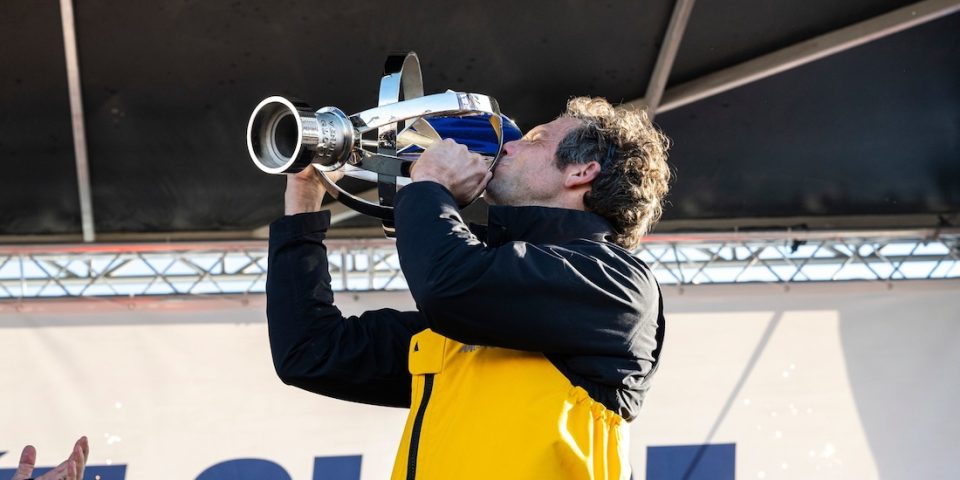
Having served as the doctor for the Finistère offshore racing training centre in Port-la-Forêt for 17 years (until last April), and also for the last edition of the Vendée Globe, Laure Jacolot speaks to Sailorz about the announcement by Charlie Dalin of the illness (gastrointestinal cancer) he has been suffering from for two years, which he also discusses in a book released on Thursday, La force du destin (The Strength of Destiny, Gallimard).
When did you find out that Charlie was suffering from cancer?
As a sports doctor and the pole’s physician at Port-la-Forêt, I have been following Charlie for fifteen years. He contacted me a week before the start of the Transat Jacques Vabre (2023) for a consultation regarding knee pain. When he walked into my office at Quimper hospital, I noticed he had lost a lot of weight. I questioned him, and he mentioned digestive issues which he attributed to seasickness. In offshore racing, digestive problems are quite common, and we don’t usually launch a battery of tests for that, but nonetheless, the digestive picture associated with the rapid weight loss concerned me, and I told Charlie: “As an offshore racing doctor, I can’t let you leave for the transat without being sure everything is OK; we’re going to do a scan.” He replied: “Yes, but I have to leave now.” I immediately called my radiologist colleagues to perform the abdominal scan. I went back to my consultations, Charlie called me because he was getting a little impatient. I told him he could leave because I wasn’t overly worried, but finally, the radiologist called me back saying: “He must not leave; something serious is happening.” That’s when we told Charlie he had an abdominal mass whose exact origin was unknown and that he would not be able to participate in the Transat Jacques Vabre.
How did he react?
He was inevitably devastated. Personally, I am a doctor and I am also working for emergency medical services, so I am used to announcing serious news to people and managing my emotions, but when I told him this, given that I’ve known him for fifteen years, it was more difficult to manage the emotional aspect. He saw by my expression that something serious was happening; it was a very complicated moment. From there, many things were set in motion, and we entrusted him to a team of experts, in connection with Quimper hospital, led by Doctor Le Cesne in Paris. Once the tumour was analysed, this led to the start of immunotherapy treatment adapted to his pathology, which is used quite frequently for cancers.
Did you continue to medically monitor him during the Vendée Globe year?
Yes, I continued my role as a sports doctor to prepare him medically as best as possible for the Vendée Globe. The objective was for him to regain muscle and fat mass. This involved advice on his diet, as well as his physical preparation. I also followed him during the races, particularly the two transats, The Transat CIC and New York-Les Sables for which I was the referring doctor. I had specifically insisted with Laura [Le Goff, CEO of the Vendée Globe, Ed.] on going to New York to ensure all the sailors were well between the two races, especially Charlie. When he returned, he was tired, but only as someone who returns from a transat would be, which is why afterwards, all indicators remained green for him to take the start of the Vendée Globe; the illness was stabilised. At the start in Les Sables, I had complete confidence in his ability to manage it, in the sense that he is someone extremely rigorous; we knew he would do everything possible to ensure it went well.
“Mental strength is fundamental”
One of the issues in offshore racing is the management of sleep and recovery, so any impairment of his energy reserves could have consequences for the treatment response. That’s why Charlie worked enormously beforehand, even more than usual, on sleep management, recovery techniques, and mental preparation (see below). This was a fundamental element; a “positive attitude” is an integral part of the therapeutic responses for cancer and chronic illnesses. His mental strength, the work he did, and his own exceptional capacities as a sailor allowed him to manage this entire physiological phase optimally and thus respond well to the treatment throughout the race.You followed him throughout the Vendée Globe as the race doctor; were there any alerts?
Personally, I did not contact him regularly. When a doctor is too overly attentive, it can also create symptoms in patients, which is well known. Nevertheless, I was extremely vigilant, especially in slightly rough weather conditions that could increase his energy debt. Afterwards, as he explained in his book, he experienced pain at certain moments which led him to contact Doctor Le Cesne several times, and the latter immediately informed me, as stipulated by the rules.Despite the illness, he won this Vendée Globe. Could having cancer have given him a surplus of motivation?
I don’t know if he needed that, because he already had enormous motivation compared to the previous edition, but yes, it inevitably played a role. As I said, we know that mental strength is fundamental. We sometimes see incredible results in certain illnesses because patients show great motivation. Of course, not every sick person will be able to go and do the Vendée Globe, but the strong message Charlie is sending is that having cancer doesn’t mean you have to stop living and stop setting goals. On the contrary, maintaining a goal allows you to have positive energy and respond better to the illness.
“A particular emotional burden”
As a doctor, you are bound by medical confidentiality. How did you manage this aspect, knowing that very few people were aware, including a large part of his team?
Medical confidentiality is indeed part of the Hippocratic Oath; however, it would be lying to say that it wasn’t more complicated than usual. With the stakes of the Vendée Globe and the fact that it was my first as the referring doctor – I was Jean-Yves Chauve’s deputy before – emotionally, it was particular. I was supported by three other colleagues who didn’t know what happened to Charlie, so when he set foot on the arrival pontoon in Les Sables d’Olonne, my mental load halved, even though I kept the other half for the rest of the fleet, and I won’t hide that it felt good to talk about it.
Precisely, is the fact that Charlie is talking about it today, particularly in his book, part of the therapy?
We discussed it together; I told him it was really a good thing for him to talk about it, because it wasn’t easy for him not to be able to share this difficulty. I also told him that by speaking out, he would help all of us, the caregivers, every day. I am a sports doctor, but I am also prescribing physical activity for cancer patients. We know that physical activity, and by extension sport if it is well supervised and measured, is a treatment for cancer in its own right; this is no longer scientifically debatable; not engaging in physical activity is a missed opportunity for the patient. Therefore, Charlie sharing his story is precious help for the entire medical community.
Today, is it reasonable for him to consider racing again?
Medicine not being an exact science, it is difficult to say. When he was told about his illness, we couldn’t predict he would race the Vendée Globe. For now, it is premature to answer that question. We will first let him recover from this episode and plan for what he wants to do next.
In his book La force du destin, Charlie Dalin notably discusses the role played by his mental coach Jean-Pascal Cabrera during the Vendée Globe year. Contacted by Sailorz, the latter recounts: “The announcement of the illness was a baseball bat to the preparation. We then had to delve into an even more specialised area, with the goal of him managing to defocus from the cancer to orient his mind toward the here and now. The question to ask wasn’t how I’m going to heal, but how to succeed in this sporting feat.”
In this process, the victory in the New York-Vendée in June 2024 “was a trigger and put him back on track. He validated the procedures we had put in place, which he was then able to follow almost blindly.” With success, after 64 days of a round-the-world race, during which, according to Jean-Pascal Cabrera, “Charlie was simultaneously close to the paradise of achievement and the hell of illness. His childhood dream of winning the Vendée Globe allowed him to overcome the hell.” And ultimately, to “transmit a gigantic message, that dreams are always possible, regardless of unfavourable conditions.”
Photo : Olivier Blanchet / Alea