
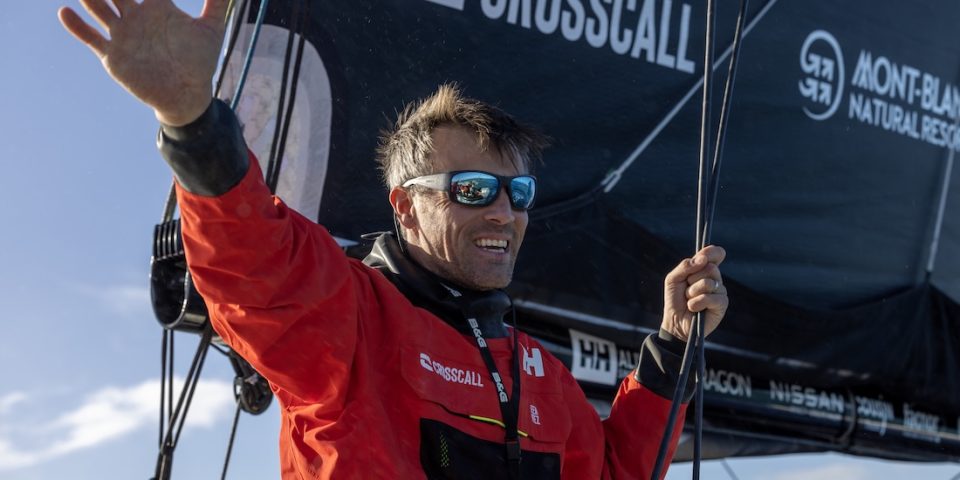
Crosscall just announced the end of the partnership that had bound you since 2020, was this planned?
Yes, absolutely, it had been scheduled since we renewed our contract three years ago, which is why I’ve been working on what comes next for a little while now; I knew we were going to reach the end of this story.
You finished with a 28th place on the Transat Café L’Or with Jonathan Chodkiewiez, I imagine that wasn’t the result you were aiming for?
Clearly, the race was complicated because we had a technical problem near Madeira that forced us to stop, and after that, we faced a very unfavorable weather scenario. It’s disappointing because we experienced the same scenario with Vincent (Riou, 26th place) two years ago; I felt like I was reliving the same thing. Plus, it was the last race of the project, I really wanted to finish on a high note and be in the fight with the lead pack. Unfortunately, it didn’t happen that way, and it’s obviously quite hard to take, but that’s the harsh reality of sport!
How do you look back on your six years under the Crosscall colors?
In a way, it’s incredibly positive because I learned and grew so much. I found myself building and developing a Class40; the experience was pretty wild, and I think we didn’t go wrong with the boat (Lift V2, Lombard design). In the end, throughout the project, all the pre-season races often went well, with nothing but top 10 finishes and sometimes better, knowing that there’s a crazy level of competition in Class40 and it’s hard to be right at the front. On the other hand, we never managed to convert that in a major race; we missed them all, with technical glitches on the Transat Jacques Vabre or Café L’Or, a dismasting on the Rhum, a broken forestay on The Transat, and that is extremely frustrating. Especially since sometimes it came down to silly details. But overall, I was extremely happy to have led a project from A to Z and to have experienced these races I dreamed of. I found myself at the start of my first Route du Rhum ten years after starting sailing; I am very proud to have achieved all that and to have progressed over five full seasons, whereas before, I only went boating once in a while.
“Returning from Martinique did me
a world of good”
If you had to pick one high and one low from these five years?
The low was the dismasting in the Route du Rhum. It was emotionally hard, with a six-day return journey adrift that was truly difficult. It’s a race I dreamed of, so I was extremely sad not to make it to the end. And the high, I would say, was the launch of the boat, because for me, designing, building, and developing a boat seemed so unrealistic. And I would also add the return delivery that I finished in early December; it took me twelve and a half days to get back from Martinique, and I loved every minute of it, with zero glitches, the boat just rolling along. That last transatlantic did me a world of good because if I had to end the project on the disappointment of the Transat Café L’Or, it wouldn’t have been very cool.
“I feel ready and credible”
The reasoning is simple: since I discovered sailing, I’ve dreamed of the Vendée Globe. But I didn’t want to go just any old way, and I think the project I just completed gave me the confidence to attempt this adventure around the world; it was a necessary step. I’ve always wanted it, but now I feel ready and credible. And there’s a little something extra: I really missed the mountains over the last five years, so I thought there might be a way to reconcile the two by creating a program where sailing and mountains would be part of the same project. That’s where the idea of integrating the ascent of the 82 4,000m peaks in the Alps into my sailing seasons came from. It’s ambitious but realistic; it’s not all 82 in one year, we have three years to do it. I wanted to set up a project with more identity, one that fits me better, by partnering with the foundation Je pars, tu pars, il part, of which I’ve been a patron for years, and which helps send families who can’t afford it on holiday to the sea or the mountains. Germain Lelarge, its president, was one of my sponsors when I started sailing in the Tour de France in 2015; this project was ultimately born from his communication needs and my desire for the sea and mountains. Now, we are looking for corporate partners to join us.
What type of boat are you aiming for?
Most likely a daggerboard boat to keep things simple, to be sure of making it, and because financially, foilers seem too heavy for me. Initially, I wanted to buy Louis’ (Duc), but I couldn’t get the timing right [it was bought by the Japanese sailor Masa Suzuki, Editor’s note], but generally, the ones that interest me are the 2008 boats which have fairly similar performances, mostly Farr designs. Some appeal to me more than others because they have been extremely well maintained; I’m thinking of those belonging to Guirec (Soudée), Manu (Cousin), Violette (Dorange) or the former Acciona which is from 2012.
What budget are you looking to raise and what is your ideal schedule?
The budget would be around one million euros per year, with a little extra for the mountain side, which costs much less than the boat! The ambition is to start as quickly as possible, ideally to be at the start of the Route du Rhum 2026, but as you know, the economic situation isn’t great; we hoped it would move faster, even though we already have five or six firm commitments on our side. So may be we’ll start in 2027, which is also possible under the new qualification system for the Vendée Globe; I’m not really setting a deadline. For the mountain part, it could start quickly, maybe as early as this spring. I’ll be going as a duo with a guide friend, Giulia Monego, who will handle all the logistics. The goal is also to bring as many people as possible—partners, donors—with us on some of the more accessible peaks; we want this mountain project to be very participatory.
Image : Crosscall Sailing Team