
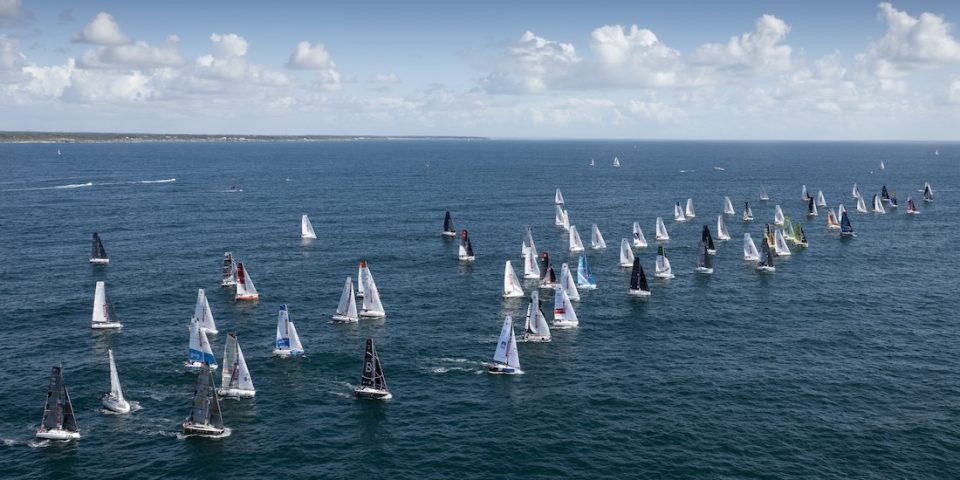
The Mini Class finalized the new route for the Mini Transat last weekend for the 2027 and 2029 editions; it will set off from La Rochelle bound for Salvador de Bahia via Las Palmas (Canary Islands). Sailorz takes a look at this choice.
After three editions between Les Sables d’Olonne and Saint-François, Guadeloupe, the Mini Transat will offer a route between La Rochelle and Salvador de Bahia in 2027 and 2029 that will bring back memories for some veterans. It has already been used six times in the race’s history, from 2001 to 2011—La Rochelle also hosted the start (bound for Le Marin, Martinique) in 2017 and 2019. This choice, voted on by the Board of Directors during the General Assembly on January 10th, is the result of a call for tenders launched by the class at the end of 2024, which resulted in two candidacy files presented last November to the class administrators during a formal oral presentation.
The first, led by the Finistère-based agency Sea to See run by Gwen Chapalain (who organizes the 1000 Race and the Course des Caps in Imoca), proposed a route between Les Sables d’Olonne and Les Saintes (south of Guadeloupe) via Lanzarote or Fuerteventura (Canary Islands). “Since Les Sables d’Olonne is part of the club of the most beautiful bays in the world, we proposed a finish in another of the world’s most beautiful bays, Terre-de-Haut. There was great enthusiasm from the city, the department, and the region,” explains Gwen Chapalain. “Les Saintes perfectly matched the Mini atmosphere, and for the 50th anniversary of the race (founded in 1977), we proposed reconnecting with the spirit of Antigua, which hosted the finish of the first editions.”
The second file, an initiative of the La Rochelle Urban Community (under the name “Collectif rochelais”), returned to the route of the 2000s, with a Canary Island stopover in Las Palmas de Gran Canaria. “We opted for Brazil to differentiate ourselves from any other potential candidacy files,” explains the president of the Collectif rochelais, Antoine Grau, mayor of Lagord and community representative—who will not stand for re-election in March. “If we had planned a trip to the West Indies, we took the risk of not standing out enough. And in the opinion of the skippers themselves, this route is quite exciting with the crossing of the Equator and the Doldrums.”
7 votes to 4
“It’s true that compared to the more trade-wind-oriented route to the West Indies, this one is more varied, and Brazil is a beautiful destination. There is a real sense of a change of scenery; you feel like you’ve truly changed continents,” comments Yves Le Blevec, who has three Minis to his credit (including a victory in 2007), all between La Rochelle and Salvador de Bahia. “I followed the matter quite closely because I was consulted by both candidates in the running. It mustn’t have been easy for the class to decide, because they were two great projects, led in a serious manner.” The result of the vote, announced on Sunday, January 11th, was indeed close, with one abstention, 7 votes for the La Rochelle file, 4 for Sea to See, the new class president, Timothée Villain-Amirat, who has just succeeded Romain Bigot, told Sailorz.What made the difference? “It’s difficult to answer because the votes were by secret ballot and both projects were really very good,” the latter replies. “The fundamental difference being the route, that probably played a part, with a particular emotional attachment to the idea of going to Brazil, even if the Les Saintes file was highly interesting for what it offered in terms of event management.”
Among the other important criteria in the specifications that may have influenced the vote were budgetary issues—“the operating budgets were very similar; perhaps La Rochelle had a slight advantage because the Collectif benefits from significant public support,” continues Timothée Villain-Amirat—and objectives for reducing environmental impact. “We had asked the candidates to present a provisional carbon footprint; there too, it was very close. We know that the main factor is linked to the travel of spectators and companions; going to the French West Indies can have a stronger impact because it’s more accessible by plane,” adds the president of a class that aims to take a major step forward in impact reduction by 2030.
Denis Hugues as advisor to the president
La Rochelle’s “victory,” accepted with fair play by Gwen Chapalain, was in any case welcomed by the representatives of a community that, according to Antoine Grau—himself a former president of the Mini Class (2004-2009)—“wants to anchor itself further in a maritime dimension and has always had a special attachment to the Mini Class and the Mini Transat; we really wanted to win back this event.” The outlines of the next edition will take shape in the coming months, with Grau already announcing the arrival of Annabelle Moreau, secretary of the Mini Class, as race director, assisted by Claire Renou. They replace Denis Hugues, who announced his departure at the end of the last Mini Transat but has joined the Collectif rochelais “as a direct advisor to the president,” Grau specifies.The Collectif will give way to a new structure, La Rochelle Grands Événements, a subsidiary of SAEM La Rochelle Tourisme et Événements, which will lead the organization alongside the La Rochelle Nautique club, the Centre Excellence Voile, and the marina management. The planned budget for the Mini 2027? “It is approximately one million euros,” replies Antoine Grau. “The urban community is putting in 200,000, Salvador de Bahia and Las Palmas 150,000 each in indirect services, registrations bring in 250,000, and we still need to find private partnerships to the tune of about 200,000 euros.”
The title partner for the last three editions, La Boulangère, will not be returning. “I spoke with them at length; they finally decided to stop sailing sponsorship,” Grau adds. “We are obviously a bit disappointed, but we fully expect to find successors. There are large companies involved in sailing in the La Rochelle area, such as Zeiss, Macif, Léa Nature, and many others; I think we are capable of attracting high-quality partners.”
Image : Vincent Olivaud