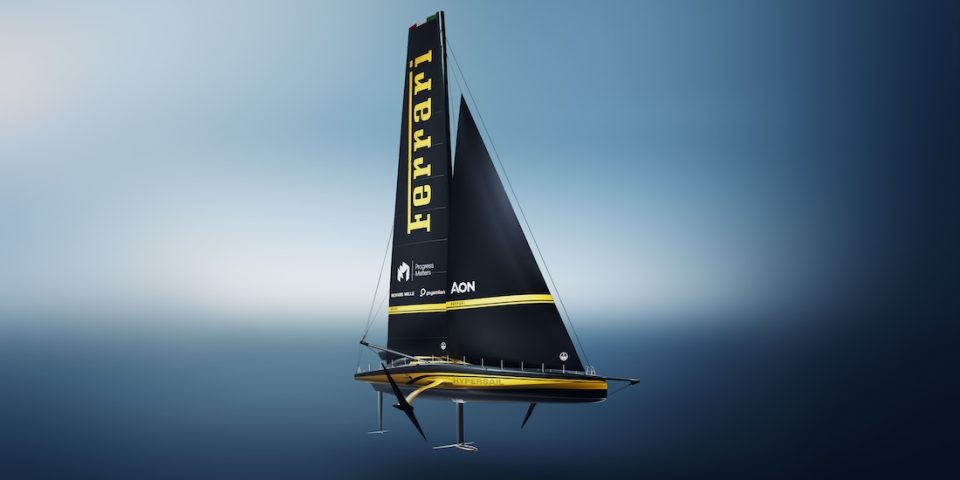
Ferrari unveiled this week the first images of its future Hypersail, a 100-foot foiling monohull designed for record-breaking campaigns and scheduled to be launched by the end of the year. Several members of the Guillaume Verdier naval architecture firm, which designed the yacht, break down the concept for Sailorz.
Launched at the end of 2022, Ferrari’s Hypersail project is entering its final stretch, with the boat set to leave the yard in the second half of this year. Following the images released this week by the Scuderia, more details have emerged about this future machine, whose project lead has recently changed: Giovanni Soldini, who initiated the project (see our article) – contacted by Sailorz, he declined to comment on the reasons for his departure – has been replaced by Enrico Voltolini.
The first key takeaway is that Hypersail is indeed a 100-foot foiling monohull, a decision made early on. “The multihull option was never seriously explored; we didn’t want to encroach on the Ultim space, and this concept of a large foiling offshore monohull – something like an offshore version of the AC75 – had been on Guillaume’s (Verdier) mind for a long time,” explains Erwan Tymen, naval engineer and collaborator of the designer. “Especially as Ferrari wanted something truly unique, something that had never been seen before.”
For architect Loïc Goepfert, the performance gains seen in the latest generations of Imocas also pointed in this direction: “When you looked at Charlie’s (Dalin) incredible speeds despite class rule constraints, you realised that with a ‘no-limit’ Imoca, performance could be pushed much further. Ultimately, the project evolved towards something closer to an America’s Cup-style hull.”
“A trimaran central hull grafted
under a conventional hull”
Indeed, this 100-foot hull – “We capped it at 100 feet because Ferrari wanted to retain eligibility for races such as the Sydney Hobart,” explains Véronique Soulé, engineer specialising in CFD and performance analysis – shares several similarities with an AC75 hull. Notably, a lower-section bustle, which leads Erwan Tymen to say: “It is a trimaran central hull grafted beneath a conventional hull. The bustle helps reduce drag both in flight and in skimming mode (when the boat is just touching the water), while the upper hull helps initiate speed to generate some RM (righting moment, hence power) when the foils are not yet working or if the boat stops.”
Around twenty hull designs were run through full test mode in the simulator developed by Benjamin Muyl – “We practically went through the entire alphabet,” smiles Erwan Tymen – tested notably by offshore sailors (Giovanni Soldini, Frédéric Le Peutrec, Karine Fauconnier), as well as Australian sailor Glenn Ashby, brought in for his America’s Cup experience.
The deck design raised fewer questions: “It’s an Imoca-style deck, with transverse curvature to provide structure,” says Erwan Tymen. “The design was really driven by aerodynamics and structure, while freeboard height was dictated by stability – you need volume to remain stable if the boat heels.” The deck is entirely covered with solar panels, which will serve as the primary onboard energy source (100 square metres). “Building a boat capable of generating her own energy was a key requirement from the outset. Ferrari has put a huge amount of work into this energy package,” adds Loïc Goepfert.
What about the cockpit, aerodynamic and fully enclosed, designed for a crew of 10 to 12 sailors? “Compared to an Ultim, it’s completely different,” explains Erwan Tymen. “On an Ultim, it’s more like a corridor; here, it’s much larger, with five pedestals to generate the required power, because loads are significantly higher.”
A double-skin mainsail
Loads will also be high on the rig, one of Hypersail’s major innovations, featuring a 40-metre mast with outriggers and a thick, double-skin mainsail which, according to Véronique Soulé, underwent extensive CFD testing in the simulator (with Romain Garo), as well as real-world testing at smaller scale on a Tornado with Romaric Neyhousser.
“The double skin delivers improved performance, with a more efficient profile generating greater low pressure, and therefore more lift.” Erwan Tymen adds: “Since the goal is to match Ultim-level performance with a keel, you need a more powerful engine. Either you go with a very tall mast, which creates massive loads, or a more compact but more efficient rig. For us, that was the winning choice. Glenn Ashby and Team New Zealand brought all their expertise to adapt this rig for offshore use.”
Similarly, America’s Cup experience influenced the appendage design, particularly the retractable T-foils, which compared to L-foils “allow for better load distribution,” notes Véronique Soulé. Their span is striking: Ferrari announces a 20-metre beam with foils deployed. “Initially, we wanted something easy to berth in harbours, but ultimately performance drove the decisions – so we’ll just berth slightly sideways,” she smiles.
“We explored a lot of options on this,” adds Mathéo Sacaze, heavily involved in the simulator work. “Some weeks we were close to Imoca-style foils, others closer to AC75s; in the end, we settled on a design closer to the Cup, with two tips of very different surface areas.”
Foils intrinsically linked to the keel
For the designers, the foils could not be separated from the canting keel, also very deep (draft is 6 metres) and fitted with an impressive wing and flap on the fin, ensuring everything is “fully adjustable in handling and trimming – you can go right, left, push up or down; the hydraulic control system behind this is extraordinary,” he adds.
For Guillaume Verdier, “the concept was to deliver a stable offshore platform, so the original idea was to support the boat on her keel with large wings (like a foil windsurf board) and, to counteract heeling moment, to use a leeward T-foil.”
“The balance between the main foil (in the water) and the wing on the keel is really the defining feature of the appendage configuration,” confirms Erwan Tymen, while Loïc Goepfert adds: “In Imoca, we’ve clearly seen that larger foils improve performance on angles requiring righting moment. However, we struggled on downwind VMG, where balance was harder to achieve. With class rule limitations, we addressed this using the ‘half foil’ concept, with both foils partly in the water. Here, we didn’t want that due to drag considerations. The solution lies in a compromise between loads on the foil and on the large keel wings. It was a massive engineering challenge to find materials and technical solutions allowing these huge foils – heavier than anything seen before – to withstand extreme loads.”
“Targeting 1,000 miles a day”
The single rudder will also endure significant loads, with an impressive size of 5.50 metres. “It had to be deep enough to remain safe regardless of flight height in waves. We wanted to avoid a situation where, as in Cup boats, losing rudder grip becomes critical,” explains Mathéo Sacaze. Why only one rudder? “Primarily due to the hull shape with the bustle, it needed to be positioned behind it,” answers Erwan Tymen. “We could have considered twin rudders on the sides, but firstly we wanted to protect it behind the keel, and secondly it would have meant larger blades, adding weight and drag.”
For Loïc Goepfert, “VPPs always push for the smallest possible rudder, as it only generates drag. We tried to remain reasonable, but I wouldn’t be surprised if, during the boat’s life, this rudder is reduced in span and depth. There will be optimisation loops.” Optimisation loops are also planned for control systems, an area handled by Ferrari teams who, drawing on their F1 expertise, have developed an automated flight control system. As Mathéo Sacaze explains: “They are implementing predictive models that allow the pilot to anticipate what will happen. Activating flight control can boost performance by 10 to 20%. When you start gaining 3–4 knots on average in rough seas, it becomes highly significant, even if it consumes a lot of energy.”
So what performance can be expected from this Hypersail, which should take off from 10–12 knots of wind and is designed to fly higher than an Ultim? Our interviewees remain cautious, before conceding: “1,000 miles per day would already be a strong target” [the 24-hour record, held by Banque Populaire V since 2009, stands at 908 miles, editor’s note].
Photo : Ferrari