
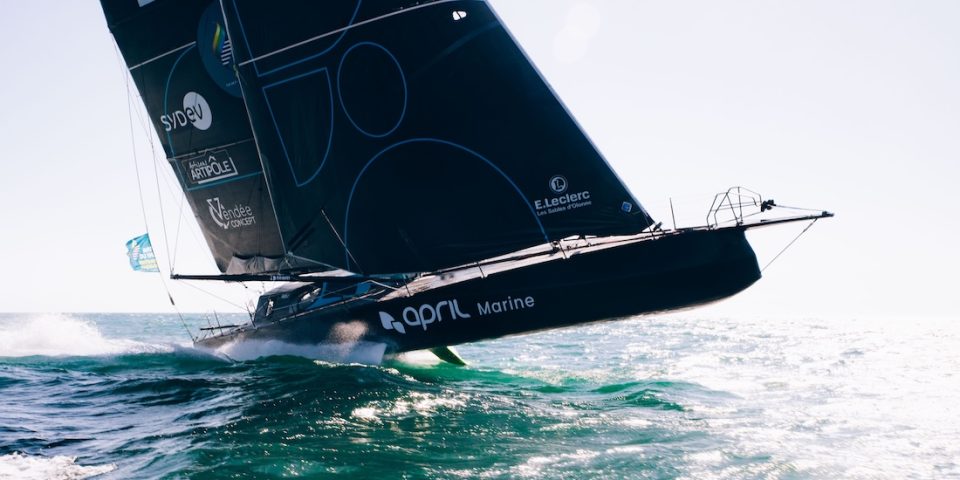
Having embarked on his sixth consecutive Vendée Globe campaign, Arnaud Boissières is among the 120 skippers (a record entry) set to line up in Cherbourg-en-Cotentin on Saturday for the 2026 edition of the Drheam-Cup aboard his IMOCA April Marine-Tahiti Déménage Tout. The 53-year-old skipper will notably be joined by Tahitian crew member Henri Michel. It was the perfect opportunity for Sailorz to catch up with him.
Last year you launched your sixth Vendée Globe campaign. How did you come to that decision?
Before setting off on the last one, I told myself I’d keep the option open: if I had a good Vendée Globe, I might continue the project, but perhaps with someone else taking my place. In the end, the way the race unfolded made me want to go again. Strangely enough, I never found the right rhythm in the Southern Ocean. I also went through things I haven’t spoken much about, including a staph infection that forced me to take antibiotics for nine days. They caused all sorts of side effects and left me completely drained. As a result, I was never really in sync in the South. Then another issue arose when we found ourselves within range of icebergs after being told they were behind us, which created a very particular kind of stress. And during the twelve days I spent under jury rig on my way to Martinique after dismasting off Cape Verde, I had plenty of time to think. I asked myself whether I should carry on or not, and I decided I couldn’t stop after a failure. Naturally, I discussed it with my partners and those close to me, because you don’t make that decision on your own – my ten-year-old son had found the last start particularly difficult – and together we agreed that setting off again was the right decision.
After five Vendée Globes, didn’t you feel any sense of burnout?
Four completed, actually, because I didn’t finish the last one… But no, because every campaign has been different. That’s true again this time, with a more competitive boat and new elements I’d never really embraced before, such as physical and mental preparation. I’d underestimated those aspects until now. So no, I’m not tired of it. The proof is that I’m always looking for opportunities to sail, which is why I’m lining up for the Drheam-Cup. I just think it’s a shame there are only two IMOCAs taking part (alongside Resilient, sailed by Pierre-Louis Attwell).
You’ve chosen to campaign a different boat this time, the one Benjamin Dutreux sailed in the last Vendée Globe (the VPLP-Verdier design launched in 2015 as Hugo Boss). Why?
I looked at several options, including buying Oceans Lab, Phil Sharp’s boat. I went to see it four or five times in La Rochelle because I thought it had huge potential. That was my preferred option for a long time, but it never came together because the deal was complicated. I’d suggested to Phil that we work on the project together, but I didn’t get much positive feedback from him. That’s just the way it goes… I also considered Bureau Vallée, because I really liked those boats [three Manuard designs were built from the same moulds: the former L’Occitane, which became Bureau Vallée, Initiatives Cœur and Oceans Lab, eventually bought by Louis Duc, Ed.]. In the end, I started talking to Benjamin, who’s my neighbour in Les Sables. I assumed his boat wasn’t available, but last year we found a great arrangement while sailing together. The budget I brought in enabled me to reduce the purchase price of the boat, we combined our teams and experience, and everything came together in a spirit of sporting and commercial cooperation. That confirmed my desire to launch another campaign with this boat, which I’ve really enjoyed sailing because, in the end, what I’m looking for is fun.
“I’M STILL ABOUT €400,000 SHORT”
La Mie Câline announced at the end of last year that your partnership was coming to an end. How did April Marine come on board?
It wasn’t really a surprise. When I came back from the Vendée Globe, I’d sensed something was changing, even though they were very supportive and encouraged me to go again. Ten years of partnership is significant. Even if they never said it in so many words, there may come a point where a degree of fatigue sets in if you’re not constantly activating the sponsorship. I really admire what Sodebo has done with Thomas Coville – they’ve always kept things dynamic and positive. As for my own project, we were in discussions with another company that was due to take over. We wanted to announce it at the same time as La Mie Câline’s departure, but it didn’t work out that way. In the end, April Marine, which had already been part of my partner collective for six years, decided to strengthen its commitment. They’d had a Mini project running for four years which they planned to end before the Vendée Globe, but I convinced them to continue. They then spontaneously asked me to manage the programme, which I accepted. We bought a boat and selected Emma (Le Clech) during the Vendée Globe race village. She completed the last Mini Transat and April Marine was delighted. After that, they had to decide whether to continue with the Mini project or step up into the IMOCA programme. They ultimately chose the second option, while I continue to look for a co-title partner.
What sort of budget are you looking at?
Right now, my annual budget is €900,000, and the goal is to increase that to €1.3–1.4 million. I’m still about €400,000 short. That would allow me to fund upgrades to the boat, including a new set of foils, while also strengthening the sporting side of the project by working more regularly with Julien Pulvé, who supported me on the Vendée Arctique and is sailing with me on the Drheam Cup alongside Tim Darni, Pierre Daniellot and Tahitian sailor Henri Michel.
Your boat for the Drheam-Cup is entered as April Marine-Tahiti Déménage Tout. Is there a connection?
Yes, absolutely. That’s the name of his company. The idea is that I want to do more crewed sailing. If you’re very wealthy, you race The Ocean Race. I’d love to, but the budget figures are a bit overwhelming, so it’s not for me at the moment. Instead, I’m trying to take part in other races, which also allows me to bring people on board. It just so happens that I’m friends with Titouan Lamazou, who spends a lot of time in French Polynesia and whom I regularly see when he’s back in Les Sables. Recently, he told me about a friend of his who runs a business and wanted to experience offshore racing. We had several video calls and I suggested he support a programme of crewed races. We’re starting with the Drheam-Cup and, if it works well, we’ll look at doing more together afterwards. He’s bringing some budget to the project, we got on really well, and I figured that if Titouan Lamazou was introducing him, he was bound to be the real deal!
“A TOP-15 FINISH
IN THE VENDÉE GLOBE”
What are your sporting goals for this new campaign, starting with the Route du Rhum later this year?
For the Route du Rhum, a top-ten finish would be great. I think I’ve got what it takes to perform well, even though the level is incredibly high. When you see the young talent coming through, like Elodie Bonafous, they’re seriously impressive! The goal for the next Vendée Globe is to finish in the top 15 with an upgraded boat – and maybe even better if everything falls into place. That said, I say all this with great humility. If I manage to complete this sixth Vendée Globe, that alone will already be something quite extraordinary. Back in 2008, when I first got into all this, I never imagined I’d still be here doing it!
Do you ever feel frustrated that you’ve never had a brand-new boat or the equipment needed to aim even higher?
Frustrated? No. Perhaps I have one small regret about not taking the plunge back in 2009–2010 with Akéna Vérandas. At one point we considered building a new boat, but it never happened because it was expensive and required being able to accept a year without visibility. That said, I have to admit that today I’m intrigued and a little disappointed by the direction things have taken. I don’t think we’ve been brave enough – myself included – to ban the construction of new boats at some point. When I see how much an IMOCA like mine can still be developed, or how competitive a boat like Macif remains despite new boats being built afterwards, it does make me wonder. These days I’m loving what I’m doing. I’d rather have fun without a brand-new boat than spend my time cutting carbon fibre and being shut away in a shed with a team of twenty people.
Will this be your last Vendée Globe?
It’s a question I inevitably ask myself. I could certainly see myself carrying on by bringing a young sailor – male or female – into the project with me, racing double-handed or with a crew. It’s fashionable at the moment, but that’s not why. It’s because I’ve discovered that I really enjoy building projects, which was never my objective when I first arrived in 2008. Back then, I simply wanted to go sailing.
Photo : Jean-Baptiste D’Enquin / Arnaud Boissières / April Marine