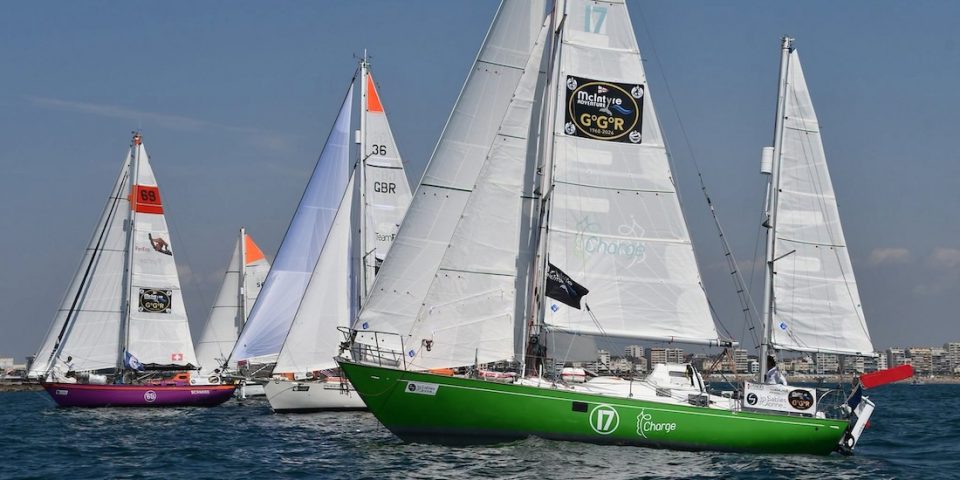
16 sailors will set off from Les Sables d’Olonne on Sunday for the Golden Globe Race, a non-stop, solo, unassisted “old-school” circumnavigation. Sailorz takes a closer look at this third edition.
Launched in 2018 to mark the 50th anniversary of the Golden Globe Challenge, the first solo round-the-world race in history, the Golden Globe Race, sailed using the navigation instruments of the era (compasses and paper charts) and on 32- to 36-foot boats designed before 1988, is returning to Les Sables d’Olonne for its third edition. There were 18 competitors (5 finishers) in the first edition, won in 212 days by Jean-Luc Van den Heede, and 16 (3 finishers) four years later, with Kirsten Neuschäfer winning in 233 days. This year, there are 16 once again, including three who were already on the start line in September 2022.
According to organiser Don McIntyre, who spoke to Sailorz this week, that figure could have been higher: “Three months ago, we still had 26 registered; we’ve lost 10 since then for various reasons: some because they didn’t have enough money or time, others for medical reasons or because, after completing their qualification, they felt they weren’t ready… It’s difficult to make it to the start line, especially as we, as organisers, don’t make it easy for them.”
The Australian is referring to rules which, with each edition, raise the bar in terms of safety equipment and qualification requirements: this year, competitors must have logged 8,000 offshore miles to enter, followed by a further 2,000 miles solo and finally 4,000 miles on their chosen boat in the 18 months leading up to the start. The race, sailed without assistance or stopovers (a sailor who stops once can, however, switch to the Chichester Class, a second ranking), does not comply with World Sailing’s OSR 0 regulations governing transoceanic and round-the-world races, hence its lack of official recognition from the international federation and the French Sailing Federation.
Jean-Luc Denéchau:
“It’s not a race”
President of the latter, which does not have the power to ban the event on French territory (that falls to the local authorities), Jean-Luc Denéchau told Sailorz: “For us, it’s very simple: the Golden Globe Race is not a race, because it complies neither with the rules set by World Sailing, nor with the regulations of the French Sailing Federation, which has been delegated by the French State to organise the sport in France, nor with those governing race directors. It’s a great adventure, which could be a rally or a passage, but under no circumstances is it a race.”
Asked about discussions with the two federations, Don McIntyre replies: “We have constructive discussions with World Sailing, which has even promoted the race, as Kirsten (Neuschäfer) was named Sailor of the Year (in 2023). With the FFVoile, it’s a different matter… They even strongly advised Les Sables-d’Olonne against supporting us.”
Its president confirms this unequivocally: “I did indeed speak to Yannick Moreau (the former mayor) several times, warning him about the risks of hosting the Golden Globe Race; I have no certainty, but I think this year will be the last time it is held in Les Sables.”
A sharply reduced budget
Time will tell. In the meantime, the Vendée Globe host city is once again welcoming the event, but with significantly fewer resources. Whereas Yannick Moreau secured around €1.3 million in public funding four years ago (read our article), including a net cost of €800,000 for the city and the wider urban area, which covered the race village and numerous activities, total sponsorship has fallen to around €150,000 this year, largely provided by the city and the Vendée department, according to Don McIntyre. For its part, the Les Sables d’Olonne local authority has informed us that the support for the GGR amounted to “€90,000 in financial aid and €50,000 in material aid”.
“For this edition, we’ve lost 70% of the sponsorship budget we had in 2022, he continues. The event’s total budget is below €1 million (compared with more than €2.5 million four years ago). As a result, there is no race village. The city is providing the marina and offices, and will organise the prize-giving at the end.” At that prize-giving, the winner will, as in 1968, receive prize money of £5,000 (provided by the Sunday Times at the time), supplied by event partner Scipio.
Hardly enough to cover the €11,500 entry fee (€10,000 more if the skipper is sponsored), while competitors’ total budgets range from approximately €150,000 to €300,000. “This time, knowing that I already had the boat (a Rustler 36 which he bought for €80,000 for the previous edition), my budget is around €200,000 all-inclusive for one year”, estimates Damien Guillou, who, four years after retiring under the PRB colours, is having another go, this time supported by Solarem. The Breton sailor, who is taking 200 days’ worth of food (and 600 litres of water) for this edition, includes his own remuneration in that figure.
A team manager for every project
The other French skipper in the race, Louis Kerdelhué, a 21-year-old engineering student, puts his budget, including the boat, at around €250,000, but does not pay himself. Each competitor must be accompanied by a team manager, and his came about by chance: “My godmother’s husband is Dominique Dubois (former head of the Carboman group, which includes Multiplast); he introduced me to offshore sailing six years ago. It was while accompanying him on a delivery from La Trinité-sur-Mer to Les Sables for a press conference for the Ocean Globe Race [also organised by Don McIntyre; Dominique Dubois competed in the first edition, Ed.] that I heard about the GGR. I asked Dominique what it was and he replied: “Forget it, it’s completely crazy”. I then went to the start of the OGR, spoke with Don and Jean-Luc Van Den Heede, who helped me find a boat.”
In this case, a Biscay 36 ketch which competed in the first two editions, bought by Louis Kerdelhué in December 2023 from Austrian Michael Guggenberger, third in 2023. “I’ve been preparing for almost three years, with Dominique supporting me since he returned from the OGR; with his experience, he asks me about things that aren’t even on the safety checklists, but he’s often right!”
Also sponsored – by IECharge, his father’s company – the student is one of eight sailors carrying the GGR Window Live system, developed for this edition, which will use a unit connected to Starlink and several cameras to provide continuous YouTube coverage of half of the 16 competitors. Until now, the few images from on board had been uploaded to a video map by the sailors at two mandatory rendezvous points, in the Canaries and Hobart.
Continuous live coverage on YouTube
“Times are changing and we decided to embark on this major evolution, to which we have devoted time and money, and which we deliberately chose to limit to half the fleet, explains Don McIntyre. Each participant has a scheduled time slot during which they switch on one of their three cameras. We then receive the signal and send it to our YouTube channel, allowing people to watch live what is happening on board. The weekly schedule is announced one week in advance.” Cost of the operation? €300,000, covered by the organisers, Swedish company TriPeak, which developed the system, and the eight sailors, who each pay €14,000 to install everything on board and cover the connection costs.
Already activated, GGR Window Live will bring Sunday’s start to life from on board: a start which, in keeping with the spirit of the original Golden Globe Challenge – when competitors had five months to set off – will not take place from a starting line at a fixed time, but directly from the Port Olona pontoon, with each sailor setting off at two-minute intervals from 16:00. “It’s also to highlight the fact that this is a very different event from other races, explains the Australian. Before racing against the other competitors, you are first racing against yourself.”
Former Figaro sailor Damien Guillou readily acknowledges this too. When asked about his objective of winning, he replies: “I’m being labelled the favourite, but my biggest challenge won’t be to go faster than the others, it will be to do everything I can to finish, that’s really the key. Statistically, we know there will be a very high percentage of retirements, so it’s impossible to make predictions. For example, four years ago, personally, I certainly didn’t have Kirsten down as a favourite given her preparation and her boat, and in the end she won. The same could very well happen this time.”
Don McIntyre is nevertheless willing to play the prediction game, naming, alongside Damien Guillou, Briton Henry Wootton and Irishman Pat Lawless, before expressing his hope that “half the fleet will make it to the finish this time”. We will have to wait until the end of next winter to find out.
Photo : Bernard Gergaud