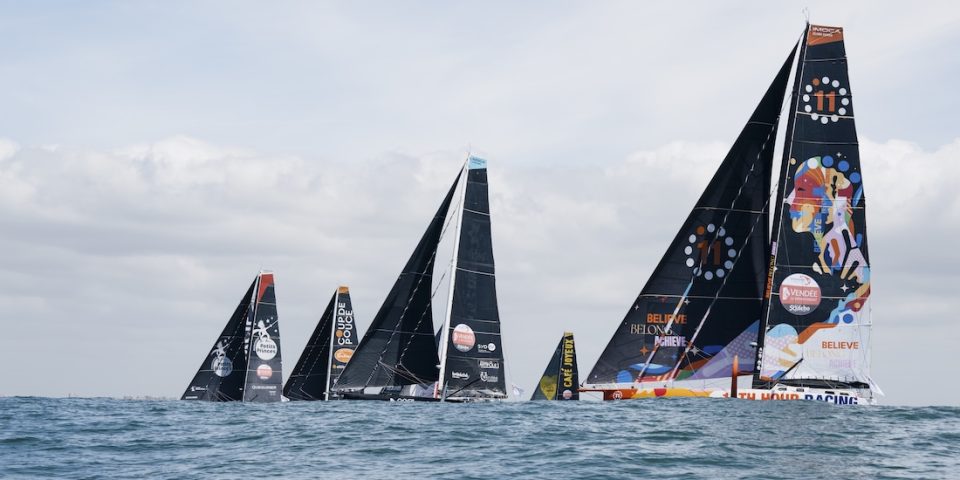
23 IMOCA boats will start the Route du Rhum-Destination Guadeloupe on 1 November, compared with 38 in 2022, with many of the boats that were on the water four years ago still looking for buyers. This situation has prompted the class to consider how to regulate its fleet, with some calling for a moratorium on new builds for the 2029-2032 cycle, a proposal that has caused a stir among stakeholders across the ecosystem. Sailorz takes a closer look.
Since the Vendée Globe, several skippers who have been pillars of the IMOCA class for years have lost all or part of their partnerships – Yannick Bestaven, Thomas Ruyant, Paul Meilhat, Romain Attanasio, Alan Roura, Giancarlo Pedote, Maxime Sorel… – leaving many of them with a boat on their hands, whose value depreciates over time due to a sluggish second-hand market and the arrival of new boats.
The class now has a fleet of more than 50 boats eligible for the next Vendée Globe (boats built after 2005), of which only 23 will start the Route du Rhum-Destination Guadeloupe. There are increasingly significant performance gaps between older IMOCAs and the latest generation – 25 new boats will have been built in total for the 2024 and 2028 Vendée Globes – as well as significant differences in team budgets.
Hence the questions being raised within the class about the future of the fleet and cost control. “As every four years, we waited until after the 2024 Vendée Globe debrief to look ahead, from early 2026, to the 2029-2032 cycle, explains Antoine Mermod, president of IMOCA. The approach is economic, technological, sporting and event-driven; everything is interconnected, but it is true that given the difficult economic climate at the moment, the economic dimension is being given greater priority.”
“55 or 57 boats eligible
for a measurement certificate, that’s huge”
A committee made up of around 15 IMOCA members is therefore working on fleet regulation, with the task of putting forward proposals. “55 or 57 boats eligible for a measurement certificate, that’s huge. My feeling is that we cannot continue with the current situation, with depreciation costs taking up an increasing share of our budgets (35 to 50% according to Antoine Mermod), so it is legitimate to question the pace at which new boats are entering the fleet and the risk of obsolescence this creates for previous generations,” comments Sébastien Marsset.
Maxime Sorel sums up the difficulty currently facing several skippers looking for partners and/or investors: “We built (in 2022) a boat whose resale value we had factored in; the fact that there are still so many new boats coming onto the market is devaluing it much faster than expected, which makes the equation really complex: how do you convince an investor to come on board when you no longer control the future?“
For Armel Tripon, “There are quite a few warning signs, both economic and environmental: many boats, including very good ones, cannot find buyers, perhaps we need to slow things down and stop building IMOCAs indiscriminately, not to mention that building a boat has a significant environmental cost.” Among the solutions being considered by the class – and backed by a significant number of skippers, to the point that some are calling for an extraordinary general meeting to settle the issue quickly – one in particular is attracting attention: a possible moratorium on new boat construction for the 2029-2032 cycle.
Top-down or bottom-up?
“Temporarily stopping new boat construction is a very good solution, but it is not the only one. We are working on several options; the aim is to have a fleet of 20-25 boats capable of racing, without excessive gaps between them,” comments Paul Meilhat, who recently won The Ocean Race Atlantic on a 2022 boat. Fabrice Amedeo, for his part, believes that “slowing things down for one cycle to preserve the value of some IMOCAs makes sense, because we now have so many remarkable boats sitting in sheds, including Thomas Ruyant’s, which is brand new.”
The idea of a moratorium has caused a stir among some, starting with the boatyards, which have decided to speak out. “I understand that there needs to be a discussion, but we should remove boats from the bottom end, not the top,” says Yann Penfornis, CEO of Multiplast. “Can you think of any motorsport where you have brand-new machines and others more than 20 years old on the same starting line? At Le Mans, old cars race in Le Mans Classic, not the 24 Hours.”
The idea of phasing out the 2008-generation boats is also at the heart of discussions within the class, as Antoine Mermod acknowledges: “One of the major issues that needs to be addressed is how we phase these boats out after 20 years, so that new ones can replace them and become accessible to skippers entering the class.” Armel Tripon nevertheless sees a risk: “Offshore racing, and the Vendée Globe in particular, has not been built on performance alone. There are also great stories and adventures; we must not shut the door on people who want to experience a Vendée adventure first on a boat with daggerboards, before building a second one with greater sporting ambitions.”
An ecosystem under threat?
Returning to the moratorium issue, Ronan Lucas, CEO of CDK, warns: “The entire offshore racing ecosystem is at stake, not just the boatyards: the designers, those machining components, making sails, deck hardware, electronics or paint, but also engineers and technicians within the teams… Going from no limit to zero boats for 2032 seems quite extreme to me. We already have people interested in a boat for 2032; if that is no longer possible, they will turn to other sports.” He also calls on IMOCA to engage in dialogue to “co-construct the future in a calm and measured way.”
Among the designers interviewed by Sailorz, Antoine Lauriot Prévost of VPLP Design understands the concerns of some skippers, but believes that “blocking new builds is difficult for boat designers to accept, because what excites us about the IMOCA class is innovating every time, learning from past experience and moving forward.” Antoine Koch adds: “It is a legitimate ambition for a class to seek to contain performance gaps and preserve the value of older boats. But we must not lose sight of the fact that IMOCA is a development class, in which partners also invest because it allows them, through their communications, to associate themselves with high-tech projects that resonate with their own activities. For example, I know that if DMG Mori had not built a new boat during this cycle, they probably would not have continued in IMOCA; there was a corporate project behind it.”
Speaking to Sailorz on Friday morning, during the presentation of the design of Yoann Richomme’s future IMOCA, Sébastien Petithuguenin, VP of Paprec, shares this view: “The idea of stopping new boat construction is the ultimate false good idea. The IMOCA class has an DNA built around both human adventure and innovation. As a sponsor, that is hugely important to us; it is genuinely one of our pillars.” Yoann Richomme, for his part, is calling for “the consequences to be carefully assessed” before adding: “When it comes time to launch new boats again in eight years, no one will be able to make that leap, because we will have created too big a step in terms of cost; in my view, we will be not far from having a fully foiling fleet in 2032, and that is how the fleet will become more homogeneous.”
Development options
And developing previous-generation boats is another area where designers have ideas. “We are trying to broaden the discussion with Guillaume (Verdier), Sam (Manuard) and VPLP, and we are convinced there are fairly simple levers for narrowing the performance gaps. For example, we could give older boats a foil-area allowance or allow them an additional sail; that could have a significant impact,” explains Antoine Koch.
Antoine Lauriot Prévost, who worked on the major modification project to Charal‘s hull, agrees, adding however that “if the rules do not evolve to allow boats to be modified more extensively, the performance gaps will remain more or less the same.” Another project for IMOCA and its technical committee, which is working on the 2029-2032 rules.
When will the first decisions be announced? “The final version will be delivered before the 2028 Vendée Globe,” replies Antoine Mermod. “After that, if there are more structural rules affecting the economic model, decisions will be taken by the end of the year or early 2027.”
Photo : Olivier Blanchet