
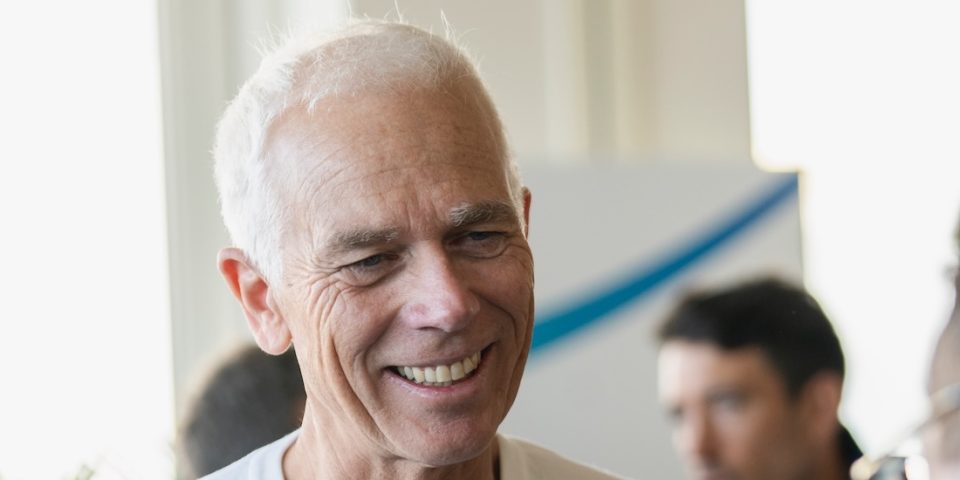
It’s been a busy spell for Philippe Presti! Fresh back from the Bermuda Grand Prix, where DS Automobiles SailGP Team France, which he manages, finished ninth, he also serves as sporting director of La Roche Posay Racing Team and flew out this Friday to Cagliari, host of the first preliminary regatta of the 38th America’s Cup, scheduled from 21 to 24 May. Plenty of reasons to sit down with him.
What do you take away from the Bermuda Grand Prix, where once again the French team was unlucky, with Glenn Ashby’s injury?
We’re in a tough phase. After the Auckland incident (injuries to Leigh McMillan and Manon Audinet in a collision with the New Zealand boat), we had chosen to bring in experienced people like Glenn, and here we are again with another injury, as he broke his tibia and fibula at the start of race two when his foot got caught in the life line. It’s really frustrating because in training things were going well, we had found good reference points on a racecourse we know well, so we arrived at the Grand Prix with ambition. We had to reset after Glenn’s injury, but what’s great is that with the resources we had, we managed to adapt and pull off a strong Sunday with two podiums. From a difficult situation, we created a bit of momentum for what’s next.
What options do you have to replace Glenn Ashby while waiting for Leigh McMillan’s return (expected mid-summer)?
The wing trimmer is a key position on the boat and, on the market, there are virtually no experienced wing trimmers available anymore. So we’ll have to find solutions with less experienced sailors, knowing that we’re in a phase where we have no training time ahead of the Grand Prix. It’s a major challenge we’re currently working through ahead of the next event in New York (30–31 May). Whoever is on board, we’ll need to reorganise our playbook so he can focus only on what matters, and that will likely require adjustments for Quentin (Delapierre).
Could these successive injuries and the lack of available substitutes lead you to broaden your sailing pool in the future?
I think the league wants to lock down transfers to allow teams to build their own sailing squads, because robbing Peter to pay Paul doesn’t really work. We do have that ambition, and we have a great structure for it, the Academy, which helps us identify young talent in French sailing. The goal is to eventually bring some of those sailors into the team, which may require shifting gears to bring more people to events, whereas up to now we’ve been fairly minimalistic.
Are you having to scale back your ambitions for the upcoming Grand Prix events?
When we have the level to win, we’re not afraid to state your ambitions, which was the case at the start of the season. Leaving Perth, where we finished third in the final after dominating the event, we were targeting podiums all season. But then we find ourselves in trouble after the Auckland incident, now Glenn’s injury, so the approach is inevitably a bit different, but that doesn’t mean it won’t work!
“Technically, I think
we’re in a very good place”
Next up is the first America’s Cup preliminary regatta in Cagliari — how have you prepared?
We started in early March in Lorient, completing 35 training days, including around 20 sailing sessions, which is a huge amount. Lorient Bay gave us incredible conditions. We first used the simulator, because even though the AC40s are like big Moths, there are specific systems, so starting on the simulator helps get hands in the right place, work on communication, and capsize without it being an issue. Then we went on the water with a lot of rotations across the seven sailors, and in the final training block we focused on shorter sessions with the crew selected for Cagliari. We rehearsed all manoeuvres in a wide range of conditions, targeting the most challenging wind ranges — strong breeze and light airs — with the aim of staying on the foils in light wind and avoiding burying the bow in heavy air. Ultimately, the only missing element was having competitors around — that’s what we’ll discover in Cagliari.
How have Diego Botín and Florian Trittel (Olympic 49er champions and SailGP winners in 2024, among other titles) integrated into the team?
It’s a real source of pride to have brought them in. Their integration has gone extremely well, thanks to a strong willingness from the core K-Challenge group, led by Quentin, to welcome them — which is not always the case in professional teams. As for their adaptation to the AC40, it didn’t take long; I wasn’t too concerned about that. The goal was then to align on the same playbook and way of communicating, and that’s progressing in leaps and bounds.
What are your expectations for Cagliari?
I honestly have no idea. Technically, I think we’re in a very good place; I see them doing things we weren’t capable of with Luna Rossa in the last Cup. But again, for now, we’re the kings of the track, all alone in Lorient!
What’s next for the La Roche Posay Racing Team programme?
The priority in June will be to focus on the AC75 simulator. The tool is now mature, and we’ll use it for design, energy, communication and boat handling. Then it will be time to go sailing at the start of the summer, with the aim of pushing this design further than was possible in the previous campaign due to lack of time, before moving on to more detailed refinements ahead of the 38th Cup.
Given your experience of the event, how do you see the potential of the French challenge?
Over the course of my long career, as you say, I’ve seen the Cup change hands three times. The first (2003), the Swiss effectively bought Team New Zealand. The second (2010) — and I was involved — Oracle found a loophole in the rules to blow up the system. The third saw a team that had lost the Cup (Team New Zealand) gradually rebuild itself. It didn’t work the first time, nor the second, nor the third, but each time it managed to aggregate skills and become progressively more legitimate and eventually win it (in 2017). That’s the path we’re on. In the last Cup we finished last; since then, we’ve been adding assets, mainly people, to create a stronger environment. My job is to make sure all the links hold together properly and there are no gaps in the system. I’m confident that if we continue on this path, we’ll reach a level where we can perform. As for where we are today, I don’t know — but we’re better than yesterday!
Photo : La Roche Posay Racing Team