
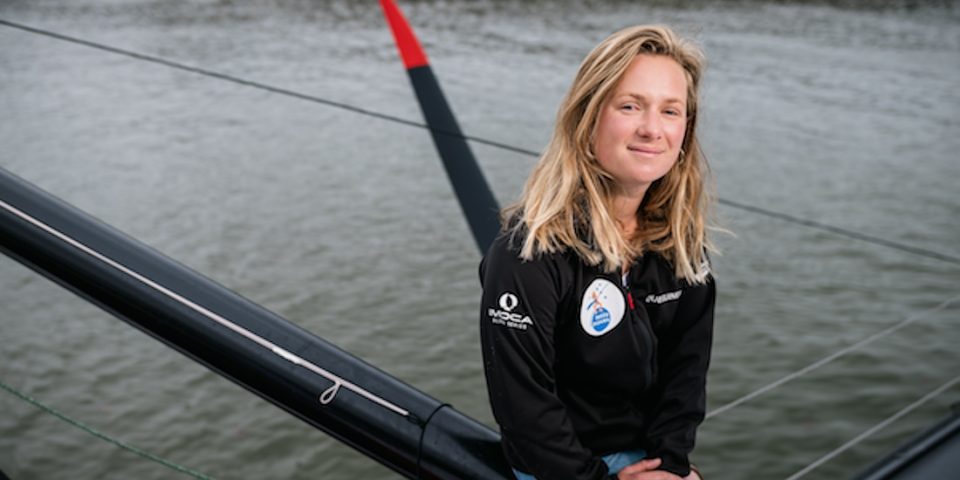
After a successful first season in 2025 aboard her IMOCA Association Petits Princes-Quéguiner, Élodie Bonafous (30) heads into 2026 with confidence. As she prepares to compete in her first solo IMOCA race, the 1000 Race – a 1,000-nautical-mile loop starting from Port-la-Forêt on 3 May at 13:00 and finishing in Concarneau – the skipper reflects on a project that fully meets her expectations.
With hindsight, how do you assess your 2025 season?
It’s been very positive. I realise how fortunate I am to have an IMOCA that is well designed, well built, with reliable and proven systems. That was a key factor in our decision to build with MerConcept. We were also convinced from the outset that a sistership of Macif was the right choice for this project, and that has been confirmed. Beyond the sailing time gained, it brings real mental confidence. And that confidence changes everything: you know you can push the boat without constantly worrying. With pure prototypes, the first races are often about ironing out issues. For us, we were able to discover and push our IMOCA without too many breakdowns or major adjustments.
Second place in the Course des Caps, victory in the Rolex Fastnet Race: the results came immediately…
The Course des Caps was demanding and intense, and I value that performance almost as much as the Fastnet win. But of course, taking first place has a special flavour, especially after a great battle against a benchmark like Charal. By the end of summer 2025, we were clearly on a high, while staying focused and realistic about what came next. In the end, the only disappointment came from the Transat Café L’Or, raced with Yann Eliès: a minor issue forced us to stop over and drift away from our initial goals.
Was it essential to surround yourself with the right people for this learning season?
Yes, both for performance and set-up, but also for technical management, which was what concerned me most. I knew how to race inshore and offshore, but mastering such a complex machine was the big challenge. Having Yann Eliès on board helped enormously. I was also able to sail with other top sailors like Pascal Bidégorry, Gaston Morvan and Basile Bourgnon. It represented a financial investment for the partner, of course, but it was a coherent choice.
Was the return delivery of the Transat Café L’Or in “false solo”, between Martinique and Brittany, a key moment for you?
Yes, absolutely. At the start of the year, I was quite apprehensive about that passage. It was the moment to cut the cord with Yann. When sailing solo, you can only rely on yourself, and mentally that changes everything. Over the course of the season, that apprehension disappeared. I was ready, and even very excited about doing that delivery in false solo. I switched into race mode and really pushed hard. I wanted to test the boat’s limits on my own and my onboard rhythm. That passage was very instructive and gave me confidence. I faced a few minor issues, but I managed them alone. I really felt at one with the boat. Rest remained the most challenging part, but otherwise I felt completely at ease, in my element.
“Getting the boat back in the water
as early as possible”
What did the winter refit involve?
We carried out a full overhaul of the systems to start again on solid, controlled foundations. The aim of the winter work was not to make major optimisations. That’s not the financial philosophy of the project at this stage. The only real upgrade was the installation of solar panels, in line with class rules aimed at limiting the amount of fuel carried. My objective was very clear: get the boat back in the water as early as possible to maximise time on the water. We also kept the refit as short as possible to allow the team some rest. They had worked extremely hard, and since we don’t have a large crew – particularly for budget reasons – there was a real need to let everyone recover.
What do you expect from the opening race of the 2026 season, the 1000 Race, your first solo IMOCA event?
Above all, I want to validate the work done in false solo. I’m not setting a specific sporting target. The idea is to complete the course “cleanly”: anticipate manoeuvres and strategic decisions, know my boat well and sail it at a reasonable performance level. I won’t try to push at 100% all the time. I’m approaching this race a bit like the tortoise and the hare fable: making steady progress without mistakes. If I can tick all those boxes, the result will already be satisfying.
The 1000 Race line-up is small, with only seven sailors entered. Do you regret that?
It’s a bit disappointing, of course, as it removes some of the sporting challenge. For the IMOCA class, we would obviously have preferred a bigger fleet at the start. Personally, as I see this race primarily as training, it doesn’t bother me too much. It will allow us to build intensity progressively.
Next comes the Vendée Arctique…
I’m almost more apprehensive about this race than the Route du Rhum. The Rhum is sailed on a route we know relatively well. Exiting the Channel and the Bay of Biscay can be tricky, but afterwards you return to more classic, familiar patterns, so there’s less uncertainty. By contrast, the Vendée Arctique features a course I don’t know. We’ll have to head far north, with one major feature: we must cross the Arctic Circle (66° North) at a longitude of our choosing. The weather conditions could be very harsh, and there will be a lot of analysis and routing to decide where to pass. The objective will not only be to reach that point, but also to anticipate the return, with the right angles and weather sequences. It promises to be complex. This race will be very open, and probably quite disorienting. I don’t yet know exactly how I’ll manage it.
“The project is following
the plan I had in mind”
The Route du Rhum will be the major event of the season. How are you planning to approach it, both competitively and from an event perspective?
If I picture myself three or four days into the race, in my rhythm, I feel calm. Honestly, what I fear most is managing the pre-race phase. That’s not necessarily my strength. I love sharing my passion, interacting and being available, but it takes a lot of energy and can generate stress. Yet once the race starts, you have to switch on very quickly. From a sporting perspective, I’m not currently able to set a finishing position target for the Route du Rhum. I have a competitive boat and I’m very driven, so I won’t be there just to make up the numbers. If I sail at 100% of the boat’s potential, I’ll be in the mix.
You seem to be following the roadmap to the Vendée Globe 2028 to the letter…
Yes, the project is following the plan I had in mind from the outset, over a four-year cycle. I’m exactly where I wanted to be. I’m lucky to spend a lot of time on the water, to be well supported and to evolve within a team that suits me. At the beginning, some milestones felt very far away. The Vendée Globe seemed like a huge summit. Day by day, that summit is getting closer. It’s a step-by-step progression, where every decision matters and fits into a long-term logic. It’s a real luxury to be able to build this project over time, in a structured way.
Photo : Jean-Louis Carli