
Having joined the Ligue de Voile de Normandie in 1994 before becoming its director in 2001, Francis Le Goff witnessed Charlie Dalin’s gradual emergence, “a kid like any other” in his early 420 sailing days. For Sailorz, he reflects on the rise of the man who would go on to win the Vendée Globe at the age of 40.
Can you tell us about your earliest memories of Charlie in Le Havre?
He joined the SNPH training centre, the only club he ever knew, around the age of 12–13 with Thomas Aubert in the 420 class. This may sound surprising given everything that has been said since Thursday, but he was a kid like any other. He hadn’t been winning everything in the youth ranks, far from it, but over the months we started to feel that this crew was actually pretty solid. It showed in small things: they were always on time, never missed a training session. Whether it was light airs or heavy weather, they never complained. And whenever we suggested something different, they were always up for it. Same with the gear: in the Le Havre mindset, it’s never the staff who prepare the boats, it’s the young sailors themselves. Charlie picked that up very quickly and kept it for a long time. You could see the care they gave their 420 — it wasn’t new, but it was the best-looking boat out there! And that stayed with him: whatever the boat, whether in Figaro or Imoca, it was always absolutely immaculate, to the point you could have eaten off the floor or the engine! Those were the first signs, though they were mainly spotted by Cédric (Chateau, the coach). I was more focused on the overall behaviour, the level of commitment he showed.
Did you already imagine what would come later?
At that time, we had a kind of golden generation, with Camille Lecointre, Mathilde Géron, lots of titles stacking up, including French championships we organised where almost everyone was on the podium. That’s when a shift happened: some went off to study, others towards Olympic sailing like Camille and Mathilde, and some were drawn offshore — which was the case for Charlie, who combined his studies with his early Mini Class campaigns. We lost sight of him a bit, although we obviously kept an eye on what he was doing. When he came back, he’d tell us all sorts of stories, like “I sailed with so-and-so”. He managed to get himself on board everywhere. We started thinking: “Blimey, he’s actually doing pretty well!”
“He became
an exceptional sailor”
Up until his move into the Figaro class in 2011, how did his early steps go?
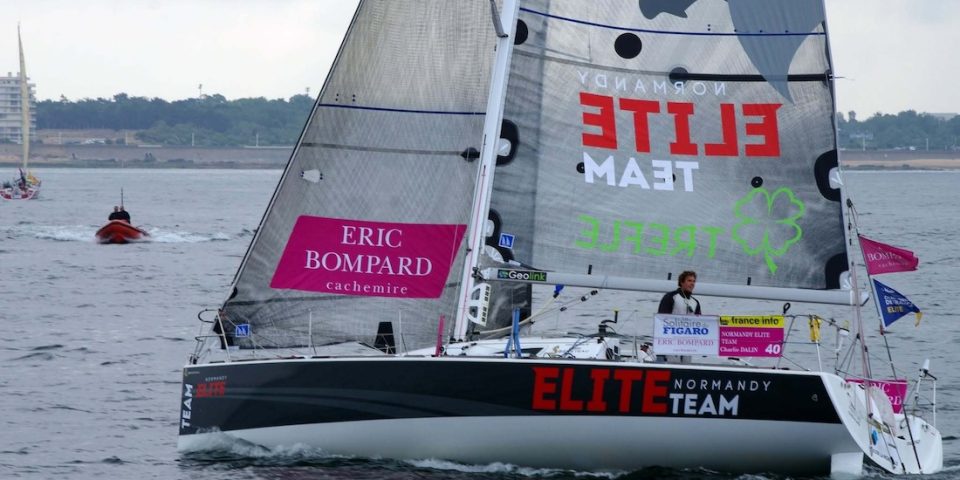
He did indeed enter the Figaro circuit with his sponsor Keopsys, but after two years he lost his backer and came back to Le Havre. Here, it’s a bit like a family: once you’re welcomed, you’re always welcomed back. At that point he was going through a rough patch, and I thought: “Given everything he’s done so far, his commitment to his studies in naval architecture in Southampton, we’re going to go all in and support him by launching our Normandy Elite Team.” We had very little money, but a nice boat we chartered — Jeanne Grégoire’s. Cédric told me we couldn’t put everything on one sailor, but with Corinne Migraine we decided: “We need to take a chance — it could launch us and help us find partners for the others later.” So we went to see Charlie: “We can give you a good boat, good sails, a boat captain, but beyond that you’re on your own, and there’s no salary.” He agreed to play along. He received the boat quite late, but as usual he quickly made it his own, and in his first year he finished third in La Solitaire du Figaro and became French offshore champion. It was a turning point! And from there, everything followed: Macif, Imoca, the fast track to the top, right up to his Vendée Globe victory.
Did he surprise you along the way?
No, never. We knew his performances would come, because Charlie was someone who never, ever let go. As I said, at the beginning he was a competitor like any other, but he became an exceptional sailor. Honestly, the only time I was surprised was when he announced he had cancer. Because with Charlie, we mostly talked about sailing, not personal matters — very little, if at all. He had a kind of reserve that you often find among seafarers. So when I learned he had done the Vendée Globe while battling cancer, I was genuinely taken aback. I don’t think it defined his performance — that result was already in him. Even in perfect health, he would have done the same. On the other hand, he delivered a lesson in strength and courage to all those affected by cancer, showing that you can still pursue your dreams no matter what, as long as you fight and work hard. And working hard was something he took to an extreme. In the end, despite how difficult all this is, there is also a message of joy — the joy you could see in his eyes, and I’ll finish on that: that little spark that you can still spot in many photos.
Photo : Bernard Gergaud