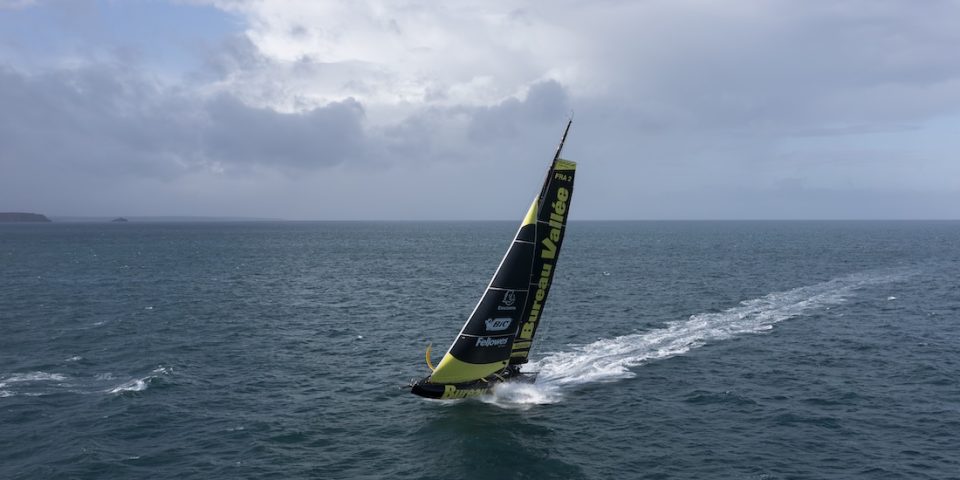
Several headline skippers from the last Vendée Globe lost their sponsors for the 2025 season (or at its end): Maxime Sorel (V and B, Monbana and the Mayenne department), Yannick Bestaven (Maître CoQ), Thomas Ruyant (Advens), Damien Seguin (Groupe Apicil), Giancarlo Pedote (Prysmian) and, most recently, Paul Meilhat (Biotherm) and Louis Burton (Bureau Vallée). In a press release on 30 September, Adrien Peyroles, CEO of Bureau Vallée, whom we could not reach (nor the skipper), explained: “In a complex economic context, Bureau Vallée has chosen to reallocate budgets dedicated to sailing sponsorship to other strategic company priorities (…) Ending this partnership today is a strategic realignment necessary for the company’s proper development.”
Asked about these sponsor departures, mostly non-renewals, David Sineau, team manager of Initiatives-Cœur until the end of the year and later seeking to host a Vendée Globe 2028 project with his Planète Racing structure (see our article), did not want to sound alarmist. “Things need to be put into perspective: the anomaly is not today’s situation but rather what we experienced four years ago. At that time, sponsor re-engagement rates were nearly 100%, unprecedented. Historically, partnerships rarely last more than ten or fifteen years. So the fact that several long-term sponsors are leaving now at the same time is not abnormal, even if it may appear as a rupture.”
Paul Meilhat, recent winner of The Ocean Race Europe and seeking partners, shares this view: “We are a bit forgetful, we remember yesterday but never the day before. We tend to think that the reality of the last four years was the same as the previous thirty. But that’s not the case. We are moving from an euphoric period to a more “normal” situation. At the end of each cycle, some partnerships end and others begin.” He adds: “Currently, many boats are being built and new sailors are arriving in the class, like Ambrogio Beccaria, Corentin Horeau, Élodie Bonafous, Loïs Berrehar, or Francesca Clapcich.”
Caution and patience
With over thirty years in sailing market and former team manager for Yannick Bestaven, Anne Combier adds: “The international context doesn’t help; it’s real stress for companies. Everyone I contacted for Yannick gave me as a reason, rightly or wrongly, the economic climate which makes them cautious and hesitant to reinvest. Initially, I was very optimistic because Yannick has a great boat and a turnkey project. We also had many open doors, yet I hit a wall.” More or less optimistic about short-term and medium-term sailing sponsorship, those interviewed agree that offshore racing remains attractive, though there is often a difficult step between generating interest and securing commitment.
Budgets in focus
The Ocean Race Europe winner also mentions “a backlash” due to overly expensive projects, especially when building a foiling IMOCA, stressing the need to “limit budgets and return to something more reasonable”. Maxime Sorel shares the view: “Insurance alone for an IMOCA costs between 300,000 and 400,000 euros. Today, I don’t have these funds, so the boat stays ashore. I kept my technical team active by finding them work to maintain the structure as long as possible. But clearly, we are approaching a critical zone.”
Yannick Bestaven has faced a similar situation, recently having to put his IMOCA up for sale after failing to secure a new partner to replace Maître CoQ. “To run a competitive Vendée Globe project with a reasonable team, you need at least 2.5 million euros per year excluding taxes,” explains Anne Combier. For comparison, a cycling team costs 15–17 million euros per year. That sport also has many more events than sailing.”
This gloomy context, combined with political uncertainty in France, pushes some sailors to look abroad. “We find the most opportunities” in the U.S.”, notes Maxime Sorel. “You have to open the field of possibilities,” adds Paul Meilhat. In IMOCA, our strength is having an international program thanks to The Ocean Race, and we must take advantage. During The Ocean Race Europe, we made contacts everywhere.” Most IMOCA projects, including international skippers, are therefore based in France, points out Anne Combier, who adds: “If prospecting internationally, it must be with companies that have interests in France, like DMG Mori, for example.”
Photo : Benjamin Sellier / Wind4Production