
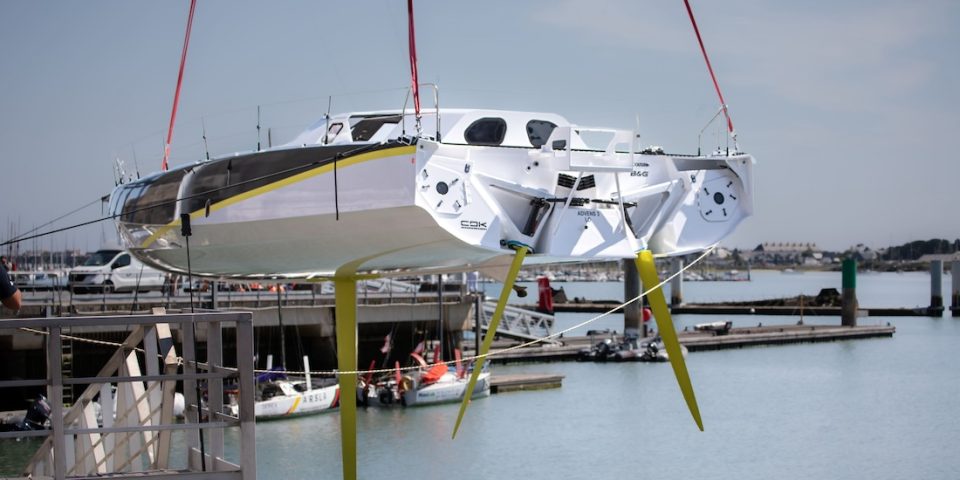
In recent weeks, two latest-generation Imoca boats have been unveiled: DMG Mori Global One and TR Racing, designed respectively under the direction of Guillaume Verdier and Antoine Koch. Two yachts with distinct philosophies, shaped to meet the expectations and programmes of their skippers, Thomas Ruyant and Kojiro Shiraishi. Sailorz takes a closer look with their architects.
The Imoca boats designed for the 2028 Vendée Globe are starting to be revealed. On 4 June, DMG Mori Global One, the new boat for Kojiro Shiraishi, was presented to the press. Two weeks later, on 18 June, again in Lorient, it was Thomas Ruyant’s turn: his Imoca, currently named TR Racing after the skipper’s company, still in search of partners, came out of the yard and was immediately launched.
Although these machines have been designed to meet the same programme—namely completing a crewed round-the-world race (The Ocean Race, start January 2027) followed by a solo race (Vendée Globe 2028)—the architectural approaches differ quite significantly.
“For the design of TR Racing, the initial brief was to improve versatility compared with the previous boat [the ex-Vulnérable, now Allagrande Mapei, ed. note]. The goal was to strengthen its strengths, particularly downwind, while correcting its weaknesses, especially upwind and on reaching in medium conditions, as well as in transitions and re-acceleration phases,” explains Antoine Koch, head of the AKO design office. A goal shared by Boris Herrmann’s team—for their new Malizia, scheduled for launch on 6 July—and Loïs Berrehar’s project, whose Banque Populaire boat is expected in spring 2027—both will feature Imoca boats derived from the same mould (see our article).
Double chine for TR Racing,
bustle for DMG Mori
Thomas Ruyant’s new Imoca is therefore a continuation of the previous generation, of which it is an evolution. It features aggressive lines with strong concavity. The hull includes a double-step chine configuration, allowing for a relatively narrow hull downwind while providing greater power reserves upwind and on reaching. “In manageable seas, the first chine will be enough to prevent the bow from burying itself; in the long Southern Ocean swell, both chines will come into play to help lift the bow, explains Antoine Koch. The boat will be less prone to nosediving because it will be able to generate more dynamic vertical lift. This will help reduce deceleration when it meets a wave. There will also be less water on deck, although that remains relative in Imoca racing, where boats are still very wet.”
What about DMG Mori? “The initial premise was simple: we were designing incredible boats, but they were becoming very difficult and punishing for sailors, says Guillaume Verdier. We received many reports from skippers telling us they were exhausting themselves on hulls that were slamming heavily. We could have continued down that path, but it would have led to ever more extreme boats. Kojiro, on the contrary, wanted a less violent machine.”
Working alongside Guillaume Verdier, Romaric Neyhousser adds: “Kojiro asked us to explore a different path. Many skippers prefer continuity, with gradual developments. That was not the case here—Kojiro gave us a free hand and accepted that we would take risks. He was one of the main drivers behind this willingness to break away from previous concepts.” The first striking feature on the hull of DMG Mori is the famous bustle, a kind of central trimaran-like hull section, first developed in 2020 on America’s Cup AC75s, but a major first in Imoca racing.
The objective is to sail with reduced wetted surface area and limited heel: “For most of the time, the boat will sail like the central hull of a trimaran and, from time to time, revert to behaving like an Imoca hull, confirms Guillaume Verdier. This will reduce slamming, dampen the boat’s movements and deliver a much smoother ride through the waves. We hope overall performance will improve because sailors will be able to make better use of the boat’s full potential.” According to Romaric Neyhousser, “once the boat accelerates, only the central hull will remain immersed, leaving us with an extremely slender wetted surface, rather like a large canoe slicing through the water like a blade, at least according to our simulations.”
Foils and rudders: the devil
is in the detail
As for the foils, the developments on both Imocas are less striking than those made to the hulls, but they are no less significant for anyone looking closely at the finer details. “The foils on TR Racing deliver 25 to 30% more lift during acceleration than our previous appendages, promises Antoine Koch. This comes down to a multitude of small refinements: the foil profile itself, its positioning within the hull, the proportions between the shaft and the tip…” On DMG Mori Global One, the foils have been designed in close harmony with the hull. “To perform properly, this hull needs to sail flatter than other Imocas. The foils help limit heel, which should remain between 0 and 10 degrees“, explains Guillaume Verdier.
As for the rudders, TR Racing features a V-shaped configuration, inspired by the concept first introduced on Charal 2, but with the appendages spaced further apart than on Jérémie Beyou’s Imoca. Extensive work has been carried out on their operation to keep the boat flying downwind with less drag and more predictable handling. Larger than before, they generate a stabilising force at the stern that improves the boat’s longitudinal stability.
On DMG Mori, the rudders have also been lengthened. “We’ve added almost a metre compared with the previous boat, reveals Léo Gonin, Head of Build for Kojiro Shiraishi’s team. The rudders are set well apart and angled, and we have also worked on the lift characteristics, whose effectiveness Charal 2 has already demonstrated.”
Boats designed for more time at the helm
From an ergonomic perspective, both Imocas have been designed to perform equally well fully crewed or single-handed, without favouring either configuration. On both TR Racing and DMG Mori, the cockpits and interior layouts have therefore been designed to be easily reconfigured depending on how the boat is being sailed. When it comes to helming, one race marked a turning point for the Imoca class: the 2023 Transat Jacques Vabre, where Thomas Ruyant and Morgan Lagravière claimed victory after spending significantly more time steering than their rivals.
“For years, everyone kept saying that autopilots had become so efficient that there was no point in hand-steering, recalls Antoine Koch. Thomas and Morgan proved otherwise, and others quickly followed their lead: during the 2025 Transat Café L’Or, the top seven crews all spent a great deal of time steering in the trade winds.” On TR Racing, the helming stations were considered from the very earliest stages of the design process. The boat has therefore been fitted with twin steering wheels, a small revolution in the Imoca class, as the last boat to feature them was Kito de Pavant’s former Groupe Bel, launched in 2007. “Beyond a certain load on the rudders, a tiller becomes difficult to manage. A steering wheel allows you to cope with much higher loads while maintaining very precise control,” says Antoine Koch.
A different solution has been chosen for DMG Mori, which features a hybrid system combining two tillers linked to the steering linkage, along with two steering wheels. “The wheels do not directly control the mechanical steering system but instead interface with the autopilot, explains Léo Gonin. They are extremely responsive and allow exceptionally fine adjustments, down to a quarter of a degree. Now that we have a better understanding of foils, we are moving towards managing a more stable flight, and we need that level of steering precision.”
Rarely has a new generation of Imocas displayed such contrasting design philosophies from its very first representatives, prompting Antoine Koch to observe: “It’s quite surprising because, in most classes, designs gradually converge. Here, by contrast, we’re seeing a very clear divergence.”
Photo : Pierre Bouras/TRR