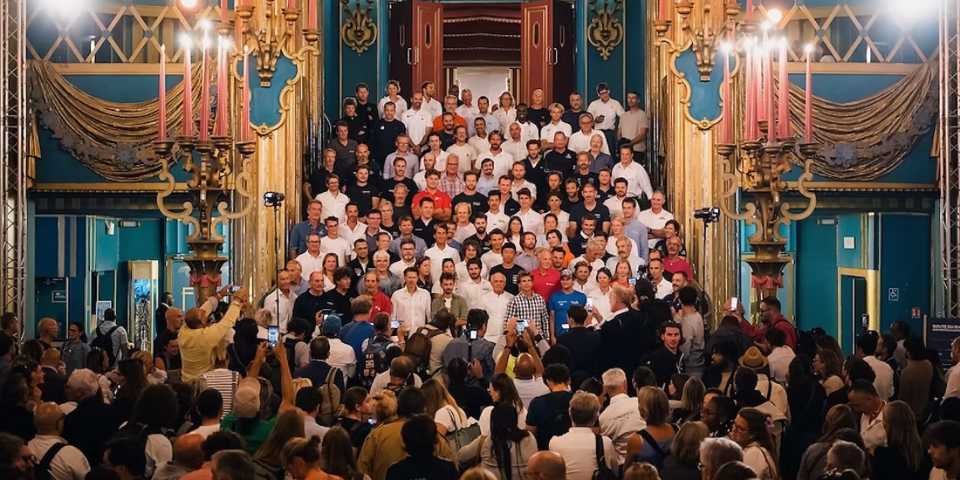
The official presentation of the Route du Rhum-Destination Guadeloupe 2026 took place on Tuesday 22 September at the Folies Bergères in Paris, preceded that morning by an economic press briefing. Sailorz was there to take a closer look at the key budget figures for this 13th edition, which will feature 118 solo sailors.
As the organisers of the Transat Café L’Or had done a year earlier, OC Sport Pen Duick invited the economic press on Tuesday morning for a briefing aimed at presenting the key figures for the 2026 edition of the Route du Rhum-Destination Guadeloupe.
OC Sport CEO Joseph Bizard opened proceedings, first reminding those present that the solo transatlantic race “is a major event that reaches millions of people every four years, and the figures are often dizzying, particularly for the city of Saint-Malo, which welcomed 1.2 million visitors in 2022 (60% from Brittany), and 300,000 in Guadeloupe”. He then stressed the specific nature of the business model of such an event, which, like other major offshore races, relies neither on TV rights nor ticketing revenue, “which generally account for 70% of the budget of this type of event”.
Bizard went on to add: “We actually make a loss on TV broadcasting because producing the start and finish broadcasts costs us €500,000″; the start has not been exclusively reserved for France Télévisions since the 2022 edition, “first because France TV was increasingly unable to finance the operation, and secondly because opening up the feed to all broadcasters allows us to reach as wide an audience as possible”.
Joseph Bizard then listed “the growing constraints“ facing the organiser, from securing the site in Saint-Malo – “the cost is exorbitant, it was €50,000 in 2014 compared with €1.1 million in 2026” – to increasing investment driven by CSR considerations: “We are now looking at a budget of around €400,000, compared with virtually nothing in 2018“, he explains. He then cited the main related expenditure items, including “demarcating and securing the Pointe du Grouin and Cap Fréhel sites as part of the Natura 2000 scheme, carbon impact assessments, the extensive educational work needed to communicate on environmental issues, particularly mobility, and, this year, a 100% electric village in Saint-Malo to reduce our carbon footprint, which is not insignificant because it is much cheaper to use generators than to have electricity everywhere”.
A budget of €11.5 million
These “growing constraints”, combined with inflation, explain why the budget – around €8 million in 2018 and €10 million in 2022 – has risen to €11.5 million this year. Of this, 35% comes from sponsorship (54 partners in total), including the €1.5 million naming partnership with the Guadeloupe Region, which, as with the other local authorities, is covered by a service procurement contract, mainly for communications and hospitality – “There are no subsidies for the Route du Rhum”, Joseph Bizard points out. The naming partnership expires at the end of the 2026 edition and, he adds, “is no longer aligned with reality because it has been the same amount since 2014“.
The remainder of the budget is broken down as follows: 22% comes from village revenue and hospitality, with the latter – 20,000 people benefit from it – managed by Rivacom Events, a subsidiary, like OC Sport, of the Advenn Group, formerly Le Télégramme); 20% comes from the host local authorities, €1.25 million from Saint-Malo, €1.1 million from Guadeloupe (in addition to the naming partnership), and €250,000 from the Brittany Region; entry fees account for 20% – €90,000 per Ultim, €30,000 per IMOCA, €20,000 per Ocean Fifty, €15,000 per Class40, €10,000 per Vintage Mono and Vintage Multi; the remaining 3% comes from “opportunistic revenue” (activations, accommodation and travel services…).
Joseph Bizard also pointed out that Saint-Malo “invests around another €1 million”, corresponding to the resources and staff deployed on and around the village, while the Brittany Region provides the port, “representing an estimated value of around €2 million“, both being in-kind contributions that “do not appear in the budget”.
“We are targeting a
profit margin of between 3% and 5%”
Asked about the economic impact of the last edition of the Rhum on the Saint-Malo area, Jean-Virgile Crance, deputy mayor in charge of, among other things, yachting and boating, who was present at Tuesday morning’s press briefing, cited a total of €29 million in direct economic benefits and 700 jobs created during the village period. He added: “Local businesses also tell us that, in general, the year following the race is a very good year, which shows that it contributes to promoting Saint-Malo’s image.” For Crance, “the Route du Rhum is an essential part of the city’s history”, to the point that it “will have its place” in its future maritime museum, L’Hydro (opening in 2029), and that it largely justifies the long-awaited development, by local professional teams, of a genuine offshore racing hub, an “10-year project” led primarily by the Brittany Region.
While the budget for the Route du Rhum-Destination Guadeloupe is up for the 2026 edition, the organiser’s ambition, according to Julie Coutts, managing director of OC Sport Pen Duick, is to “do better rather than more”. When it comes to the fleet, the trend is even towards fewer boats, with 123 participants in 2018, 138 in 2022, and 118 this year. “We want to continue having fewer boats; adding more competitors does not necessarily add interest in light of the constraints it creates”, Joseph Bizard comments.
The Saint-Malo village, which takes five weeks to set up, remains the same size as in 2022 (70,000 m2), with the aim of “trying to spread visitor numbers more evenly over the 13 days of opening”, notes Julie Coutts. Supported on mobility issues by the agency Mollow, OC Sport Pen Duick carried out a study on the previous edition, which reported an 80% satisfaction rate regarding ease of access to the village. This year, the organiser is announcing a total of 281,000 train seats to Saint-Malo during the village period, as well as 15 additional TGV trains from Paris (60,000 seats).
Is the Route du Rhum profitable for OC Sport Pen Duick? “In 2022, we lost more than €1 million, mainly because of the postponed start, which resulted in significant additional costs. For this edition, we are targeting a profit margin of between 3% and 5%”, Joseph Bizard replies [i.e. a result of between €345,000 and €575,000, ed.]. Asked finally about OC Sport Pen Duick’s annual turnover, he explains: “In a Rhum year, we are around €15 million, which is nothing compared with the €350 million of Roland-Garros or the €150 million of the Tour de France, even though the Route du Rhum is one of the major events of the year. In 2027, when we have the Transat Paprec, the Tour de Belle-Ile and the Solitaire du Figaro Paprec, we will be at €3.5 million in turnover, so over a four-year average, we are between €8 million and €10 million.”
Photo : Jean-Louis Carli/Fact Story