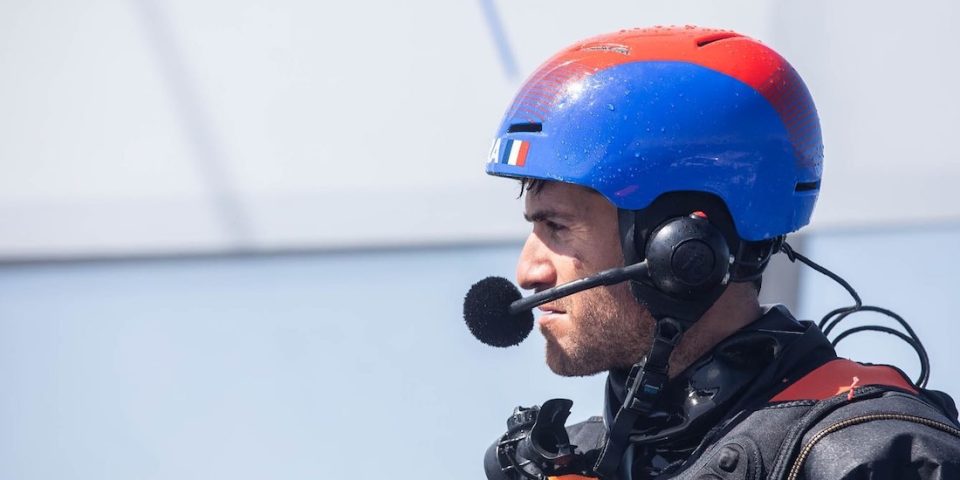
SailGP announced on Thursday the transfer of Kévin Péponnet, who is leaving the French team to join Germany SailGP Team, led by Erik Heil, still as wing trimmer. An opportunity for Sailorz to speak with the 34-year-old sailor.
Can you explain how this transfer came about?
It happened during the season when the management of SailGP France announced to me that my contract would not be renewed. Throughout the end of the season, a transfer window opened following the arrival of a new team, Artemis, which, rather than relying on new sailors, preferred to pick up experienced crew members already on the circuit from other teams. This triggered a game of musical chairs, and teams began looking for wing trimmers, notably the Germans, Brazilians, and Danes, who contacted me. Discussions went quite far with the Germans and Brazilians. I chose to respond favorably to the German proposal, a choice that is above all sporting, as it is a team that is in a great dynamic: if you consider the last four or five events of 2025, they are in the top 3. I didn’t want to leave the French team, but I tried to bounce back and I am very happy to have found a team that is hungry for success.
Was it a disappointment for you when you were told your contract would not be renewed? And what reasons were given?
They spoke to me about wanting change, about bringing a new breath of air (see the explanations below from Bruno Dubois), more than technical considerations. I understand that and I’m dealing with it. Now, it is naturally always delicate to leave a group you appreciate and friends. Especially Quentin (Delapierre), with whom we have shared a lot for over ten years. Our first regatta was the SB20 Worlds in 2014, then we did several Tours de France à la Voile; we’ve come a long way together. More broadly, I had been with the team for three years and things were going well; I have always sailed in my projects with people I had an affinity with. Now, I’m arriving in a German team where I don’t know many people; it’s going to be new.
“You can live
just on SailGP”
It has always existed, but given the growth of the league, with more and more money and investors, it has gained more importance and become more structured, with a new framework that was put in place this season, regulated loans, official transfers from team to team. It is getting closer to what is done in football or major leagues. This season, it mainly affects the wing trimmers, since almost half of them are changing teams this winter (see below), and also the flight controllers and grinders a bit, but less so the drivers.You talk about more money; does that mean that a sailor like you can now live 100% financially from the SailGP circuit?
Yes, since last season, you can live with this sole project. That was less the case in the first few years, and it is notably due to the fact that there are more and more events. Next year, we will have thirteen, with two or three Grand Prix events very close together at times; it’s almost a daily commitment. From the outside, you only see the Grand Prix events, but the work continues between events; it doesn’t leave much room for other projects. In 2024, we managed to do both SailGP and the America’s Cup; it’s not incompatible, but it is becoming increasingly complicated to combine the two.Would you give us an idea of the salary range on the circuit?
It’s a bit like football; there can be quite a few differences depending on the teams and profiles. Personally, among the offers I received, it ranged from single to double, I would say that the average salary would be 10,000 euros per month on an invoice basis. Now, it can go above that; I’ve heard rumors of new teams looking to attract experienced sailors with offers of 25,000-30,000 euros.
“Coaching, I would like that”
Maybe not 100%, but close. I could settle for SailGP, but I still want to invest myself in other projects, in foiling boats anyway, and I am fortunate that the Germans are very open to that. That could be a personal Moth program, or missions for ETF26 or TF35 teams; I am in discussion with some. For the Cup, I remain in contact with K-Challenge, but it won’t be a primary project, and not necessarily as a sailor. Coaching, for example, I would like that; I really enjoyed training the K-Challenge ETF26s at the end of the season; this type of mission could interest me.Can you tell us a word about the German team and its skipper Erik Heil?
He is a double Olympic medalist in 49er, which says a lot; he is brilliant, simple, and very sociable with the crew members; he likes to visit them during the year with his wife to connect the families. And he is very effective; the results speak for themselves: the Germans have only been on the circuit for two years and their progression is quite incredible, with two or three finals and a victory, which was not in their initial objectives. And from the little I have seen, since my contract started at the beginning of December, I am quite impressed by how they are structured and the quality of the work. My main challenge will be to integrate into the team as quickly as possible. Since communication is a key element on these boats where everything happens very quickly, my immediate goal is to work hard on my English; we have also started doing exercises simulating races to be able to deliver from the first Grand Prix in Perth.
Questioned about the non-renewal of Kévin Péponnet’s contract, Bruno Dubois, the manager of France SailGP, replied: “I think we were reaching the end of a cycle. Kévin and Quentin are more than friends, they are like brothers, they have been sailing together for a long time, but we felt that for him and Quentin to continue to progress, their paths perhaps needed to separate. Now, it is happening without animosity; we remain in contact with Kévin, who did a great job coaching in ETF26. We are discussing whether he can continue and join the K-Challenge Academy with a view to the Youth and Women’s America’s Cup.” The composition of the French SailGP team for the 2026 season will be unveiled next week.