
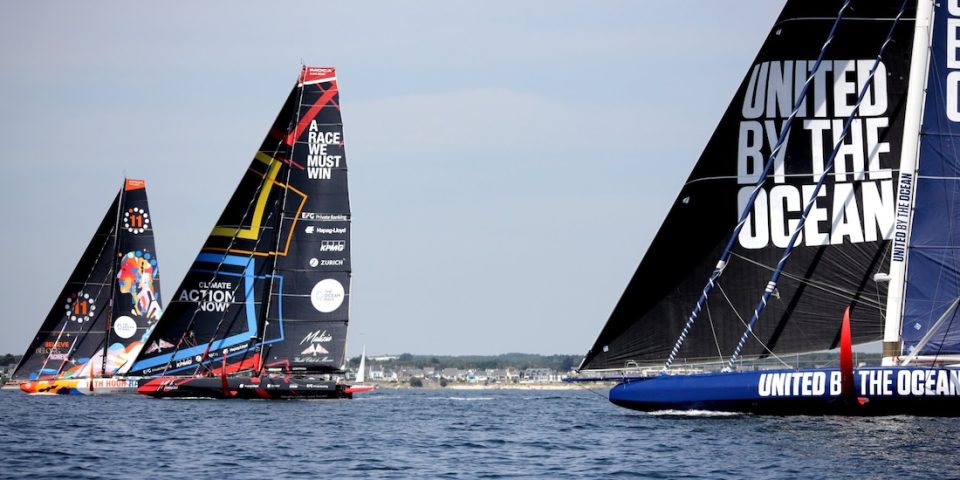
Six mixed crews will set off on Tuesday 1 September from New York for the inaugural edition of The Ocean Race Atlantic to Lorient. From organisation to sporting stakes, Sailorz takes a closer look at this new race in the Imoca Globe Series.
The origins of The Ocean Race Atlantic, announced in July 2024, lie in the FNOB’s (Fundació Navegació Oceànica de Barcelona) desire, after organising three editions of the Barcelona World Race (from 2007 to 2015), to bring back an Imoca race that took place in June 2014, ahead of the third and final Barcelona edition, the Imoca Ocean Masters New York to Barcelona Race. “They contacted us in 2024 to revive the concept,” confirms Johan Salén, co-director, alongside Richard Brisius, of The Ocean Race. There was a lot of interest from Barcelona, which was then about to host the America’s Cup.”
That interest did not last, however, as just over a year after the race was officially announced, Barcelona ultimately terminated the contract in September 2025. “It was essentially linked to a change of management at the FNOB; the new team didn’t want to continue,” continues Johan Salén. “We had other bids from Spain and Italy, but as we didn’t have much time to find an alternative, the most obvious solution was to reach an agreement with Lorient, where a lot of things were already in place. All the teams agreed, and we signed the contract last March.”
Caroline Olagne Vieille, former deputy director of the Initiatives Cœur team and elected last April as Lorient Agglomération’s councillor responsible for maritime affairs and boating, explains: “As Barcelona was unable to host the race, the organiser naturally turned to us. As Lorient wants to raise the profile of its territory internationally, this applies both to tourism and to our unique sailing ecosystem, so it came together without too much difficulty.”
A dress rehearsal
for The Ocean Race
In practical terms, unlike New York, which, as is the case throughout the United States, provides no funding – it actually costs around 500 euros per boat per day for a berth at Brooklyn Bridge Park Marina – the local authority has committed 200,000 euros through a service contract for an event which, according to Johan Salén, is based on a budget of “between 2 and 3 million euros, depending on what we include”. And it represents an investment for the organiser: “We had some funding from Barcelona, we have a few partners, and we are also drawing on reserves we had built up, because we really wanted to test this concept for the future.“
The Ocean Race Atlantic will also be a dress rehearsal for the round-the-world edition of The Ocean Race, which will start from Alicante in January 2027. “We’re going to test both our organising team, which numbers around 50 people, and a system of fixed cameras connected to Starlink to produce live broadcasts,” says the race co-director.
As for the fleet, six crews of four sailors (plus one onboard reporter) will start from New York on Tuesday, a relatively small field which leads Johan Salén to say: “We would have liked to have two or three more; the current environment isn’t easy for finding partners, and many Imoca teams are very focused on the Route du Rhum.”
The president of the Imoca Class, Antoine Mermod, nevertheless believes the two objectives were compatible: “Crossing the North Atlantic, presumably at high speed downwind, is an excellent dress rehearsal for the Route du Rhum, which will be a sprint. Some teams are still worried about breaking something before the main objective of the season, though; doing two transatlantic races within eight weeks is not yet fully established practice. But for those taking part, in a period when there aren’t many other races, it’s a positive from a media perspective: they will have a good platform for telling their stories.”
Strict gender balance
And in particular, stories about gender balance: a pioneer in this area – it was the first organisation to require a woman on board for the 2017-2018 round-the-world race -, The Ocean Race has gone a step further this time, with crews that are 100% mixed – two men and two women. “It’s a strong commitment, a very tangible lever for opening offshore racing to women; we would all have dreamed of having this kind of opportunity when we started sailing,” says Caroline Olagne Vieille.
Already heavily committed to this approach during the last edition of the crewed round-the-world race aboard Biotherm, Paul Meilhat, who will start The Ocean Race Atlantic aboard the same boat, now renamed United by the Ocean, also welcomes the move, but is looking further ahead: “What will be interesting is to see whether, after this race, there will be more women sailors on board or mixed crews without it being compulsory.”
Francesca Clapcich, skipper of 11th Hour Racing Team, adds: “This rule is positive, even though it is almost a constraint for me, because when I was putting my crew together, I wanted more women; I was told that wasn’t possible and that it had to be 50/50! But it proves that there are now many highly talented female sailors with solid Imoca experience: none of the teams taking part will tell you they struggled to find them, the difficulty was more about choosing which ones. It really shows that the level among women is rising.”
Two much-anticipated new boats
The Ocean Race Atlantic should provide further evidence of this, with six boats on the start line, including two new boats, DMG Mori Global One (Verdier design) and Malizia 4 (Antoine Koch Océan design), launched on 30 June and 7 July respectively, with very different designs (see our article).
What are the first impressions from on board the two new Imocas? For Will Harris, who has just completed the delivery of Malizia 4 but will sail aboard 11th Hour Racing Team (ex-Malizia 3) in The Ocean Race Atlantic, they are extremely positive: “I think you can really call it a new generation, with boats that, once they are fully optimised, will be flying almost all the time. In just a few weeks, we’ve already found full-foiling modes at the helm, thanks to the rudder system similar to that of Charal, which provides a lot of stability, and the hull shape with the two chines, which help prevent the boat from diving under the waves, instead riding over them!” The Briton adds: “As the boat takes off earlier, the speed gains are significant. We’re still at the discovery stage, but reaching in good sea conditions, it is capable of going 40% faster than the Malizia 3 polars.”
What about DMG Mori Global One, with its very different concept and the famous bustle under the hull, a sort of central trimaran hull designed to reduce wetted surface area and allow the boat to bounce over the waves rather than bury its bow? “It seems to work very well once the boat gets up on its foils,” replies Nicolas Lunven, who is part of Kojiro Shiraishi’s crew. “It’s more complicated upwind and in light airs, because it adds wetted surface area and the boat has less righting moment than a conventional hull shape. But we’re only at the beginning, and we still have time to find the right way to use it. What will be really interesting is to go up against Malizia 4 or Paul’s boat (Meilhat), which is very versatile, and hopefully we’ll get some downwind conditions so we can really compare and confirm the boat’s strong potential in that mode.”
Four of the six boats taking part in the transatlantic race are currently officially entered for the round-the-world TOR – 11th Hour Racing Team is focused on the Vendée Globe and Conrad Colman’s project has not been confirmed -, including United by the Ocean, led by Paul Meilhat and Mariana Lobato, who have taken the risk of lining up for the Atlantic crossing. “We are not at all taking the same approach as we did for TOR Europe last year; that was the end of a cycle, so we were at maximum efficiency and the project had reached maturity. Here, we are starting a new one, with The Ocean Race in January as our goal,” explains Paul Meilhat. “So we don’t have the same level of technical preparation at all, and the same goes for the crew, but the most important thing for us was to be there; it’s a gamble. We want to show that we have a fantastic project to bring partners on board.”
Photo : Theophile Wannebroucq