Ultim: a flawless performance by SVR-Lazartigue
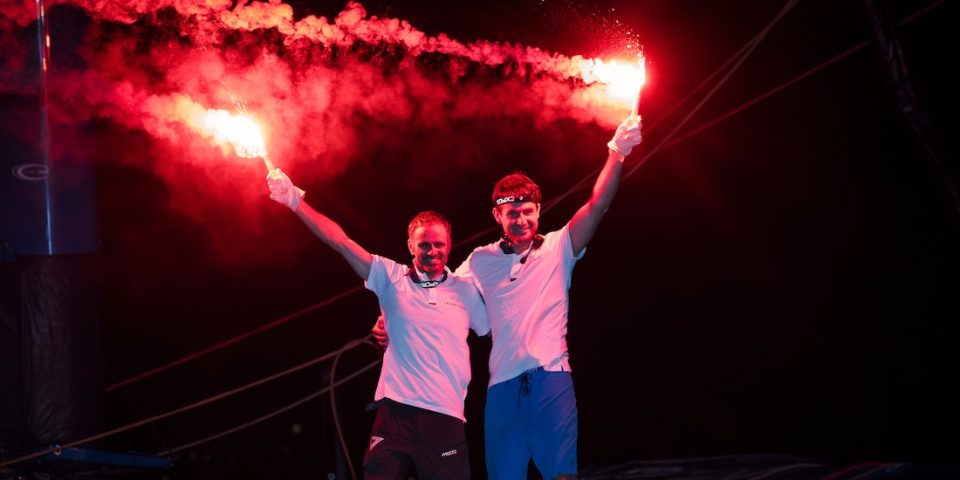
While some of our experts were not captivated by the Ultim race due to a fleet reduced to four boats and little suspense, they agree that the winner, SVR-Lazartigue, delivered a “remarkably clean copy, with the right tacks, the right speed, and the right choices right from the start,” summarizes Yves Le Blevec. The latter adds: “We can see that these boats take a long time to develop. SVR was launched in 2021, and after four years, they have achieved something finished. Their great asset is that they go very fast upwind—aero is quite fundamental—whereas downwind, there is much less difference between the boats.”While this victory seemed rather easy from the outside, Pierre-Marie Bourguinat is keen to point out: “Everything looks easy behind the tracker; the track is very beautiful, and it seems to unfold smoothly, but during the interviews, Franck Cammas insisted several times on the level of nervous tension that these boats generate, especially downwind in sustained trade winds. Benjamin Schwartz told me the same thing: they are right at the edge all the time.”
And Sodebo Ultim 3 ultimately finished only 4 and a half hours behind the winner, which leads the journalist to say: “They clearly made up some of their speed deficit compared to the others, but perhaps at the cost of a greater physical expenditure than SVR, which at certain moments, sailed with a touch more security. I think Thomas and Benjamin pushed very hard in terms of personal demands in multiplying maneuvers.”
What about Actual Ultim 4, which finished third? “We might have expected to see them a little further ahead, but I think Anthony (Marchand who took over the former Maxi Edmond de Rothschild last summer) and Julien still lack knowledge of the boat; they are in a learning phase.” Yves Le Blevec adds: “This is a boat that was extensively developed until the Route du Rhum 2022. Since then, it had been operated and maintained, but may be less optimized, because the Gitana Team was focused in the same time on the future Gitana 18. Meanwhile, the other teams did not wait for us. For the future, we have already ordered upgrades that you will see appearing during 2026, and we are working on the validation of what will be implemented in 2027—all of that takes time.”
Ocean Fifty: an “old school” podium
While the Transat Café L’Or had a rough start for the Ocean Fifty, with three capsizes on the first night, it captivated our experts, with an undecided battle right to the end and four boats finishing less than 45 minutes apart in Fort-de-France. The suspense for the victory might not have been so intense if Edenred (Basile Bourgnon/Emmanuel Le Roch) hadn’t suffered damage on Monday night that prevented it from using its large gennaker, essential in the trade winds, on one tack. “The boat is a little new (launched in July); things are bound to break. For me, it takes at least 12 to 18 months for an Ocean Fifty to truly reach maturity,” notes Matthieu Souben. “That’s part of the sport, but we still saw that Edenred had a speed advantage; when they wanted to accelerate, they quickly moved ahead,” adds Erwan Tabarly.At the finish, Viabilis Océans (Baptiste Hulin/Thomas Rouxel) won, 17 minutes ahead of Wewise (Pierre Quiroga/Gaston Morvan) and 27 minutes ahead of Le Rire Médecin-Lamotte (Luke Berry/Antoine Joubert), boats launched in 2017 for the first two (VPLP designs), and in 2009 for the third (Verdier design). “That means that the rules are well enough made that there is no arms race and that you can remain competitive on the scale of a transatlantic race with boats that are not the latest generation,” observes Matthieu Souben, winner on Luke Berry’s boat in 2021 (with Sébastien Rogues).
How did Viabilis Océans, which was trailing the leader by up to 200 miles at the start of the race following its pit stop in L’Aber Wrac’h (torn mainsail), manage to win? By benefiting from the fleet tightening around the Canaries, and then, according to Pierre-Marie Bourguinat, “by showing great speed qualities when the trade wind started to pick up; it was the one that best held the infernal pace of Edenred.”
“I think the fact of coming back into the pack, in terms of morale and tenacity, gave them a slight edge,” observes Matthieu Souben, who adds, regarding the final sprint, which saw Viabilis favor a more southerly route than its rivals: “My feeling is that there was always a gain for the one who was a little further south. In the end, they made a small final adjustment; I think they won on that, it allowed them to push ahead, they were incisive right to the end.” This victory rewards two discreet men, Baptiste Hulin and Thomas Rouxel, about whom Pierre-Marie Bourguinat says: “Baptiste is unknown to the general public, but he is starting to have solid offshore experience, as for Thomas, he is a very talented sailor, an excellent helmsman, who, coming from Ultim racing (he sailed several seasons on Sodebo Ultim 3) is used to these high-speed transatlantic races.”
Victory was very close for Wewise, which favorably impressed Dominic Vittet: “Pierre and Gaston used all their Figaro sailing know-how in the English Channel; it was magnificent. I think they made a blunder by sailing in the wind shadow of Lanzarote and between the Cape Verde islands, but for people who haven’t done that many transatlantic races, they showed exemplary maturity by taking the lead at one point.”
Imoca: Charal the strongest
Fourteen years after winning alongside Jean-Pierre Dick, Jérémie Beyou returns to victory in the double-handed transatlantic race, winning on an Imoca that impressed our experts. “They found something. Previously, Charal did not have this ease downwind in 20 knots; it is rare to be so radical in progress,” notes Yves Le Blevec. For Pierre-Marie Bourguinat, the Manuard design “has clearly gone up a gear; before, it was an intermediate boat, slower than Macif upwind in light airs and slower than the KFC (Koch Finot-Conq) in a downwind breeze; here, it found a compromise that was more effective than everyone else, by sailing lower faster.”Asked about this little extra something in last Tuesday’s Pos. Report, Nicolas Andrieu, technical director of BeYou Racing, replied: “It’s a combination of small things, knowing that everything we did this year in development was oriented towards this transatlantic race. Given the obligatory passage at the Canaries, we knew there would be a strong downwind component in medium wind, we worked for those conditions.”
“The little something extra might be Morgan,“ smiles Matthieu Souben about a sailor who wins the transatlantic race for the third time in a row in Imoca (the previous two with Thomas Ruyant). Erwan Tabarly agrees: “He is the person, along with Franck Cammas, you need to bring on board to win. It is an obsession for him to go faster than the boat next to him, and he steers superbly. In double-handed races, it really brings something to have a guy capable of making the boat go fast by spending hours at the helm.” And Erwan Tabarly adds, regarding Jérémie Beyou: “He has been chasing a major victory for a long time; he came close several times. This one will do him good, especially since it was clean and neat.”
While Charal was expected on the podium, the surprise comes from the second place of Francesca Clapcich, the first woman to make it onto the Imoca podium since Ellen MacArthur in 2005, and Will Harris. “When they passed the ridge at the Canaries, I told myself they had pulled off a nice move, but I expected them to be caught up on the crossing, and in fact, not at all. Apart from Charal, they managed to hold their own, especially against Macif which is still a benchmark,” admires Erwan Tabarly. Who adds: “Will knows the boat by heart, he has done all the sailing for the last two or three years, and the duo with Francesca seems to have worked well.”
Class40: north/south battle
While we know the winners for three of the four classes competing in the Transat Café L’Or, the suspense should last another good week for the Class40s. Having restarted last Saturday from La Coruña after a first leg won by SNSM Faites un don (Corentin Douguet/Axel Tréhin), the 40-footers split into two groups, “two rooms, two atmospheres,” smiles Yves Le Blevec. “It’s the real strategic choice of the transatlantic race,” observes Dominic Vittet, “with on one side a pack that positioned itself very quickly to stay on the orthodromy (the direct route) and face the storm to pass close to the Azores, before going to seek the north-westerly shift behind. On the other, the largest part of the fleet considered this route more complicated, because it involves upwind sailing and bad weather, so they preferred to go seek the downwind sailing to the south, but lengthening the route.”The northern group is led by SNSM Faites un don, the southern group by the second and third place finishers in La Coruña, Seafrigo-Sogestran (Guillaume Pirouelle/Cédric Chateau) and Amarris (Achille Nebout/Gildas Mahé), which makes this strategic battle all the more interesting. Which camp might it favor? “For the moment, we don’t know and it could last a while,“ replies Dominic Vittet. “The question is when those in the north will be able to cross south. Will the anticyclonic bubble shift eastward and allow them to find a loophole to take advantage of the western edge of the high pressure and plunge down? That is the uncertainty.”
Photo : Jean-Marie Liot / Alea