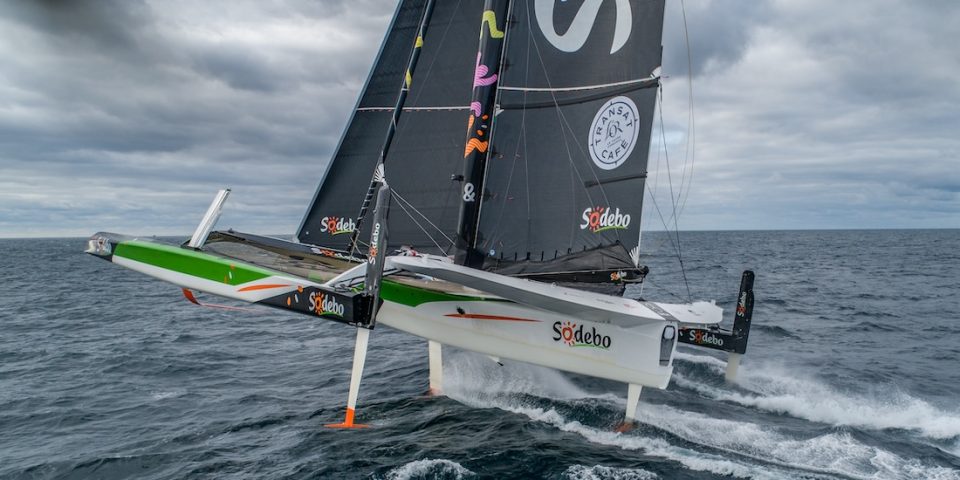
Confronted with particularly heavy conditions as it approaches Cape Finisterre at the very end of its journey, Sodebo Ultim 3 remains well-positioned to claim the Jules Verne Trophy this weekend and break Idec Sport‘s record (40 days 23 hours and 30 minutes in 2017), which will happen if it crosses the line before Sunday, 8:31 PM. Sailorz asked two former Jules Verne holders, Franck Cammas (2010) and Loïck Peyron (2012), and two Ultim skippers, Tom Laperche and Armel Le Cléac’h, about the performance of Thomas Coville and his six crew members.
Saving the toughest for last! Having crossed back into the Northern Hemisphere on Monday with a lead of just over 20 hours on Idec Sport‘s pace from nine years ago, the crew of Sodebo Ultim 3 is about to experience what will likely be the most difficult hours of their world tour from Friday to Saturday. If they want to break the record, they have no choice but to deal with Storm Ingrid, featuring forecast winds of 40 knots (gusting to 50) and 10-meter swells.
Understandably, the experts interviewed by Sailorz remain cautious when discussing the record, even if they obviously hope Sodebo Ultim 3 navigates this final hurdle to cut the line off Ushant, likely on the night of Saturday to Sunday. Regardless, they are already hailing the overall performance and specifically that of skipper Thomas Coville. Having already held the trophy in 1997 (with Olivier de Kersauson) and 2010 (with Franck Cammas), he could claim the Jules Verne for a third time—a feat achieved only by Bruno Peyron (the only one to do so as skipper each time), Florent Chastel, and Ronan Le Goff.
“It’s beautiful management,” admires Loïck Peyron, himself a Jules Verne winner in 2012 at the helm of Banque Populaire V. “Thomas knows the game; he does his job so well it looks easy. It’s like watching Federer play; you feel like you could do the same, but no, it’s reserved for an elite. Only a few people on the planet are capable of doing this—it’s beautiful.” Tom Laperche, who unsuccessfully tackled the Jules Verne last winter aboard SVR-Lazartigue, praises Coville’s “perseverance“ after several failed attempts, including two interrupted in the Indian Ocean (winters 2020/2021 and 2024/2025): “This Trophy has driven their winters for several years; it’s a great reward for their commitment and tenacity.”
“Thomas shows
great resilience”
Armel Le Cléac’h, who plans to set off at the end of the year at the helm of Banque Populaire XI, agrees: “Thomas shows great resilience. Despite the setbacks and occasionally some criticism, he believed until the end—it’s part of his DNA. It’s a similar approach to when he broke the solo record; it took time, but he got there through sheer willpower and guts. He is 57; he won’t have dozens more opportunities. I’ll be very happy if he makes it this year; it’s deserved, for him and his entire team. They managed to improve their boat, which perhaps wasn’t initially up to their expectations, but they succeeded in fixing its weak points. They are following up a great second place in the Café L’Or with this Jules Verne.”
Franck Cammas, who held the Jules Verne in 2010 on Groupama 3 (with Thomas Coville on board) and co-skippered with Tom Laperche on the Transat Café L’Or 2025 (which they won), notes that “it was very courageous and ambitious to leave right after the Transat, which was very intense, but fortune favors the bold.” He adds: “We’ve been saying for a few years that if a ‘flying’ boat finished the world tour, there was a good chance of breaking the record. I am personally happy that an Ultim is finally proving it, but it isn’t easy, because reliability at these speeds is harder to maintain.”
Regarding reliability, Cammas praises the Sodebo team’s work: “Clearly, the boat is finishing in good condition; they still had very good upwind/reaching speeds in the trade winds. That means everything is running smoothly and there is not too much degradation on the appendages, which is a feat over 40 days for these boats.” Armel Le Cléac’h concurs: “Their biggest problem was the broken J0 tack, but it didn’t slow them down. They also had a few non-serious collisions with UFOs (Unidentified Floating Objects). They are finishing with appendages that look to be in very good condition—a key element to keeping the boat’s potential near its maximum.”
“A superb departure window”
Do our experts believe Sodebo Ultim 3 benefited from good weather? “They managed to seize a superb departure window; their descent of the North Atlantic was remarkable, with an almost straight track at very high speed. It will be hard to do much better than their record on that leg (4 days 4 hours 2 minutes),” notes Tom Laperche. The South Atlantic, however, was not as clear-cut (third fastest time in history), which didn’t stop the “Sodeboys” from holding a lead of 1 day and 19 hours over Idec Sport‘s pace at the Cape of Good Hope. This leads Le Cléac’h to say: “They were smart to leave very quickly during their standby, even though there was quite a bit of uncertainty in the South Atlantic. Today, Ultims can go very fast in transitions and in tight winds; that allows you to look for windows that are a bit less ideal on paper. We will try to have that same vision of accepting a window that might improve as you advance.”
The Indian Ocean was more complicated for Sodebo Ultim 3. To stay in the match against Idec Sport—which had a straight trajectory that is difficult to match—they had to head very far south, even encountering growlers. “It’s never pleasant to leave ice to port, but it was a necessity to shorten the route as much as possible; it was a risk they had to take,” explains Franck Cammas. Coville’s crew lost nearly a day and a half compared to Idec Sport between Good Hope and Cape Leeuwin.
“They had a mediocre Indian Ocean with a front blocking them; they were in a bad wind sector, south-westerly, chasing a depression rather than escaping ahead of it,” continues Cammas. “In the Indian Ocean, the problem is no longer the speed of the boats, but the speed at which the depressions move; the two have to match up well. The ideal scenario arriving at Good Hope is to be followed by a depression moving at 35-40 knots, because Ultims are capable of maintaining that pace.”
“A way to shave off
hours here and there”
According to our observers, the rest of the course went better, aside from “an upwind passage of the Horn” (Franck Cammas), a climb up the South Atlantic “where they took a detour after the Horn” (Armel Le Cléac’h), and this final stretch in very strong winds and seas. At the finish, Sodebo Ultim 3 will have actually sailed about 2,000 miles more than Idec Sport. This leads Cammas to conclude: “There is a real difference in average speeds; Sodebo was consistently above 32 or 33 knots until Cape Horn, which was quite impressive. They set the bar very high in how they pushed the boat; there weren’t many moments where it felt like they were backing off.” Tom Laperche adds: “Hats off to the crew, because sailing at high speed for so long in demanding conditions and a cramped environment inevitably generates stress.”
If the record falls this Saturday or Sunday, can it be beaten again soon, perhaps as early as the 2026-2027 winter? “It will require perfect weather,” estimates Loïck Peyron. “It’s been nine years since Francis broke the record, and how many unsuccessful attempts have there been since from Sodebo and others? (Nearly ten) It’s proof that it’s really not an easy record and, for me, it will become increasingly difficult because of the weather.”
Armel Le Cléac’h is more optimistic: “The performance is beautiful, with incredible legs that will be hard to match, but others that can be improved in terms of time. I think there is a way to shave off hours here and there.” See you in a year.
Image : Jérémie Lecaudey