
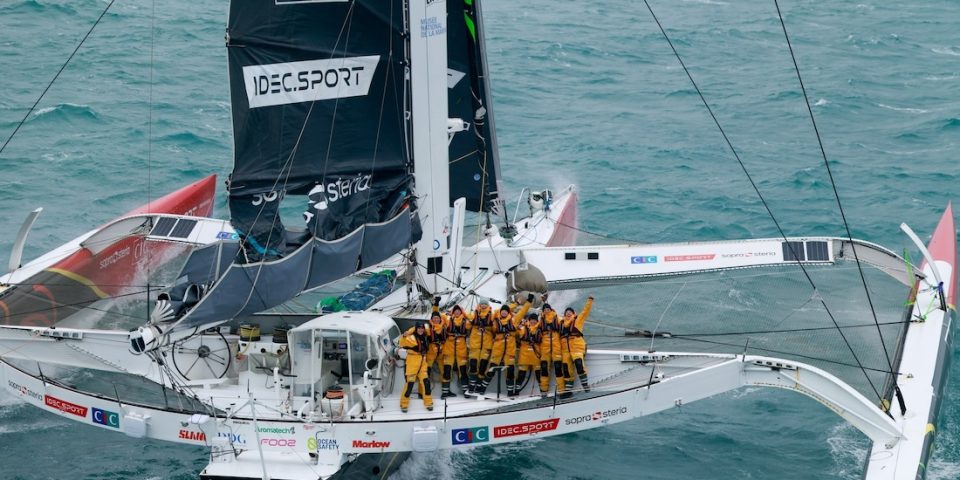
Idec Sport, led by Alexia Barrier and her seven female crew members, completed its world tour on Monday, January 26 at 12 PM, in 57 days, 21 hours, and 20 minutes. To measure the impact of this historic first for an all-female crew, Sailorz interviewed several female sailors, all of whom were unanimous in praising The Famous Project CIC.
57 days, 21 hours, and 20 minutes: this is now the reference time for the Jules Verne Trophy for a 100% female crew—specifically that of Idec Sport, “forever the first,” to borrow a phrase popularized in French football. This milestone could have been achieved 28 years earlier if Tracy Edwards and her Royal Sun Alliance crew had finished their 1998 attempt, which was unfortunately cut short by a dismasting 2,000 miles off the Chilean coast after 43 days at sea.
On board back then was a certain Samantha Davies, only 23 at the time, who comments today: “It’s incredible that it took so long to put a project like this together again, but it’s great for women’s sailing that Alexia dared to take it on, especially since it wasn’t easy to finalize, particularly from a budgetary standpoint. It probably wasn’t the project she initially dreamed of—she would have wanted much more preparation time before leaving—but her talent lay in not giving up; she never let go.”
This tenacity from the Mediterranean skipper leads Anne-Claire Le Berre—who, along with Audrey Ogereau, will be the first woman to compete in an Ocean Fifty in the Route du Rhum-Destination Guadeloupe later this year—to say: “It’s beautiful to think they managed to find the budget, the boat, and the crew to complete this world tour. They have broken down new barriers and opened a new chapter. Even if we are first and foremost athletes setting performance goals, this is what we all try to do in the background of our projects.”
“An enormous feat
to have made it around”
One of the very few women to have sailed an Ultim to date—on Actual Ultim 3 and then SVR Lazartigue—Amélie Grassi emphasizes: “Many people dream of setting off on the Jules Verne; these are very difficult projects to bring to fruition, so I am incredibly respectful of the fact that they managed to be on the starting line. Additionally, Alexia set the challenge of doing it with a female crew, which was far from obvious. Even though offshore racing is becoming more democratic and there are more and more women, we remain underrepresented on the various circuits, and even more so on multihulls. She combined girls who had already done world tours with others who had little offshore experience; under these conditions, with such a small budget, it is an enormous feat to have made it around.”
For Charlotte Yven, both the first female Elite French Offshore Racing Champion and a Solitaire du Figaro podium finisher (second in the last edition), “They took on the challenge of doing something that had never been accomplished before; it’s a door opening and it’s very inspiring. It reminds me a bit of when I followed Sam Davies’ Vendée Globe on Roxy (in 2008, when she was just 12). I was a huge fan; I watched all the videos and had a bus-shelter-sized poster that totally covered one wall of my room. What she projected, but also her performance, inspired me a lot. I was doing Optimist racing then, and I told myself it would be truly amazing to sail a big boat one day like she did.”
This inspirational aspect is also highlighted by Victoria Low, Managing Director of The Magenta Project, a program designed to provide opportunities for women to reach the elite level. “This accomplishment is both awe-inspiring and a significant milestone for women in sailing. It is a key moment in the sport’s history and a reference point that will stand going forward. Importantly, the value of the achievement is not defined by the time recorded, but by completing the challenge itself.”
“A very good thing to establish
a first female reference time”
Regarding the time—which could have approached 50 days if not for a complicated finish involving a torn mainsail and waiting out Storm Ingrid—Amélie Grassi is keen to set the record straight: “I heard some rather negative comments about the fact that they did it in ‘cruising mode,’ but I don’t think you can ‘cruise’ for 57 days on a giant trimaran! OK, they took many more days than the record, but there aren’t many people today who have completed the Jules Verne in under 57 days. It’s hyper-inspiring; it opens a path.”
For Italian-American Francesca Clapcich, who came second in the last Transat Café L’Or in Imoca (with Will Harris) on 11th Hour Racing, “they showed incredible resiliance especially in all the technical issues they faced. Most of other teams would have probably give up and turn around and they pushed till the end to make history. It’s an important milestone for women in the sport and showing what we can do in a sport that is still quite male dominated and where there is a lack in sponsorship for high performance women.”
Chloé Le Bars, who succeeds Charlotte Yven this year in the Figaro circuit under the Skipper Macif program, adds: “They encountered quite a few technical problems and didn’t have the newest equipment, but the fact that they reached the end shows that female sailors absolutely have the skills to sail multihulls around the world. It’s a very good thing to establish a first female reference time; I hope it will make other female sailors want to go into multihulls.”
“Even if the time is far from the record, it allowed for communication on the fact that it is possible for women to do a crewed world tour. And since the time is beatable, I think it can make others want to launch into the same type of project,” explains Caroline Boule, skipper of the foiling Mini 6.50 Nicomatic-Petit Bateau. “Personally, I would dream of buying Actual Ultim 3 and launching a project like that; it would be the ultimate dream!“
“Alexia offered a golden opportunity
to her crew members”
For our interviewees, one of the great virtues of The Famous Project CIC is that it allowed eight women to prove themselves around the world on a multihull—previously, only Ellen MacArthur (solo), Adrienne Cahalan (with Steve Fossett) Dona Bertarelli (aboard Spindrift 2) had completed this course. This significantly expands the “pool” of female sailors with this experience. “Once you’ve done that, you enter the very short list of female sailors who check this box, which until now could be counted on the fingers of one hand. Now, we’ve just added a whole lot more,” smiles Amélie Grassi. “Even if we are generally well-received, sometimes you have to elbow your way in to find opportunities in a field that remains very masculine. Here, Alexia offered a golden opportunity to all her crew members.”
“It reminds me a bit of our Volvo Ocean Race with Team SCA (2014-15),” adds Sam Davies. “It had been twelve years since there were women in the Volvo; we had great female sailors, but we didn’t have the experience of that race. Bringing that project to completion opened many opportunities afterward for all the girls.” For Caroline Boule, the eight crew members of The Famous Project CIC “now have this business card; they have proved they have their place on a multihull.” This leads Anne-Claire Le Berre to say: “True success for inclusion is when men call on women more for their skills than for a question of gender, and I hope Thomas Coville will take some women on board next time.”
Sam Davies adds: “I also hope The Famous Project will show sponsors that supporting female and mixed crews is worthwhile and that it will allow Alexia to continue and improve this record further.” This wish is shared by the “pioneer” Tracy Edwards, the first woman to assemble an all-female crew for the Whitbread 1989-90, and then nine years later on a multihull: “It is such a shame they didn’t have the budget to turn back when they knew they were so far behind the record time, repair and start again as other projects have done. I sincerely hope they find the budget to mount a serious attempt at the overall record.” Amélie Grassi agrees: “The ideal would be natural diversity, but seeing what they did, we would also love to see a female crew with a real budget and a recent boat be able to beat the record.”
The Famous Project CIC was also hailed by many male skippers, such as Benjamin Schwartz, a new holder of the Jules Verne Trophy with the Sodebo Ultim 3 crew, interviewed last Tuesday in our podcast Pos. Report: “We marked a new page in sailing history, but so did they, with a project that came together very late and a crew that didn’t have experience with giant multihulls. They finished this Jules Verne Trophy in a very honorable time; I hope this will launch a dynamic so that a female crew can set off to conquer the record.”
Contacted by Sailorz, Paul Meilhat, who has opened his Biotherm Imoca project to female sailors in recent seasons (Amélie Grassi, Mariana Lobato, Marie Riou…), commented: “It remains an incredible performance; we must not undervalue a world tour in an Ultim in 57 days, especially in the face of adversity, with little budget and training. What I find unfortunate—and I absolutely don’t blame them—is that there were no girls on Sodebo, given that it’s been over ten years now that mixed crews have existed and we’ve seen that it works very well.”
Image : Lloyd/Jean-Marie Liot Images/CIC