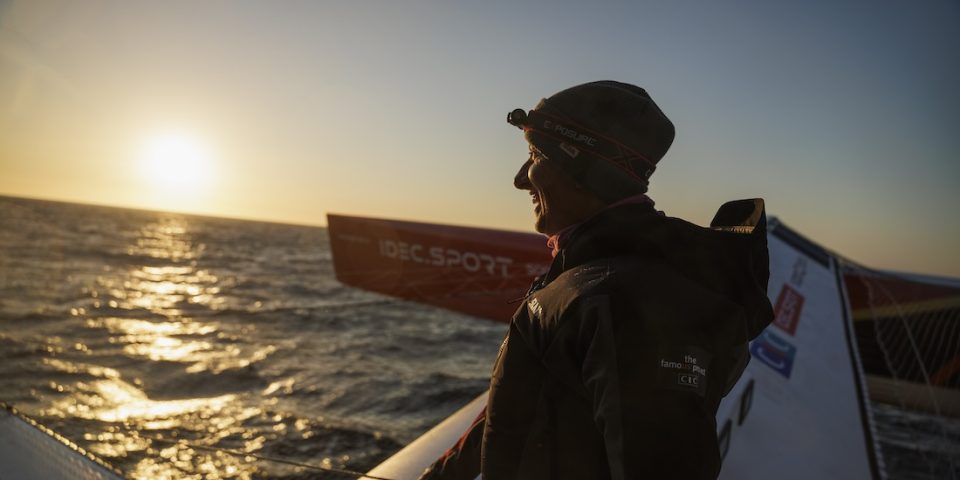
The eight-female crew of Idec Sport, led by Alexia Barrier, set sail at 2.40pm on Saturday 29 November for their first attempt at the Jules Verne Trophy as part of The Famous Project CIC, with the aim of setting a women’s record time. Sailorz spoke with the boat’s co-skipper, experienced British sailor Dee Caffari (42), who has six circumnavigations under her belt, on Friday morning as Idec Sport entered the Doldrums.
Tell us what was the weather window that was decisive in terms of leaving?
At the beginning of the week, leaving on the 29th was a 20% chance. Then it went to 25%. And we’d had several other weather windows open and close. So we were all kind of a bit relaxed and chilled out by it, but still saying to ourselves ‘okay, we’ll be ready for it’. And then suddenly 50% turned into 75%. And then Thursday, we knew we were going to make the decision which was confirmed when we had the weather briefing with Christian [Dumard, the shore-based router, editor’s note].
What was the key factor?
There were two issues that made us hesitate: first, the sea state, which was heinous to start with, and the risk of getting caught in a ridge at Cape Finisterre. In fact, it turned out that the sea wasn’t so bad. So we were like, ‘okay, well, we’ll go and try it,’ knowing that Finisterre was the key feature. In the end, we managed to sail down the Portuguese coast and we didn’t get caught till the end of that coastline, it was still actually opening up ahead and was not so bad. So it was ‘okay, well, we haven’t been caught and we’re still going.’
You’re averaging about 500 miles a day, are you satisfied?
We even did a 600-mile day [620, editor’s note], which was a bit annoying, really, because it should have been faster, but we had to keep slowing down for different things. So we know there’s definitely more in the tank. For now, it is good, I feel like it’s almost taken us this North Atlantic to settle in and lean our marks, which is understandable. We had a slowdown day, which was super frustrating to get through a ridge and a front. We were kind of really struggling to get across it. So we stayed in there a bit longer than we needed to. But in the end, I think it was a good time because I think the emotion of leaving surprised a few people. It was definitely more emotional than I thought it was going to be. And by then people were tired and hadn’t really eaten or slept. So actually, that period where we were slowed allowed everyone to kind of get on top of that again. And we practised a few things with the pilot and stuff so that we all became a bit more confident and competent at what we were doing as well, which is good.
“It would be great to have a South Atlantic
like on the Vendée.”
I think for me, it’s delivered what I thought it would be. And it is amazing how quickly you get used to going everywhere out between 25 and 30 knots. And when you’re not, you feel super slow. But what is funny is the resilience needed mentally to see the miles lost from IDEC’s record pace when she got the record [40 days, 23 hours and 30 minutes, in January 2017, editor’s note], but you also know that it can come back just as easily. For example, we were 800 miles behind and on Friday we were only 400 miles behind.You’re watching IDEC’s record pace all the time, are you?
It’s hard not to. And especially when we saw him slow down at the Doldrums we were like, ‘this is our time’. And we thought we were going to have a tricky night last night, but it hasn’t materialised. And we’ve probably got another 300 miles to get out of this active area. You know, we could get easily caught. So everyone’s like the focus is on to keep the miles ticking down while we still got some speed.How is the South Atlantic looking?
A couple of days ago, it looked really miserable, as in, you know, we were like beach hopping along Brazil, which is never what you want. But it’s changing. It’s very fluid and very dynamic at the moment. Even the doldrums have been very dynamic. There’s a lot of disturbance, but there is no need to go all the way west. So our trajectory out of them should be quite a nice angle. Now we are busy looking at what’s coming out of Brazil. You know, imagine if we had a Vendée situation like they had in the last edition. If we got that nice train ride and cut in the corner of the Atlantic. It’d be great.
“Alexia is relaxing”
Oh, my God. Yes, she is relaxing for her because she hasn’t got to deal with all the stress and the phone calls and the emails and partners, funding, and overall project management. Now Alexia can just do what she wanted to do. But also for her is remembering she’s not a solo effort, she can rely on the team and, you know, not have to do everything herself. It’s really nice, like, letting her see that side of, ‘oh, there’s all of us doing this’. This is great.Is part of the good atmosphere on board due to the fact that it’s an all-female project and you’re not racing but trying to get a record?
Truthfully I don’t know whether gender’s made any difference. My experience now says that the atmosphere you create as a leader is really important. And Alexia and I are very similar and on the same page with this. And we’ve tried to create this environment where each individual has got an area of responsibility. So it doesn’t mean that they have to know everything, but it means that they’re responsible for it and they can ask for help. And, you know, I’m not micromanaging them. I’m just empowering them and then checking in and making sure all’s okay. And because of that, everyone’s quite collaborative. And I think that’s been a real strength and allowed some of the later members into the team to catch up quickly.