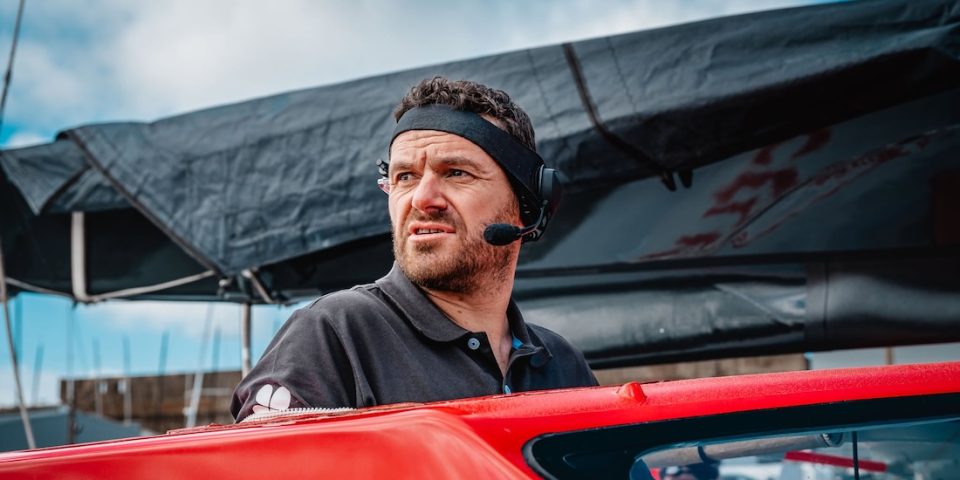
Back on Friday morning from 48 hours of training with the Finistère offshore racing hub in Port-la-Forêt, Anthony Marchand (41) immediately headed to Laval to celebrate the 35th anniversary of his sponsor, Actual. In between and ahead of the 24h Ultim, an event bringing together four Ultims and 11 Ocean Fiftys from 23 to 27 September in Lorient, the skipper of Actual Ultim 4 took the time to discuss his main objective of the season, the Route du Rhum-Destination Guadeloupe.
Let’s go back a little: can you tell us about the modifications you made last winter to the former Gitana 17, which you took delivery of in summer 2025?
We got our hands on a really great machine, and it was already a big performance step up from the previous boat [Actual Ultim 3, now Armand Thiery for Louis Burton, Ed.], but when we relaunched her, she had a repaired and sleeved mast following the dismasting it had suffered. So even before sailing the boat, we decided to commission a new mast, especially as construction takes a long time, around a year. And if we were going to have a new one, we thought it would be a shame to build an identical one. Our discussions with Gitana Team, with whom the handover went very smoothly, and with Julien [Villion, Anthony Marchand’s co-skipper on the 2025 Transat Café L’Or, who sailed the boat extensively with Gitana Team, Ed.], confirmed our decision to go for a taller mast, at the maximum permitted height, and also to revise the sail plan.
Concretely, what does this new mast bring compared with the previous one?
The aim of a taller mast is to take off earlier, but also, thanks in particular to a specific lay-up, to bend the mast much more. This allows us to remove much more volume from the mainsail and, at the same sail area, flatten it more. So we don’t have to reef as early and can play much more with the volume and shape of the sails. Until now, we couldn’t really play around with our wing masts, which are a bit like huge street lamps. With this development, which we also see on the new Gitana with its spreaders, we can make much more proactive adjustments.
And does that have an impact on the sail inventory?
Yes, inevitably, the forestay angles are different, so the sails are too. With this new sail inventory, we chose to have the mainsail, J3 and J2 all at the same sail area, which works very well for us. We also have a close-reaching J1 that can be adjusted on the tweaker and also works very well downwind, plus a large gennaker. We’ve tried to make it as big as possible for now, and it’s easy to reduce if necessary. We’ve also done a lot of work with Pixel sur Mer on Lidar (sensors), which allows us to see the shape of the sails in three dimensions and get instant measurements of camber, draft and volume. This means we can communicate much more effectively about sail shapes with the North Sails sailmakers and the design office, using data rather than gut feeling.
“Pascal Bidégorry
leaves nothing unchecked”
Are the gains from these modifications significant? Can you put figures on them?
No figures yet, but by feel and from some of the data, we can see that it’s faster, particularly upwind and downwind when it starts to take off, in the 13-16-knot range. We’ve improved in the conditions where we were weaker, and it hasn’t cost us anything in the others. We’re happy with the changes, and we also know that our competitors are progressing in the same way. Some have new rudders or foils; they haven’t stood still over the past year either. I do think that downwind at VMG, all the Ultims have much more similar speeds, with the differences mainly coming from the settings, regardless of hull shapes and architecture. Upwind, on the other hand, if you don’t have, for example, foils that reach far outboard, you’ll have less RM (righting moment), whatever the shape of the boat.
For your specific preparation for the Rhum, have you brought in any outside expertise?
Yes, a young guy, Pascal Bidégorry (smiles). When I was a kid and starting out in offshore racing, he was one of my idols. He has extensive multihull knowledge, is extremely meticulous and uncompromising when it comes to settings and sails, he leaves nothing unchecked. I have a lot of respect for him, we get on very well, and it’s great to have him in the team. With him and Alan Roberts, we make a very good performance team when it comes to data analysis, discussions with the design office and sailing. And I also have Ronan Treussart in the sailing role, liaising with the technical team. The three of them are with us 24/7 and are helping me prepare for the Rhum as well as possible.
What are you expecting from the 24h Ultim next week?
A battle, and for all four of us to start and all four of us to finish. After that, I’m not putting any more pressure on myself than necessary. There naturally is some because it’s a race, there are competitors and I want to do well, but I don’t tell myself that winning the 24h Ultim is essential; instead, it’s essential to race it flat out with the Route du Rhum in mind.
“The Jules Verne? We’ll decide
when we finish the Rhum”
How do you see yourself compared with your competitors, particularly SVR Lazartigue, Banque Populaire and Sodebo Ultim 3? Do you think you’ll start the Route du Rhum in a month and a half with the same chances of a podium finish, or even victory, as them?
With better chances than with the old boat, that’s for sure. In any case, the boat now has the speed to allow us to say that we have the tools to stay with the pack. We know we’re better downwind than some and slightly weaker upwind, which we’re trying to make up for with the taller mast. For now, a podium finish in the Route du Rhum would already be a great reward.
A quick word on Gitana 18, which will line up in Saint-Malo without any prior head-to-head racing against you: what’s your view of the boat?
I think that in certain conditions, it’s going to be very, very fast and it’s going to be mind-blowing; it will reset the benchmark and make every team’s design office rethink things. On the other hand, having such a boat reliable enough for the Route du Rhum is a huge challenge. When you see how long it takes to make a new component on Actual Ultim 4 reliable and feel confident with it, here it’s the whole boat that has to be made reliable: the systems, foils, rudders… It must be incredibly stimulating, but for the Route du Rhum, it’s certainly a different challenge from ours. In any case, what we’ve seen so far is magnificent.
You’ll be racing your first Rhum at 41. What does that mean to you?
You could say it’s taken a while, but it was never an objective in itself. My goal was more, for example, to sail an IMOCA; in any case, I don’t even know if I could have imagined racing the Route du Rhum in the Ultim class; it’s even beyond the dream. When I was younger and watched them setting off in ORMA, I used to think “It must be crazy to set off on a multihull in the Rhum like that”, and now I’m doing it in an Ultim. It’s just fantastic! I realise how lucky I am, and that’s why I want to give myself every possible advantage; between the team and Actual, everyone deserves us to have a great Rhum.
Will there be a Jules Verne Trophy option afterwards?
We’re preparing for it; it’s a great challenge, something that’s been on our minds, and we’ll see if there is a window. We’ll make the decision with Actual once we finish the Rhum, based on a lot of factors: the condition of the boat, next year’s calendar…
Photo : ATM Communication