
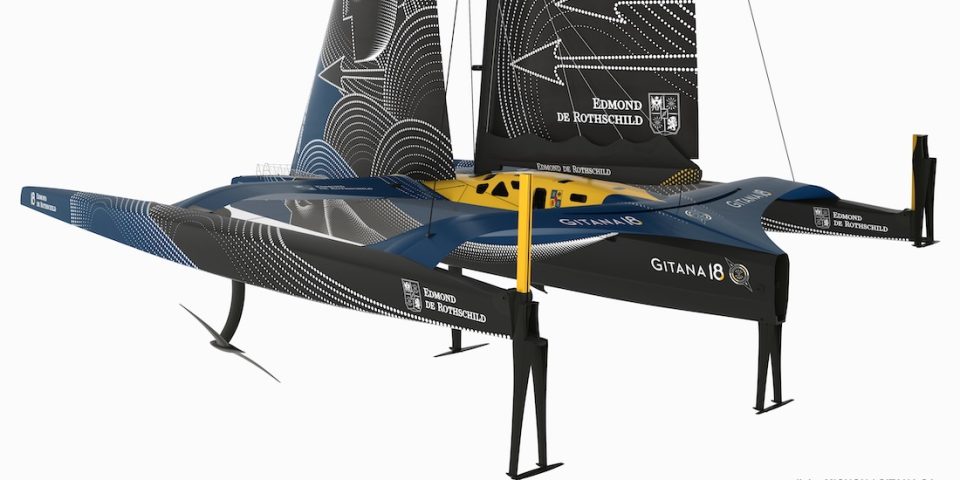
Highly anticipated, the new Gitana 18, designed by Guillaume Verdier with the Gitana Team, was unveiled on Wednesday in Lorient. Sailorz was present and introduces you to the main innovations of Charles Caudrelier’s Ultim.
It was at the Lorient premises of a fully assembled Gitana Team that the latest Ultim, Gitana 18, was unveiled late on Wednesday, December 3. Ariane de Rothschild, who founded the offshore racing stable with her husband Benjamin (who died in 2021), opened the evening by recalling the reasons that led to the launch of this new boat. “Gitana 17 had reached maturity, so we asked ourselves whether to continue with fully feasible improvements or, once again, to take the risk of moving towards something very radical, knowing that we had a very strong conviction that we could go even faster and further.”
For skipper Charles Caudrelier, who joined the Gitana Team in 2019, the challenge was clear: “Gitana 17 flew well, but as soon as there was swell, we had a lot of trouble stabilizing the flight, which lowered the average speeds. In waves over 1.5-2 meters, we lost 4-5 knots of speed, so we looked for solutions to fly better in the sea and take off earlier.”
The reflection, led with Guillaume Verdier, was notably fueled by the simulator developed by Team New Zealand and used by the architect, which allowed, according to Erwan Israël, one of the pillars of the Gitana Team, “to test all the ideas; we notably did a lot of fluidic studies on the hulls to really accurately reproduce the behavior in the waves.” All this work resulted in Gitana 18 which, according to the team’s general manager, Cyril Dardashti, required “12 months of studies, 24 months, and 200,000 hours of construction, with 200 people involved across the globe.” Particularly in Lorient at CDK Technologies, which, according to its general manager Stéphane Digard, constructed “80% of the boat’s parts in an autoclave, which had never been achieved before.”
After this preliminary presentation, Gitana 18 was finally unveiled, with a film presenting its main innovations and its decoration, the work of artists Florian and Michaël Quistrebert, followed by comments on stage from Charles Caudrelier, Guillaume Verdier, Pierre Tissier, and Sébastien Sainson — the latter two being the technical director and head of the Gitana Team’s design office, respectively. And to go further, a series of workshops were organized immediately afterward, aimed at delving into the details of a new Ultim that, like its predecessor, intends to leave its mark on its era.
A mast with dynamic spreaders,
a lowered cockpit
For maneuvering, Charles Caudrelier has two small winches and two larger ones, plus two pedestal grinders, one of which will be used to supply oil (100 liters in total) to the customized hydraulic cylinders – 44 in number (compared to 18 on Gitana 17). These actuate the mast tilt, the raising/lowering of the foils and rudders, the flaps on the rudders, daggerboard, and foils, as well as the mainsail sheet and the cunningham. The smallest (700 grams) can push one ton, the largest, weighing over 40 kilos, pushes 28 tons for the mast tilt.
10-11 knots of wind to take off
At the risk of exceeding the maximum width allowed by the Ultim class rule? “We managed to push to the limit, which gives us more power, but we remain within the class rule,” assures Charles Caudrelier. Another new feature is that these foils are equipped with two dissociated flaps, “one that generates anti-leeway force, the other lift,” specifies An Bertrand. Guillaume Verdier estimates that these new foils, although heavier — Gitana 18 weighs in at 19.5 tonnes on the scale, 4 more than G17 at its launch in 2017 — should allow “a substantial gain in flight stability downwind in rough seas.” But also enable Gitana 18 to take off “starting from 10-11 knots of wind,” according to Charles Caudrelier, who adds: “On Gitana 17, you needed 24-25 knots of speed to start flying; here, we should be able to lift the floats at 19-20 knots.”
Optimized steering
The functioning of the pilot, as well as all the systems, relies on the extensive data provided by the 500 sensors on board (compared to 250 on G17) which supply “3-4 gigabytes of data per day,” according to Nicolas Le Griguer, electronics manager, which arrive in real-time on a data logger, capable of relaying the figures to the skipper and also to the shore team. “We have a centralized and automated system that monitors the database and alerts us via instant messaging on specific groups depending on the targeted department,” he continues.
In short, Gitana 18 has raised the bar at all levels; it is now up to Charles Caudrelier and his team to learn to master it – the first sail is planned for late January – with a view to the first major objective, the Route du Rhum 2026. “We have a real challenge, which is to achieve the double for Charles and the treble for Gitana [winner in 2006 with Lionel Lemonchois and in 2022, Editor’s note], which has never happened,” smiles Cyril Dardashti.
Image : Olivier Michon / GITANA SA