
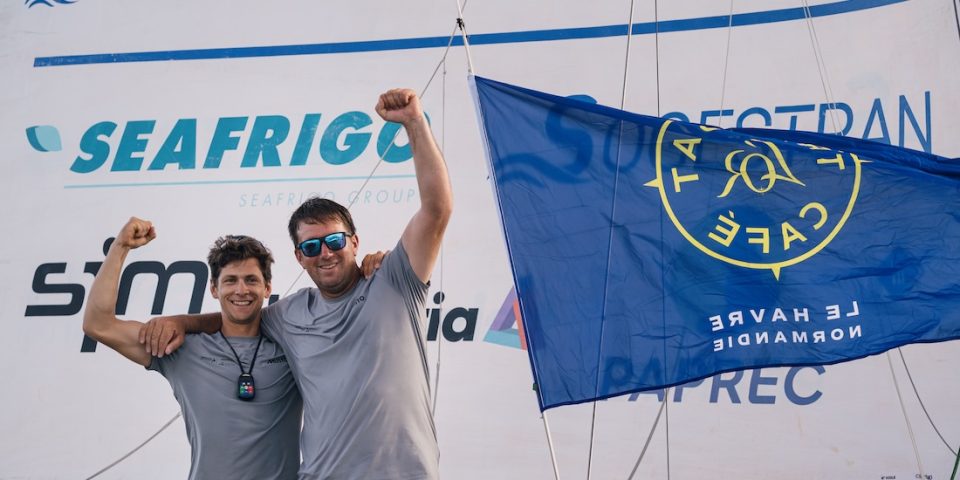
The second leg saw the fleet split between northerners and southerners after three days. Could you explain how you chose the south?
Guillaume Pirouelle: Two years ago, we hesitated too much and the north/south choice didn’t work out well for us (they finished 14th after opting for the south). So this year, we had worked on the weather to have more information to decide. Except that where two years ago the choice was made 10 days before the finish, this time it was 14 days, which is to say that the weather forecasts for the end weren’t worth much. So we had to look at other parameters to choose.
Which ones?
Cédric Chateau: Even though we ultimately agreed, Guillaume was a bit more north route than I was. I admit that doing upwind and reaching against SNSM, which was much faster than us at those speeds, didn’t appeal to me too much. I thought we could aim for a podium, but it would probably jeopardize our chances of victory against boats that had weapons we didn’t necessarily have. Whereas the south route left the door to win more open.
G.P.: Two or three days after the start, we found ourselves in 45 knots when we thought we’d have 30, we were afraid of breaking everything, and that played a role in our choice of the south, because it only confirmed what we were seeing, which was that there was a lot of activity in the North Atlantic and that the phenomena were more powerful than expected. The north route also meant three or four fronts, passages through the center of the anticyclone and then crossing the anticyclone to descend towards Martinique, so much more uncertainty. And more risk of material breakage; in fact, we saw that, apart from SNSM, they all broke things in the north and that slowed them down. Regarding the south, the major difficulty was passing the ridge after Madeira, but after that, you reached well-established trade winds. Furthermore, we had a boat that was rather suited for downwind sailing, we were quite confident in its capabilities in those conditions. All of that tipped the balance towards the south, even though the route was much longer (almost 700 actual nautical miles of difference upon arrival).
“It was a bit of a rollercoaster!”
G.P.: The key point was to pass the ridge as quickly as possible, because once you caught the trade winds, you shot forward. At that moment, I emphasized that we had to give it our all so that we would be the first to exit the ridge. That’s what happened and we managed to gain ground.
What does “give it our all” mean?
G.P.: Ask Cédric!
C.C.: We had a difference of opinion on that descent in the south: we had somewhat underestimated what we were going to take on; it was rarely violent. At one point, we lost 15 miles in a cloud, we worked hard all night, it’s a miracle we didn’t break anything. Towards the end of the night, there were two or three hours of strong wind left, and I told Guillaume: “It’s okay, we’ve caught up, we’re going to ease off a bit.” He replied: “No, we continue, the boat was beaten up in the Quebec-Saint-Malo last year, it held up, I have confidence.” He convinced me that we had to keep going full throttle. I think that was a key moment, because we managed to get out of those very difficult conditions in a very good position and we knew that after that, the first ones would be the best served. The second key moment was two days after the Canaries: we had a huge nosedive in horrible seas, our medium spinnaker ripped, and we were left with just the large and the small. And there, we knew how to adapt to this new situation, we spent our time alternating between the two and managed to mask the absence of the medium, which was the sail for those conditions, by sailing at great angles.
We imagine you spent a lot of time routing north-south…
G.P.: It’s true that it was a bit of a rollercoaster! With every routing, I also routed SNSM. Initially, they showed the northern group winning; ten days from the finish, us with a day’s lead; five days out, the northern door reopened, and then it changed every day. Mentally, it was quite impactful. In fact, two days from the finish, I stopped routing them for a moment, because it was getting on my nerves and I told myself that anyway, we couldn’t control what they were doing. At the same time, it showed that we really couldn’t give up. We said several times that it would be decided by a few minutes, but probably not to that extent; the scenario was quite crazy!
“A kind of state of grace
from start to finish”
G.P.: Really at the very end. We picked them up on the AIS south of Martinique; it was really tight because they had come back well, we weren’t sure we would make it. Afterward, we sailed really well around Martinique, we gained ground, and at Le Diamant, we started to think we could do it, even though the uncertainty of Martinique’s relief remained. As we crossed the line, we felt good about it, but it was really fifteen minutes after crossing the line that we understood we were going to win.
Is this your best victory?
C.C.: Between finishing second in the TP52 World Championship (this year with Paprec), third in the 52 Super Series season, and winning the Class40 transatlantic race, I don’t know how to rank them. On the other hand, it’s the most impactful: after the TP52 World Championship, I must have received four texts; here, I threw my phone in the boat because I kept receiving alerts! Beyond that, there is a special emotion, because originally, we shouldn’t have raced it together. The idea was for me to pass the torch to a younger sailor, and we had actually had a feeling of bitterness and sadness two years ago, because we thought we were going to stop after a disappointing result. And finally, because of the lightning episode (see our article), that handover was postponed. Managing to bounce back, being offered a second chance and seizing it, with Guillaume who is an important person in my life, is a really great revenge!
And you, Guillaume?
G.P.: Even though we set out with the ambition to win, there’s a world of difference between being capable and actually succeeding. We were in a kind of state of grace from start to finish, so for me, it is clearly my biggest victory and the one I have been waiting for for a while.
Photo : Jean-Louis Carli / Alea