
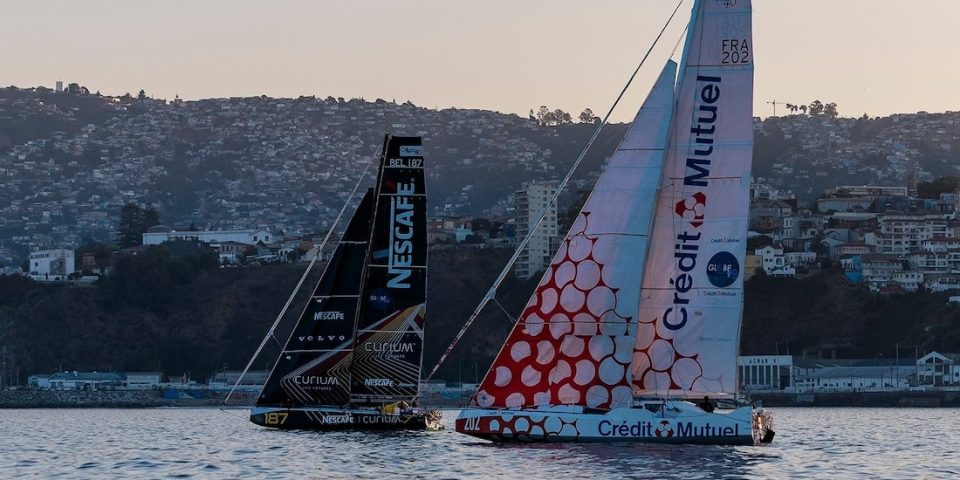
The fifth and penultimate leg of the Globe40, between Valparaiso (Chile) and Recife (Brazil), sets sail on Wednesday, February 18. For Sailorz, the organizer, skippers, and architects provide an initial technical and sporting assessment of this second edition of the double-handed round-the-world race in Class40s.
Before the start, it was THE big question of the Globe40 2025-2026: would the scows be capable of chaining together so many legs and facing the Southern Ocean without suffering major breakage? Two-thirds of the way through the world tour, as the fleet has arrived in Chile after crossing the Indian and Pacific Oceans, the technical report is positive.
Of the three scows at the start, all officially remain in the race, even though the Germans on Next Generation Boating (Lennart Burke/Melwin Fink) suffered breakage during the third leg in the Indian Ocean and will only rejoin the race in Recife for the final leg. “This was rigging damage already encountered by many Class40s and is not linked to the length of the legs, notes Ian Lipinski, skipper of Crédit Mutuel. As far as we are concerned, we have had no issues with the structure or the rigging. And yet, we pushed the boat hard, in sustained conditions.”
The architect of Crédit Mutuel, David Raison, is not surprised by the machine’s robustness: “I knew we had the sturdiest boat in the fleet; we set the bar very high in the design, he asserts. We racked our brains to have a very tough Class40 without it being too heavy. I was therefore confident, but I am always happy to hear at the finishes that there is nothing to report, or only minor details.”
Encouraging perspectives
On the side of Belgium Ocean Racing-Curium, currently leading the general classification, some technical issues were noted upon arrival in Sydney after a demanding Indian Ocean crossing. “But remaining in the race was never in doubt, clarifies Belgian skipper Jonas Gerckens. Before the start, we wanted to play it safe. In addition to adding the mandatory watertight bulkheads, we planned for reinforcements, particularly at the keel. We also switched to a mast with two sets of spreaders.”
Éric Levet, architect at the Lombard firm and designer of this Lift V2, also expresses his satisfaction: “It was the moment of truth for the behavior of scows in the Southern Ocean. They performed very well and proved they are fit for this exercise. Granted, these boats are sometimes very uncomfortable for the sailors, but they have stable hull forms, are very seaworthy, and are capable of handling sustained strain over the long term.” Globe40 organizer Manfred Ramspacher, for his part, praises “the quality of the upstream preparation and the technical monitoring throughout the event.” He also points out that the five pointed-bow boats are all still in the race.
While caution remains the rule until the end of this round-the-world tour, the fact that the Southern Ocean crossing has gone well so far offers, in his view, encouraging perspectives for a third edition of the Globe40. “We are proving that Class40s, and scows in particular, are true ocean-going boats, just like other classes, says a delighted Manfred Ramspacher. This shows that you can experience the emotions of the Deep South and confront this mythical universe without necessarily competing in the Vendée Globe.”
A particularly close duel
On the sporting side, the Globe40 is turning into a duel for the final victory. Belgium Ocean Racing-Curium and Crédit Mutuel are neck and neck, with finishes decided by a few minutes (in La Réunion) or even a few meters (in Valparaiso). In Chile, after a three-week leg, the two crews were declared tied. “After a technical investigation, the conflicting results of the Adrena tracking analysis and the Yellowbrick beacon system did not allow for an indisputable result,” justified the organisation.
Specifically, the finish line was virtual, with no race committee present on site, which prevented a visual ruling and did not fail to surprise Jonas Gerckens (who did not compete in this leg). “This should give us pause for the future. Virtual systems cannot replace everything; the human eye must still serve a purpose, he points out. Aside from this small hiccup, this edition of the Globe40 is magical. I am impressed by the pace we set for ourselves; it’s a kind of Normandy Channel Race, but on a global scale. It’s both exhausting and great to experience. Crédit Mutuel was the big favorite and we had more of an outsider role. We are thrilled to be on equal footing.”
Ian Lipinski is just as enthusiastic about the intensity of the duel: “I knew the Belgian team would be tough and that we would have to fight to win, but honestly, I didn’t expect such a close duel at all because I anticipated large gaps during the legs, with one or the other crew holding a significant lead, almost sailing in different weather systems. I thought there would be long stretches sometimes; that hasn’t been the case at all. The excitement of the race is there from start to finish. It’s truly motivating. The fleet lacks a few more boats, but at least there is a real competition.”
Ian Lipinski:
“There is no room for error”
According to our contacts, the probability is high that this duel will continue until the end, with the Belgians holding only a 2-point lead in the general classification before the final two legs. “On the last leg, the return of the German crew will spice things up, analyzes Manfred Ramspacher. They could play the role of referee if they slot in between the two leaders, as they did at the finish of Leg 2 in La Réunion. This could shake up the final standings.”
For these final two legs (Valparaiso-Recife then Recife-Lorient), Ian Lipinski will be partnered with Antoine Carpentier, while Jonas Gerckens will set off with Corentin Douguet for the next one and a co-skipper yet to be determined for the last—Benoît Hantzperg, Renaud Dehareng, and Djemilla Tassin have sailed on the Belgian boat during previous legs.
“There is no room for error: overall we have to win the last two legs to win the event. The pressure is more on us than on them,” admits Ian Lipinski, eager to get back to sea and tackle the “big challenge ahead: the passage of Cape Horn.” The Crédit Mutuel skipper adds: “In theory, it’s the best season to round it, but we know the reputation of that area and hope conditions will be acceptable. In any case, when the Horn is behind us, we will feel a sense of relief.“
Image : Jean-Marie Liot / Globe40