
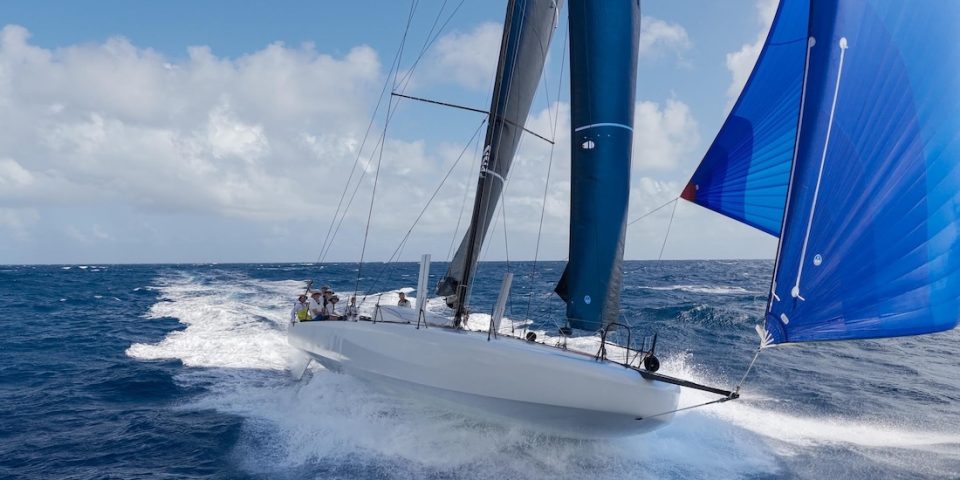
Overall winner in January of the Rorc Transatlantic Race, Palanad 4, a 50-foot scow designed by Sam Manuard and built at JPS Production, is helping to shift the goalposts in IRC racing. The owner, Olivier Magré, and the architect—who was part of the crew for the transat—decode the concept of a boat looking to confirm her form in the RORC Caribbean 600 (starting Monday, February 23rd).
It took Palanad 4 only 8 days, 5 hours, and 55 minutes to complete the 3,000 miles of the RORC Transatlantic Race between Lanzarote and Antigua, at a fine average of 15 knots. The only faster competitor was the Maxi Raven, equipped with AC75-style articulated foils and measuring… 111 feet long! Palanad 4, however, soundly beat it on corrected time, as it did for the fourteen other IRC entrants, notably Ino Noir, a renowned Carkeek 45 and a typical expression of Anglo-Saxon IRC prototypes.
At the finish, aerial footage of the all-white scow surfing with ease at over 20 knots on the blue waters of Antigua went viral. “The whole transat was like that!” exclaims happy owner Olivier Magré. “We truly had a blast, going fast without getting tired, unlike other boats where the crew is forced to hike out night and day to hold the spinnakers. Palanad‘s aesthetics might shock some purists, but to try it is to love it!”
Having scoured the Class40 circuit with his son Antoine—first on a pointed bow and then on no. 160, a 2020 Mach 40.4 signed by Sam Manuard (winner of this same Transatlantic Race in 2021)—Magré eventually tired of the technicality of Class40s, their cockpits dedicated exclusively to solo or double-handed sailing, and their spartan interiors. This led to his wish for “a boat for sailing with friends that allows me, at nearly 60, to sleep in real bunks, not on soaked sails.“ He once again turned to Samuel Manuard, who, after this first transat, is also pleased with “the easy yet fun side of Palanad—well understood in France, but not necessarily abroad—which was created not to fill a rating gap but to provide maximum pleasure.“
This isn’t the first time the architect-sailor, who co-signed the Pogo RC with Bernard Nivelt, has designed a boat intended for IRC by drawing on open racing recipes. He previously designed the Mach 45 Cartouche, launched in 2006 in collaboration with Nicolas Groleau (founder of JPS), with which Palanad 4 shares a true lineage. “Cartouche was already equipped with a canting keel; it was a very nice boat to sail with good results,” confirms Sam Manuard. “With Nicolas, we said that if we imported everything we’ve learned from the latest generations of Class40 onto a boat of this size, it would be insane!”
A UFO in the World of IRC
Canting keel, asymmetric daggerboards, a width of nearly 5 meters running all the way to the transom, an immense cockpit, and double companionways—Palanad 4, launched on July 19, 2025, is a UFO in the world of IRC racing, and not just for her unapologetic scow hull. To describe his approach, the architect begins by noting that the IRC “is a rating rule that forbids nothing; it ultimately leaves more freedom than certain box rules, with a few blind spots—including hull stability, which is not measured.”
From this perspective, Palanad 4 is the exact opposite of a TP52, many of which continue to enjoy successful IRC careers after a first life in Grand Prix racing (Audi Med Cup then 52 Super Series). The hull offset when heeled and the canting ballast allow the Manuard design to be both more powerful and lighter, thanks to her lower ballast mass and reduced crew (7 during the transat), for a rating very close to a TP52 (TCC 1.426, versus a range of 1.360 to 1.400 for TPs). Finally, the cant of the keel (the axis is not horizontal) generates lift, making this boat very aerial when downwind in heavy seas.
“Another major driver of performance in IRC is the waterline length,” continues Sam Manuard. “If you reach planning speed faster than larger boats, you can come out on top.” The low-slung nose of Palanad 4 reduces the static waterline by nearly 3 meters and visibly exploits a rating gap—even though the IRC rule already modified its measurement of forward overhangs in 2026. Asked about this, Ludovic Abollivier, director of the IRC calculation center for the Yacht Club de France (which holds the rule alongside the RORC), confirms: “The inclusion of scow hulls began on January 1, 2026, but the IRC acts in small steps. We don’t bring out the heavy artillery in the first year, and it is very likely that additional taxation will be adopted in 2027.”
Will the Concept Set a Trend?
Needless to say, Palanad 4‘s future performances will be closely watched, starting with the RORC Caribbean 600, which sets off on Monday, February 23rd. Olivier Magré is taking on a crew built for victory, including Spaniard Pablo Santurde and Briton Will Harris, even if the competition promises to be tougher than in the transat, with IRC benchmarks like Rán or Daguet 5. “There’s a strong field, and they’ve been warned,” smiles the owner, for whom this 600-mile race—a giant slalom through the Caribbean islands—is “the true test for the boat.“
On board during the Transatlantic Race (though he won’t be for the Caribbean 600), Swiss sailor Simon Koster, who oversaw the entire build and managed the electrical installation, seems confident: “It will be more competitive, but it’s a great course for the boat because there is very little VMG sailing. It’s at intermediate angles that Palanad makes the difference. With her asymmetric boards, she can also sail very high, but she needs speed.” In everyone’s opinion, the boat’s weak point is not upwind, but light air and choppy seas, where the wetted surface area is a disadvantage compared to narrower hulls. “We are at V1 of the boat, while others are already at V10. We’ll need to keep working on the sails, and we are still far from getting 100% out of the boat,” tempers Sam Manuard.
Can the concept gain traction in the very Anglo-Saxon world of yachting? Olivier Magré, who invested 2 million euros in this boat—carbon-built down to the shrouds—and who showed her off in Antigua, wants to believe so: “People are surprised by her simplicity, her seaworthiness, and how watertight she is compared to other models. We might face rating changes, but I believe it’s the direction of history.” After this Caribbean campaign, the immediate direction of Palanad 4‘s history will be to head back to Europe for a program including the Spi Ouest-France, the ArMen Race, and the Round Britain and Ireland Race.
Image : Roddyacqua