
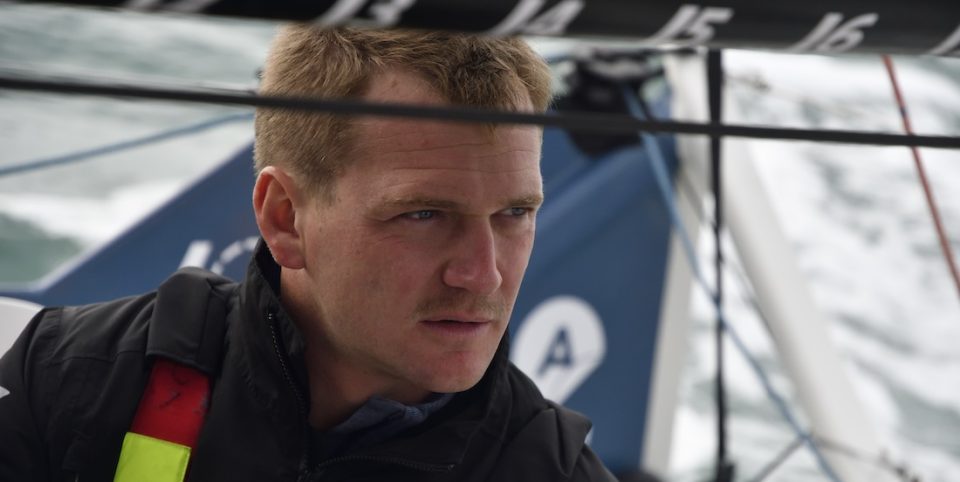
Having joined the Class40 circuit in 2019, Pierre-Louis Attwell announced this Friday the launch of Resilient, an Imoca project that will take him as early as this year through to the 2028 Vendée Globe on a daggerboard boat. The 29-year-old sailor from Normandy outlines the project for Sailorz.
Can you tell us how this Imoca project came about?
For several years we’ve been running an offshore racing project called Vogue avec un Crohn. It started in Figaro in 2018 before moving to Class40 in 2019, mainly focused on digestive diseases, as I myself live with Crohn’s disease. The aim is to raise public awareness of these conditions, but also to carry a positive message to patients by showing that, even when dealing with complex illnesses, you can still pursue goals and dreams. In Class40, we operate on four-year cycles structured around the Route du Rhum, and each time there’s a similar process: in the third year, we always start asking what comes after the Rhum. In 2021, since we were sailing an older-generation Class40, number 135, we decided to build a new one (Mach 40.5) to say: “For a few years we’ve shown that you can be ill and still race offshore; now we want to prove that you can also be competitive.” We launched the boat in 2023, won the Class40 championship in 2024, and in 2025 the same question arose again about the post-2026 Route du Rhum.
And this time you answered it differently…
Exactly. You have to understand that we don’t run a single-sponsor project – quite the opposite, in fact – with around thirty partners, some of whom have been with us since the very beginning in 2017. So by the end of 2025, some of them were experiencing their fourth Transat Jacques Vabre, they had been through six or seven Normandy Channel Races, four Les Sables-Horta… At the same time, given the cost of boats and the performance gains we might expect, we were wondering whether it made sense to build another one. Above all, we didn’t want to fall into the trap of repetition and simply reproduce what we had already done. We also noticed that in the Imoca class there was a slight slowdown, with boats sitting in boatyards that might potentially be available. From there the idea gradually matured that it was time for us to step up into Imoca.
Why start this year when you had planned to do the Route du Rhum in Class40?
Because we felt that it was getting late, both in terms of Vendée Globe qualification – even though there’s less pressure on that now than in previous cycles – but above all in terms of learning the boat. So right at the end of last year – around 20 December – we decided to commit to Imoca as early as this season. So in January we turned up at our partners’ offices, even though all the budgets had already been approved since September, saying: “Well… the plan has changed a little.”
“A budget that almost doubles”
You also had to find a boat and probably sell yours to finance the purchase – how did that work?
We did indeed have a Class40 “on our hands”, and as she’s relatively recent we didn’t want to sell her cheaply – the idea is to recover our investment. Since we waited to hear back from a number of partners about their ability to increase their budgets for the move into Imoca, we eventually decided to lease her this year to Kéni Piperol. At the same time, we are currently in the process of acquiring a daggerboard boat. As we haven’t finished paying for it yet, out of respect for the seller we can’t announce it immediately, but let’s just say that among the daggerboard Imocas on the market it’s one of the good ones – which narrows down the possibilities…
You mentioned convincing partners to increase their budgets – what’s the gap between a competitive Class40 project and an Imoca campaign on a daggerboard boat?
The step is smaller than between a daggerboard Imoca and a top foiler, and that also influenced our decision. To put it very concretely, this year we offered our partners an “initiation” budget that is almost double what we had in Class40. In 2025 we were operating on around €450,000; this year we are aiming for €850,000 in total, bearing in mind that we’ll only do half a racing season, since our first event will be the Drheam Cup (in July), followed by the Défi Azimut and the Route du Rhum. One of the big differences is the size of the team. Where we previously had the equivalent of three full-time people, we’re aiming for six to eight on the Imoca project.
Among your thirty partners, can you give an idea of their level of contribution?
In Class40, contributions ranged from €3,000 to around €50,000. In Imoca, the entry ticket is €25,000. One of our current challenges is already to retain as many of our existing partners as possible, but since we know we’ll inevitably lose some who can’t follow us, we have real work to do to secure the budget for this first “initiation” year. From 2027 onwards, the target will be €1.5 million per year. Because the ambition is clearly to have a project capable of fighting for victory among the daggerboard Imocas.
Inspired by Louis Duc
You’ve also changed the project’s name, from Vogue avec un Crohn to Resilient. Why?
With the greater visibility we’ll have in Imoca, thanks to the opportunity of the Vendée Globe, we felt it would be a bit limiting to focus only on digestive diseases. So we wanted to broaden the project by highlighting the ideas of resilience, accepting vulnerability and invisible disabilities. As a patient myself, I realise that when I meet someone living with multiple sclerosis or even cancer, we share a lot of common challenges.
If all goes well, you’ll race your first Vendée Globe in 2028. Was that always a goal, or more an opportunity that arose, as you explained?
I’d say it’s a mix of both. Until very recently I didn’t necessarily feel legitimate, either from a sporting perspective or in terms of project management, because stepping into the Imoca class is a major leap. The real trigger was seeing sailors I know take the start – I’m thinking particularly of Louis Duc, who has always been a bit like a big brother in offshore racing. When I arrived in Class40 he already had a competitive project, one of the first “quasi-scows” at the time, and he managed to make that transition to Imoca and all the way to the Vendée Globe. Seeing him on the start line fuelled my own offshore ambitions. And in the end there’s a certain logic in our progression: a bit of Figaro at the beginning, an older-generation Class40, then a new Class40, and now Imoca.
Image : Xavier Delestre