
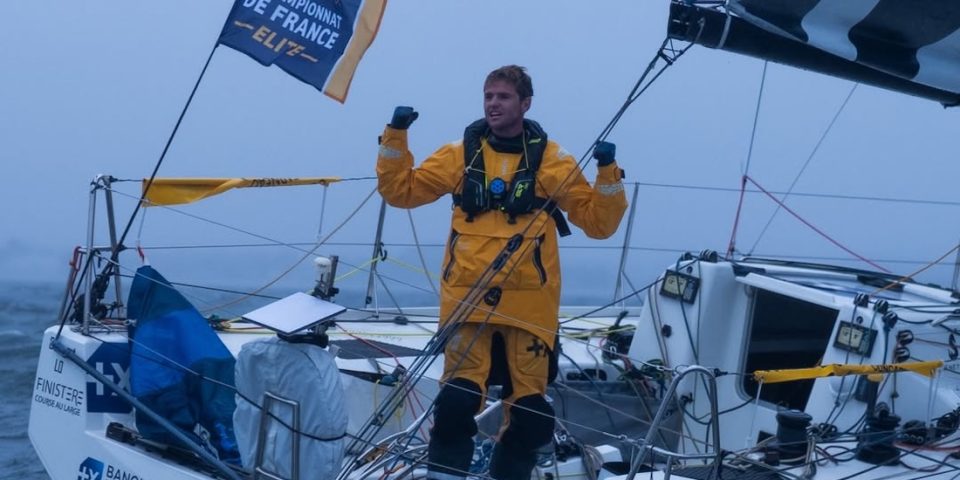
Back on the Figaro Beneteau circuit this year while waiting for the launch of his future Imoca in just over a year’s time, Loïs Berrehar stood out at the Solo Guy Cotten, the first race of the season, by winning the 240-mile offshore race on Thursday evening. Fifth overall in an event won by Paul Morvan, the Banque Populaire skipper (32) looks back on the race and discusses his Imoca project.
Before going into the details of the race, tell us how your return to the Figaro circuit has gone this year, given that you actually only left it for one season, in 2025?
When we mapped out the roadmap to the Vendée Globe with the Banque Populaire team at the beginning of last year, we realised there wasn’t actually much solo racing on the programme, apart from the final year in Imoca (2028). So we looked at different options and quickly agreed that the Solitaire du Figaro was perfect for solo racing. We therefore chartered a boat (Erwan Le Draoulec’s), launched her on 15 January, and I took part in all the winter training sessions in Port-la-Forêt. The idea was to try to get back as quickly as possible to the level of preparation I had with my previous Figaro (Skipper Macif), especially since I knew we had to push hard, with the Solitaire just two months away (starting on 17 May). Quite quickly, I was pleasantly surprised: things came back rather well and I was matching up well with the others in training in Port-la-Forêt.
What was your mindset going into this Solo Guy Cotten?
I knew it was the first and last solo race before the Solitaire. So in my head, I was telling myself it would be good to be competitive. And from the start of the first coastal race I could see I wasn’t far from the mark – I got away well and had good speed. It didn’t end very well, but it showed that we had done a relatively good job.
You finished 27th and 21st in the two coastal races, which probably weren’t the results you expected. How did you react on the evening after the second leg?
In the first one I got caught in a squall, then made some poor choices – it was a bit of a downward spiral. The next day I made a mistake on another competitor and had to do a 360 penalty, so I wasn’t very good. So I was disappointed, but I wasn’t in “nothing is working” mode. It’s pretty much the only year since I’ve been racing Figaro that I’m not targeting the French Offshore Elite Championship, so I wasn’t devastated thinking these results would ruin my season.
“I think experience made the difference”
And how did the big 240-mile leg unfold?
I made a decent start, not amazing, but then managed to find good speed and good positioning on the first upwind leg to l’Occidentale. I made a small mistake late in the night that cost me my lead, but I still rounded the Audierne buoy in first place. After that, the downwind leg was interesting, with small speed differences and some sailors performing well, especially Paul (Morvan), who made a profitable gybe inside, slightly further north. Not only was he fast, but he also had a better angle, which allowed him to be almost a mile ahead.
How did you manage to come back?
It came down to the rounding of Groix; I think experience made the difference. The wind angle, the gusts, the sequence of manoeuvres, the fatigue – those are things I know almost by heart on these legs. So I took the helm, trimmed the boat properly and put Paul in my sights, managing to overtake him two miles from the finish. After that, the leg was tough. I have a certain ability to push myself when needed, but that one really hurt, with huge swell and horrible cross seas. I hit myself several times inside the boat – it was genuinely hard going. That’s why I was so satisfied at the finish: we spent a lot of time working this winter to get back up to speed, me sailing in bad weather, the team tinkering with the boat, and I was happy it paid off.
What’s your view of the competition after this race?
While I was sailing Imoca last year, some sailors improved enormously in Figaro. The competition is seriously sharp and I had to give everything to win that leg. Today there are very young sailors who are impressive – I’m thinking of Tom Goron, he’s barely 20 (19), we have more than ten years between us, which feels strange! Paul Morvan as well – I didn’t know him before, he’s really solid. And among the slightly older sailors who have also progressed a lot, there’s Hugo Dhallenne, who is always in the right moves; he’s very strong.
“A great preview of the baby!”
And what did you think of those often referred to as the “old guard” (Yoann Richomme, Jérémie Beyou, Nicolas Lunven, Xavier Macaire, Adrien Hardy), who came back to take on the younger sailors and who, for some of them, struggled during this Solo Guy Cotten?
It wasn’t easy for them, but it wasn’t easy for me either! I was talking about the ten-year generation gap between me and the youngsters; here it’s ten years the other way, so twenty years or more. I’m really impressed by their approach. It’s very honourable and respectful to the circuit to come back and compete on such a demanding boat – honestly, the conditions we had during the offshore race were tough! These guys have each won the Solitaire two or three times, achieved loads in Imoca, and yet they have the humility to return to the Figaro exercise. And they’re far from being out of their depth, with several around the top 10 (Jérémie Beyou 10th, Nicolas Lunven 11th, Adrien Hardy 12th). You have to remember that we have a lot of hours on this boat, which they don’t, but I think on the Solitaire, after three legs of four days each, they’ll be right there.
Is the Solitaire really a major goal for you?
The main objective is to race solo. Returning to the Figaro circuit is an opportunity to try to win it, but that’s not the goal in itself; the project is to build a boat for the Vendée Globe, which is the priority. That said, I’ll be on the start line with a top team and a top boat, I’ve never won it yet, so yes, I’d really love to.
Speaking of that Imoca project, how is it progressing?
Everything is going well: the team is being structured and the boat has been under construction for two months. We’ve completed the first curing phase and it’s extremely exciting. Especially since in the shed next door there are TRR and Malizia (sisterships, the three teams are collaborating, see our article), which are three or four months away from launching. The boats have really taken shape; I’ve been able to step inside them and it gives a great preview of the baby! Malizia will be launched in early July and I can’t wait to sail a few miles on her. On our side we’re still working on elements that haven’t yet gone into production: we haven’t finalised everything regarding the pilots, electronics or sails, and we’re not quite finished designing our future foils…
You said you were eager to sail on Malizia. Does that mean you’ll race with them next summer, notably in The Ocean Race Atlantic? And then The Ocean early next year?
The programme isn’t completely finalised yet, but I’d like to do as much as possible with them, yes. And the aim is to sail in the Southern Ocean in an Imoca, ideally racing on the sistership of my future boat.
Image : BPCE / Qaptur