
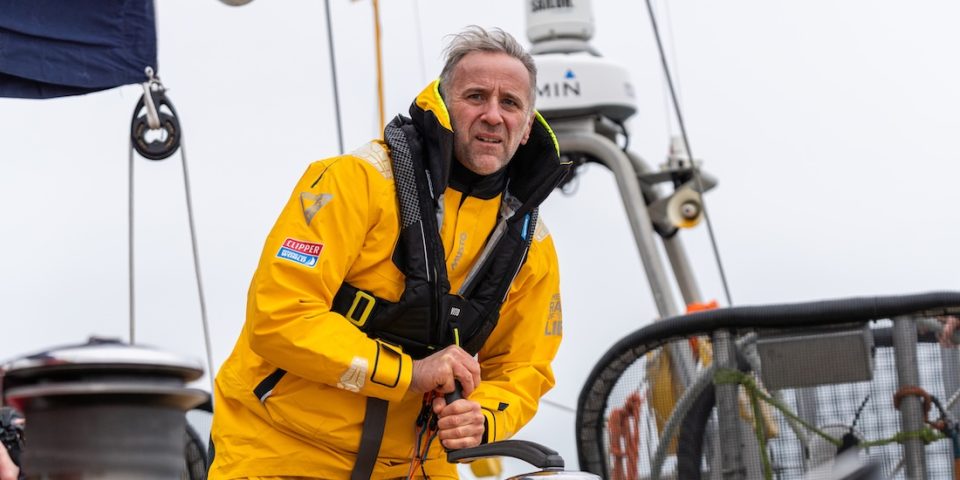
At 51 years old, David Sautret is the only French skipper competing in the Clipper Round The World Race, whose Seattle to Panama leg was stopped at a virtual finish line off the coast of Mexico due to a lack of wind. While delivering Yacht Club Punta del Este to the Panama Canal, he spoke to Sailorz about the experience.
Can you tell us how you ended up becoming skipper of Yacht Club Punta del Este, one of the ten boats competing in the 14th edition of the Clipper Round The World Race?
Ever since I started sailing, around 25 years ago, my dream was to race around the world. Back then, I was really inspired by the Volvo Ocean Race, but being a crew member on that race is reserved for the elite. I then built my life, worked as a sales engineer selling industrial products, had children, and let’s say that when I hit my midlife crisis, the dream resurfaced. I started looking into it and that’s when I discovered the Clipper Race, which finally allowed me to put a price on that dream [the race is open to any amateur willing to pay for their place, editor’s note]. Time passed and in 2023, I became interested in the Ocean Globe Race; I had seen adverts looking for first mates, but applicants needed the Yachtmaster Ocean qualification. I therefore trained in Gosport, near Portsmouth, which is effectively the headquarters of the Clipper Race. There, I saw the whole environment, the boats, the training centre, the offices — it really impressed me and made me want to apply as a skipper, especially as my various leads for the OGR had not materialised. My first application arrived too late, so I applied again for this edition and in October 2024, I was invited to the selection trials.
What did those involve?
On the water, I found myself with a crew of alumni (former race participants) who gave me a series of manoeuvres to complete, some heavily focused on safety, but also spinnaker hoists, sail changes and timed exercises. Ashore, there were interviews where you are expected to be both a good sailor, a good teacher, a competitor and a strong communicator — as much as possible!
What was your sailing background before applying?
I started in the early 2000s. At the time, I was working in the Île-de-France region, which sponsored a Mumm 30 on the Tour Voile. I was recruited into Jimmy Pahun’s crew, which gave me excellent training and opened doors to sail on owners’ boats. In 2003, I competed in the Mini Transat on a Pogo 1, and in 2005, I raced between Marseille and Brazzaville in Congo (the Route de l’Équateur) with Bertrand de Broc. After that, I sailed more in IRC racing, as well as on sport catamarans for eight seasons. Then in 2020, as I already held a state sailing instructor qualification, I changed career and became a professional skipper.
“It’s well paid for achieving
the dream of a lifetime”
When did you find out you had been selected by the Clipper Race organisation, and what did your programme look like afterwards?
I joined Clipper Ventures as a skipper in March 2025, and you immediately enter an extremely well-oiled system, very much in the Anglo-Saxon style: before I had even started, I already had my day-by-day schedule right up to the race start! I completed a lot of training, for example on racing rules and the weather systems for the different legs, and at the end of April came a key moment, which is also one of the race’s unique features: the crew draw. Then begins the crew training programme, which is divided into four levels: the basics of sailing; a toughening-up week where we spend several days at sea to establish the watch rhythm, discover night sailing and observe how people cope with seasickness; level three, focused on spinnaker work; and finally a week in race conditions, including a Channel crossing over the final 48 hours.
There are two professional skippers per boat — can you tell us roughly what the pay is?
It’s well paid for achieving the dream of a lifetime in very good conditions. I’d say it’s in line with the averages in this sector, around £5,000 per month (€5,800).
You are currently fifth overall — what were your ambitions when you left Portsmouth in late August 2025?
I looked closely at who the other skippers were; most already knew the organisation and the boats, and some had already completed part of the course, so I saw us more as outsiders, aiming for a top-five finish. So far, we are on target, with three races still to go and a mathematical chance of making the podium.
What has been the highlight of this round-the-world race for you so far?
I would say our run of podium finishes at one stage [three third places in races 5 to 7, editor’s note] and the Indian Ocean, sailing in consistently tough conditions. We went down to around 45° South — these are places very few sailors venture into outside professional offshore racing.
“You have to keep an eye on everything”
Is it difficult managing a crew of amateurs?
There are challenges, inevitably highs and lows, tough moments and weather-related setbacks. The most important thing is safety, which is non-negotiable; it is really the cornerstone of the organisation and what makes it possible to take amateurs around the world. You have to be uncompromising about every onboard rule — winch handling, positioning on the boat during manoeuvres… you really have to keep an eye on everything. The other important aspect is that we have 17 nationalities on board, so cultural differences must be taken into account. And with seven people completing the full circumnavigation, you spend more than a year living together on the boat, so there is no choice: everyone has to get along. Thankfully, that has been the case — we have managed to build a strong team spirit through dialogue and mutual understanding.
Would you recommend this adventure to someone who, like you, dreams of sailing around the world?
100%, yes! What is fantastic about this race is that it makes the dream of sailing around the world accessible to everyone and one of its core values is sharing knowledge and training. If I take the example of my first mate (Lorraine O’Hanlon), she was a crew member in the previous edition, during which she became a watch leader, and by the end of it she had completely reshaped her professional career and earned her qualifications. Today, she is my first mate and, if she wants, she could come back as a skipper. There are many stories like that of crew members who got hooked and became professionals.
And what about you — do you plan to return?
That’s a good question! Dreams also come with sacrifices: you are away from home for a year and a half, and I have a young child, so not seeing him is a major sacrifice. That said, there is never a perfect time to achieve something important in your life — you have to seize the opportunity when it comes, and that’s what I did. Will I come back? There is an added incentive: from the next edition onwards, a new boat will be introduced, which could bring an extra challenge, so why not? Maybe not the next edition, but after that, I’d be delighted.
Photo : Brian Carlin/16 Degrees South