
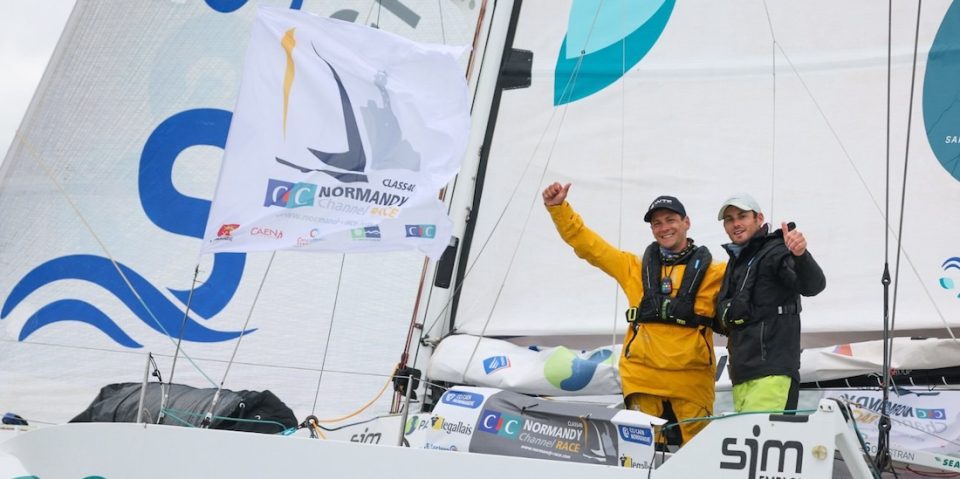
With a background in Olympic sailing and the Tour Voile, Guillaume Pirouelle, 32, is riding a wave of success. Runner-up and top rookie in the 2022 Solitaire du Figaro, he is now one of the leading figures on the Class40 circuit, having won the Transat Café L’Or, the Trin’40 and, on Wednesday, the CIC Normandy Channel Race with Jules Ducelier, all within the space of six months. Not to mention winning the Jules Verne Trophy last winter aboard Sodebo Ultim 3. Sailorz caught up with the Normandy skipper of Sogestran-Seafrigo.
Can you talk us through the story of this CIC Normandy Channel Race, which was sailed in some pretty demanding conditions?
The conditions were definitely pretty full-on! With Jules (who succeeded him in 2024 at the helm of the Figaro Région Normandie), we slightly missed the start because of a small sheet issue, but fortunately we made up for it straight away on the coastal section. I always make sure we’re in the right pack from the outset, because you’re never safe from a split in the current zones. We saw that with Axel (Tréhin) and Antoine (Carpentier), who struggled to get back into the game. After that, things went well up to the Solent. We had a bit of a scare on the way out; we were alongside Legallais (Fabien Delahaye/Pierre Leboucher), who managed to slip through just as we got stuck going backwards in the tide. Fortunately, we still had the gennaker tack attached on deck, so we had time to hoist it and get through. Along England’s south coast, Legallais pulled away slightly because they’re very quick upwind, but we managed to close back in just behind them by the time we reached Wolf Rock.
That was that the point where you took the lead for good. How did it happen?
The Channel crossing was intense, under the large gennaker at 120 degrees to the wind. It was a proper battle, with surfs at 24 knots. We were a little faster than Legallais because our boat (Mach 40.5, Manuard design) is better suited to those conditions. Then we had a great speed battle all day in the Channel under the small spinnaker, which is fairly unusual. We took some serious hits; I’ve never shipped so much water into a Class40! The positive side was that we extended our lead on that long downwind leg, which gave us a small cushion before heading upwind, a point of sail that suited others better. The finish, with all those tacks, felt like punishment because we were completely exhausted, but in the end we held on to enough of an advantage to stay in front.
“I knew I was capable of
learning quickly”
What does this latest victory mean to you?
First of all, it’s great to win in Normandy, especially as Cédric (Chateau) and I finished second here last year. I’m delighted to lift the trophy, because the fleet is always incredibly strong in this race. I think we made very few mistakes and, looking ahead to the Route du Rhum, I’m really pleased with what we learned about the boat in demanding downwind spinnaker conditions. It only lasted three days, but we finished as exhausted as if we’d been racing for a week and gone all the way to Fastnet. Conditions are always tough in this event.
You’ve won the last four races, both double-handed and solo, and you’ve just come off a victorious Jules Verne Trophy campaign. How do you explain this run of success? Is it what people call being “in the flow”?
It’s true that things have been going very well lately, but people shouldn’t forget how much we struggled with the Class40 beforehand. The project could easily have come to an end. We poured huge amounts of energy into rebuilding the boat twice in succession [it was notably almost lost after being struck by lightning, see our article], and it also took time to get it fully optimised. I think that today we’re getting very close to the peak of its potential. The same applies to me. When I moved into Class40 in 2023, I had very little experience of the class. These boats are quite different from Figaros and there were certain keys I was still missing, which I now have a much better grasp of. That’s really satisfying.
When you moved into offshore racing in 2021, did you ever imagine achieving results like these?
No. Olympic sailing and offshore racing are two very different worlds. I wasn’t entirely sure what I was getting into; I simply wanted to discover new things and keep learning. I was fortunate to get an opportunity with the Région Normandie Figaro programme, but I had no certainty that it would work out. What I was certain of, however, was that I was capable of working hard and learning quickly. After that, other opportunities came along and things progressed naturally, particularly with Sodebo.
“The desire to race the Vendée Globe
grew gradually”
With these results, you’re now one of the favourites for the next Route du Rhum. Are you comfortable with that status?
Yes, it’s better to be a favourite than an outsider! But there will be plenty of other contenders. I’m thinking in particular of Corentin (Douguet), who wasn’t on the Normandy Channel Race and remains a very serious candidate with huge experience. There are quite a few of us capable of finishing on the podium, which will make things all the more interesting.
You recently spoke about your ambition to race the Vendée Globe. Can you tell us more?
Since this winter, I’ve started thinking: why not? Before that, I was more reserved about the idea. It was never a goal or a dream, because it belonged to a very different world from the sailing I had done previously. The ambition developed gradually. My round-the-world experience with Sodebo certainly didn’t put me off, and my recent successes make me feel better equipped. So yes, the team and I have started working on the project, with 2032 as the target. Since I’ve never sailed an Imoca before, and because the aim is to launch a competitive project with genuine performance ambitions, either with a 2028-generation boat or a new build, we’ll need a thorough preparation programme first. We don’t yet have the partners in place, but we’ve started approaching potential backers. That’s actually the biggest challenge for me: some people are very comfortable with sponsorship and fundraising; I’d much rather be out on the water. But I’m getting stuck into it — it’s all part of the job!
Photo : Jean-Marie Liot / CIC Normandy Channel Race