Ferrari unveiled its upcoming Hypersail to the French and international press this week. Construction is nearing completion at a yard near Pisa. Sailorz was invited to visit the site and takes a closer look at this impressive Verdier design, with its first sailing trials scheduled for the end of the first quarter of 2027.
Early on the morning of Tuesday 13 October, a ten-minute drive from central Pisa takes us to the yard where the Hypersail is being built, alongside the Navicelli Canal linking Pisa to Livorno, the heart of a thriving local superyacht-building industry. With Ferrari involved, we expected gleaming, brand-new buildings. Instead, we arrive outside two unremarkable-looking sheds, tucked away from prying eyes. It is hard to imagine that they house what Matteo Lanzavecchia, chief technical officer (CTO) of the Hypersail project, describes in his introduction as “the world’s first energy self-sufficient foiling offshore monohull”. “This place was completely empty when we arrived four years ago. There were just the walls; we fitted it out entirely ourselves,” he adds.
Before the tour begins, the ten journalists invited – twenty more, along with three content creators, will follow that afternoon and the next morning – must sign a non-disclosure agreement prohibiting them from revealing anything before noon on Friday 16 October. They are also required to cover their smartphone cameras with a sticker. Photography and video are strictly forbidden, and a security officer keeps a close watch until we leave!
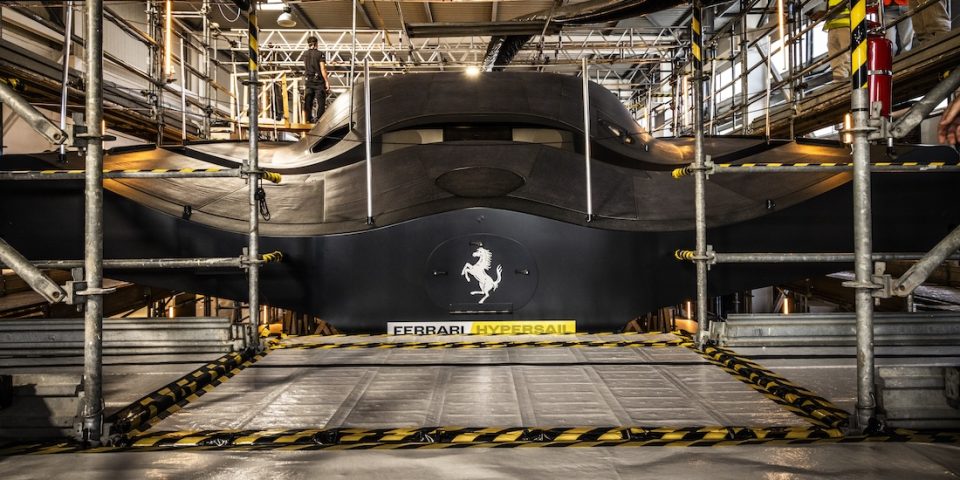
The visit begins in the shed housing the Hypersail’s fully decked hull. First impressions? The Verdier design, finished in yellow and matt dark grey, is striking in its sheer size: 100 feet long (30.50m) and up to 23.5m wide with the foils deployed. A truly XXL IMOCA! Above all, the hull shape immediately reveals the signature of the French designer, who designed the boat with his team, particularly the famous bustle, a kind of central trimaran hull running from bow to stern and supporting the rest of the hull structure. It is a concept he has already developed with Team New Zealand on the AC75 that won the last America’s Cup, and subsequently on the recent IMOCA designs DMG Mori Globa One (read our article) and Groupe Dubreuil.
“We worked extensively with our engineers and with Guillaume Verdier to determine the best possible aerodynamic shape. Guillaume came up with the initial concept, and we then worked closely with him in an iterative process to test and refine the shapes, drawing on our extensive experience in computational fluid dynamics (CFD) from the automotive sector. There were over 20 iterations of CFD calculations to finalise the hull shape; the key benefit for us was understanding the methods used in offshore racing whilst bringing a fresh perspective”, Matteo Lanzavecchia, who is also in charge of Ferrari’s sports car programmes, later told us. He worked on the design of the Hypersail with around twenty engineers specially seconded from Maranello, the Scuderia’s headquarters.
A Flight Control system to stabilise the boat
“The bustle is designed to help the boat lift off, but also to minimise wetted surface area once flying. Its shape (slightly curved) has also been optimised to help the boat bounce back if it touches the water,” explains Marco Guglielmo Ribigini, technical team leader, as we begin our tour of the boat. This is also reflected in a chine running the full length of the hull, “to channel water out to the sides”. Another chine serves the same purpose at the bow of the upper hull. The design also features a hull that tapers to an extremely thin section at the stern.
He continues: “From the lowest point of the keel to the waterline, we can technically regulate flight height up to 1.50m, which equates to nearly five metres at deck level. We want to fly as high as possible to reduce drag, but the higher we go, the more difficult it becomes to control the boat. We therefore need to strike the right balance between flying high and keeping the hull as close as possible to the water’s surface, to prevent air from getting underneath it.”
Flight height will be managed automatically by the Flight Control system, developed in-house by Ferrari’s engineers, once again transferring technology from cars to boats. “We adapted our car attitude and roll-control algorithms to develop this flight controller, which actively adjusts the appendage flaps to keep the boat perfectly stable,” explains the technical team leader.
Solar panels and wind turbines
for energy self-sufficiency
The tour, moving from stern to bow, shows just how far the aerodynamics of the imposing cockpit have been taken. Completely enclosed, with two sliding doors on each side (the Hypersail will be sailed by a crew of ten), it follows the approach Guillaume Verdier has developed in the IMOCA class. The visit also reveals that the deck, from the foredeck to the stern and across the coachroof, is covered in solar panels totalling 100m².
One of the project’s major innovations is its energy self-sufficiency, meaning no fossil fuels are needed to meet its substantial energy demands, primarily to operate the systems controlling the appendages. “Managing these systems requires a great deal of energy,” confirms Matteo Lanzavecchia. “But this is an area in which we have made tremendous progress recently, particularly with the development of our first electric vehicle, the Ferrari Luce. We have transferred all that expertise to the boat.”
“The key principle was not to rely on a single energy source,” explains Marco Guglielmo Ribigini. “That’s why we have installed solar panels divided into 16 independent sections: if a cell or panel breaks, the others continue generating power. We have also designed three mounting positions for wind turbines at the stern, which can be used in winds from 0 to 80 knots, although we won’t fit all three at once. If our energy-consumption calculations are correct, one or two will be more than enough.”
Ferrari’s engineers have also run numerous simulations in this area. “The aim was to predict as accurately as possible battery levels, the energy required to control the boat, and how much energy could be harvested depending on its geographical position relative to the sun and the apparent wind strength, whether sailing upwind or downwind… All these parameters have been incorporated into our digital models.”
Appendages with geometry
reminiscent of the AC75
The tour continues along the starboard side of the Hypersail’s hull, five metres above the ground, revealing the substantial openings in the hull where the foils will be installed, a longitudinal box integrated into the foredeck to house the headsails and, finally, at the bow, a three-metre bowsprit to which those sails will be tacked. The North Sails rig, with a maximum sail area of 462m², will include a double-skin mainsail, as on the AC75. “This allows us to adjust its camber and provides a much wider operating range. It delivers significantly more power with a shorter mast (35 metres), reducing inertia and weight while lowering the aerodynamic centre of effort,” explains Marco Guglielmo Ribigini.
Up front, the Hypersail will sail “under J2 80% of the time,” he continues. “We’ll also have a J3, and we’re considering a larger jib top for very light winds, particularly during displacement-mode testing or the initial foiling phase. And, of course, a J5 for storm conditions.” At the stern, the mainsheet traveller is designed to withstand a load of 40 tonnes, while the rotating mast has been built by Southern Spars in New Zealand.
With the tour of the boat complete, we head to the second shed, where the appendages are displayed like museum exhibits, each with its own explanatory panel. Here again, the sheer dimensions are striking, and the geometry is reminiscent of the AC75s. The components include a 6.50m foil arm, an impressive canting keel with a 35-degree angle of rotation, fitted with a lifting surface whose half-span (4.80m) matches the size of the F80 hypercar, a carbon rudder with a bulb, and titanium flaps on all the appendages’ lifting surfaces, “a material that offers greater resistance to cavitation”.
“It’s a new Ferrari”
On the choice of materials, Matteo Lanzavecchia explains: “For the foil, we wanted a very thin profile, so we developed a special composite-and-titanium sandwich construction to maintain high strength while keeping weight down. To achieve this, we carried out numerous multi-material simulations, a process we also use, for example, for our car roofs, where the aim is to reduce weight and thickness without compromising structural strength.”
One final example of technology transfer between Maranello and Pisa? The “major innovation” presented at the end of the tour, backed up by successful live demonstrations for the journalists: the winch by wire. Its purpose is to convert the human power applied at the pedestal into electrical energy, which is centrally managed and redistributed in real time to control the sail plan. This allows a crew member to multiply their effort and handle loads of up to nine tonnes at the pedestal!
“It’s a system derived from the suspension system of the Ferrari Purosangue, which we developed for the Hypersail,” says Marco Guglielmo Ribigini. The CTO adds: “We then used it to develop the by wire gearbox controls for the upcoming Ferrari 12 Cilindri Manuale, demonstrating that innovations developed for the Hypersail can also be adapted for our production cars.”
The visit, which will be followed by individual interviews (see the interview below with project leader Enrico Voltolini), concludes with a presentation by Maria Conti, Ferrari’s communications director, who sums up the project: “The Hypersail isn’t just a boat; it’s a new Ferrari, a laboratory for innovation.” Does that mean it has an unlimited budget? “There is always a budget limit, but let’s just say that in this particular case, the ceiling is very high,” Marco Guglielmo Ribigini replies with a smile.
Photo : Ferrari