
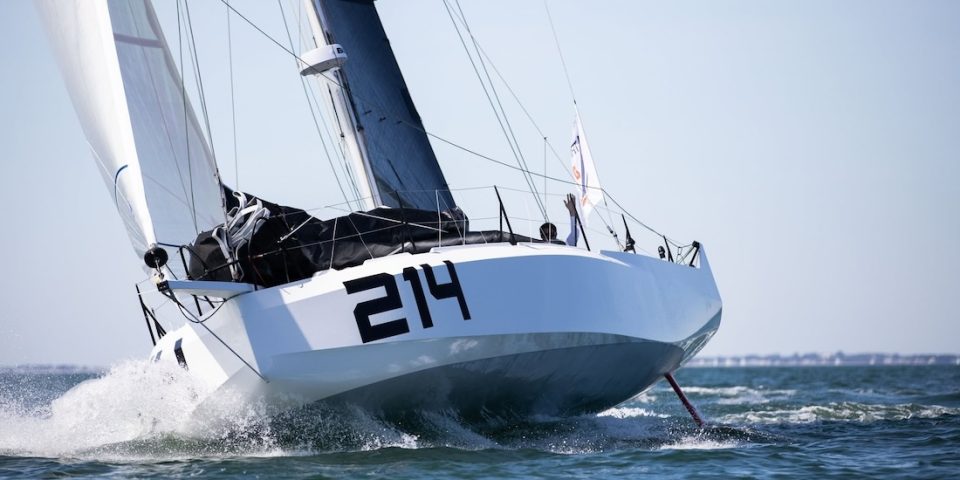
After four years aboard Project Rescue Ocean, the Raison-designed Class40 launched in 2020, and a 2025 season alongside Corentin Douguet, Axel Tréhin launched his new Class40, a Lift V3, in April. He finished fourth this spring in both the solo Trin’40 and the double-handed CIC Normandy Channel Race (with Antoine Carpentier). Ten days before the start of the Drheam-Cup, the 37-year-old skipper reflects on a project that has overcome more than a few obstacles.
You joined the Class40 fleet in 2021 with a brand-new Raison design. What do you take away from that first campaign?
I really found my feet aboard No.162 and within the Class40 class, which allows you to achieve great things with sensible resources. It’s not necessarily an arms race, many races are decided by incredibly close finishes, and the circuit enjoys genuine enthusiasm among sailors. During the first two years, I managed to do things properly with the budget I wanted [an annual budget of around €350,000 to €400,000, Ed.]. The following two years were much tougher, with around €140,000. By 2025, I simply couldn’t afford to run the boat anymore.
How did you bounce back?
We found someone to charter the boat, which freed me from having to manage everything on my own. As it was a Transat Café L’Or year, the idea was to become part of an ambitious campaign. It also came after I had to lower my ambitions following an unsuccessful attempt to put together a Vendée Globe 2028 project. I got in touch with Corentin Douguet, who was building No.209, the very first Lift V3 (Lombard design). Since he hadn’t yet secured his full operating budget and I was able to bring some funding as well as joining the team and sailing programme, we shook hands at the end of 2024. We quickly realised we complemented each other well and got to grips with the boat very quickly, which allowed us to be competitive from the outset. In the end, we had a great season [winning every race except the Transat Café L’Or, where they finished second, Ed.]…
“An efficient, race-ready boat”
Was that experience what convinced you to launch your own brand-new Lift V3 this season?
The original plan was actually to have two boats running together with a second skipper, creating economies of scale. When that second project fell through, there was a completed hull and deck sitting there with the keel alongside it! Naturally, quite a few people showed interest, but nobody really committed. I also had it in the back of my mind and kept seeing that the boat wasn’t selling. My interest really grew once I started sailing Corentin’s boat. I began looking ahead to the Route du Rhum and realised it would be a genuine asset if I wanted to be competitive. I spent a few evenings working through the numbers on an Excel spreadsheet and quickly realised that taking over the unfinished platform and completing the boat with a small team would generate significant savings while also reducing operating costs from year one.
Can you explain how that works?
A new boat like this costs around €1 million, with first-year depreciation of roughly €140,000. On an ambitious annual operating budget of between €400,000 and €500,000 [he didn’t complete, Ed.], you can immediately save between €50,000 and €100,000. On top of that, I spent a year helping optimise and improve the reliability of Corentin’s boat, which means I now have an efficient, race-ready boat from day one, with proven systems already in place. It’s a deliberate choice on my part to approach the Route du Rhum with the technical and sporting resources needed to fight at the front of the fleet, even if that comes at the expense of other areas, such as staffing. If I actually pay myself, it’ll be a miracle… So, as the season is already well underway, I propose a winning project at an unbeatable price: €250,000 turnkey for a sponsor. Within the team, we’re convinced our biggest challenge isn’t the project itself, it’s simply getting in front of the right decision-makers and convincing them.
“Once everything burned down,
the project suddenly became much more achievable”
In the middle of all this, a year ago you and your family went through the devastating fire that destroyed both your home and your workshop. How did you manage to cope with that while continuing the Class40 project?
We had signed for the boat just three weeks earlier, so naturally we questioned whether we should carry on. I genuinely think that if the contracts hadn’t already been signed, I would probably have walked away because what happened was overwhelming. We suddenly found ourselves dealing with things we had absolutely no experience of… But I was fortunate that people still believed in me and trusted me to continue. In the end, this project became one of the driving forces that stopped us from standing still and gave us something positive to focus on. Above all, though, there was our one-year-old daughter, who needed us from the very next morning. At the same time, the season with Corentin was just beginning, right before Spi Ouest-France. I remember that in the five or six days before signing, my legs were shaking because I wondered whether I was making a huge mistake. But ultimately, once everything burned down, the project suddenly became much more achievable, because my concerns shifted completely. My brain went from wondering, “How are we going to finish building the boat while racing with Corentin?” to “How are we going to rebuild our home?”
After your first two races of the season, you’re lining up for the Drheam-Cup on 12 July. How are you approaching it?
With a huge amount of motivation. The Trin’40 and the Normandy Channel Race showed that the boat is fundamentally very good and has real potential. I want to keep progressing at this event, which features an outstanding fleet (36 Class40s), with many sailors who know their boats inside out. Personally, I’m not at that level of familiarity yet; I still have a lot to learn. And because my project is not yet fully funded, I spend a lot of time on other work, which means I can’t train as much as I’d like.
Will you race the Route du Rhum whatever happens?
At this stage, I’d say yes. We’ve invested far too much energy and taken far too many risks not to see it through. Right now, if I stop, I’ll still have some debt and a lot of frustration. If I race the Route du Rhum, I’ll have more debt—but a lot less frustration!
Photo : Manon Le Guen / La Trin’40