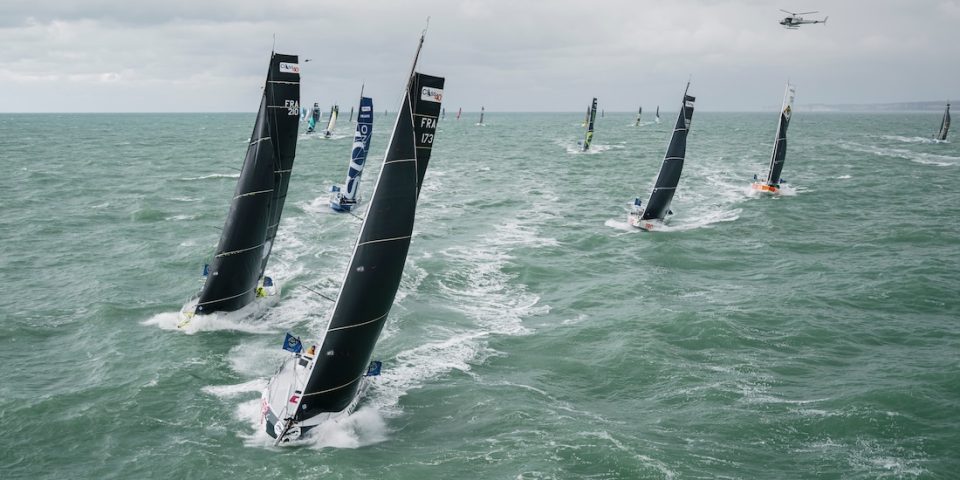
While the Rorc Caribbean 600 kicked off the season on 23 February, things really get underway for the Class40 in April with the Spi Ouest-France BPGO followed by the Trin’40. A new solo race designed to prepare sailors for the year’s flagship event, the Route du Rhum-Destination Guadeloupe, the highlight of the four-year cycle for a class that remains as dynamic as ever.
An ever-rising sporting level, a fleet of 70 to 80 boats regularly racing, 16 events on the calendar… “The momentum is there!,” says Cédric de Kervenoaël, president of the Class40. At a time when offshore racing is affected by economic and geopolitical uncertainty, investments in Class40 are far smaller than in other classes, so they are less likely to be questioned, although that doesn’t mean finding partners is easy.”
And he adds: “Overall, budgets remain accessible. I spoke with a skipper heading to the Route du Rhum with a total budget of €80,000, while others aim for as much as €500,000. And the second-hand market is beginning to stabilise.”
Stéphane Le Diraison, whose aim is to line up in the 2026 Route du Rhum-Destination Guadeloupe on a second-hand Class40, confirms: “The economic, political and international situation means companies are extremely cautious. I had 19 years of uninterrupted sponsorship from 2005 to 2024, and in 2025, when I tried to launch this new project, it was clearly the most difficult year, even though on paper I had never been more credible.” The sailor who finished 18th in the 2020-2021 Vendée Globe continues: “I found a sponsor, but we were uncertain about my qualification for the Route du Rhum. As the number of places for Class40 has just increased, the path is clearing and the decision should be confirmed quickly.”
“OC Sport, the race organiser, initially announced 40 places, which would have been catastrophic for us and something we fought against for four years, but we will finally have 50 plus a few wild cards, so 52 or 53 boats,” confirms Cédric de Kervenoaël.
The Route du Rhum remains
the class catalyst
Holder of the Jules Verne Trophy on Sodebo Ultim 3 since January, Pierre Leboucher is among the candidates. He recently acquired Nicolas d’Estais’ Lift V2 thanks to an investor, but admits he is struggling to secure sponsorship: “I started actively searching after the Transat Café L’Or, but so far nothing has come through. And I will have to find solutions because I must pay €18,000 in entry fees and €5,000 in deposit for the Route du Rhum by 31 March.”
Axel Tréhin faces a similar challenge, with his new Lift V3 scheduled to launch on 6 April: “Even if it has always been difficult to find funding, recently, with political uncertainty in France and the international context, it doesn’t reassure potential partners.” The skipper, who took over in June the composite structure (deck, framework and hull) of the boat originally launched by Frédéric Denis—whose project failed due to lack of funding—is finishing the build himself to reduce costs. “It allows us to offer a Route du Rhum project at a very attractive price, with an annual operating budget of €250,000, whereas my competitors are looking for roughly double.”
On the new-build side—where construction now approaches one million euros—three boats are expected this year (compared with six last year): those of Axel Tréhin, Alexis Loison (currently being completed at Neo Sailing Technologies) and a third skipper not yet officially announced. In total there will be 28 builds over the 2023-2026 cycle, close to the previous one (30 between 2019 and 2022). After nearly twenty years in Figaro and a victory in the Solitaire du Figaro Paprec in 2025, Alexis Loison, still supported by Groupe Réel, has chosen Class40, a platform he has already sampled. “It’s a very dynamic class with a strong fleet and a sporting level that has clearly risen in recent years. And not doing the Route du Rhum in a sailing career would have been a bit of a shame—it was really starting to bother me watching others leave without me.”
The Lift V3, “a weapon“
Like Axel Tréhin, he opted for the Lift V3, with the Lombard design clearly gaining momentum on the circuit. “The results speak for themselves, confirms the Normandy sailor. It’s the design office that won the last two editions of the Route du Rhum [Yoann Richomme in 2022 on a Lift V2 and in 2018 on a Lift 40, editor’s note] and Corentin Douguet, with co-skipper Axel Tréhin, gave it strong exposure last year.” The skipper of SNSM, faites un don! made a strong impression by winning the Spi Ouest-France, the CIC Normandy Channel Race and the Rolex Fastnet Race before finishing second in the Transat Café L’Or behind the duo Guillaume Pirouelle/Cédric Chateau.
“Even though we haven’t yet discovered its full potential, it’s a weapon, I think it’s the new benchmark for speed on the circuit, adds Axel Tréhin. According to the designers, once the boat starts accelerating, the speed differential becomes increasingly significant with our competitors because we have less drag.” Alexis Loison, who will receive his Groupe Réel in mid-May, offers some balance: “In the past, as soon as a new boat appeared it blew the others away. Today, we’ve reached a stage where platforms can still evolve; the boats are not identical but close enough that it quickly becomes clear the sailor remains central to performance.”
A view shared by Achille Nebout, who sails Amarris, the Lift V2 that won the 2022 Route du Rhum: “Even though around thirty new Class40s have been built since mine, it remains a strong reference boat. And since solo racing is a particular exercise, I hope to play my cards well this year.” Pierre Leboucher adds: “The Lift V2 is very competitive upwind and on reaching legs, and in a Route du Rhum we know the northern route—where you have to cross the fronts—is often the one that works.”
The Trin’40, a solo appetiser
Before focusing on the season’s big event and the four-year cycle that drives most Class40 projects, skippers ready to compete will be able to warm up in the Trin’40, a new race launched at the initiative of several skippers from Orlabay, the offshore training centre based in La Trinité-sur-Mer (start on 24 April). “We wanted to create a solo race so everyone could benchmark themselves right at the start of the season and make the first adjustments quickly, right after the Spi Ouest France (2-6 April), which is attracting more and more Class40s [around fifteen entries, editor’s note], explains Quentin Le Nabour, one of the skippers behind the event. The 1,200-mile course is also long enough to be a Route du Rhum qualifier.”
“It’s extremely important to have a fairly long solo race in a Route du Rhum year because we need to prepare for it, says Achille Nebout, currently delivering his boat back from Cascais (Portugal), where he went to train with Pep Costa and Luca Rosetti. There will be plenty of competitors—it looks set to be a great success for a first edition.” Axel Tréhin also welcomes the initiative but admits he will not start “with a very specific performance objective because it will be the first solo race of the season. For many of us it will be a working race.”
Co-organiser of the new event, the class, which according to its president wants to “gain greater control of the circuit and take ownership of the races on the calendar”, is investing around €50,000 and handling communications, while delegating the sporting side to the Société Nautique de La Trinité-sur-Mer. “Next year we want to do the same for Les Sables-Horta,” he adds, as the Class40 aims to increase its visibility. “We have a great championship, but on some races we think improvements can be made, particularly in terms of media coverage,” confirms Quentin Le Nabour.
Looking ahead to 2027, “we have been approached by Genoa for a race project there, the class president concludes. The idea would be to start the season in the Mediterranean with that event, followed by the CIC Med Channel Race, before heading north to the Atlantic and the English Channel.”
Image : Vincent Curutchet / Alea