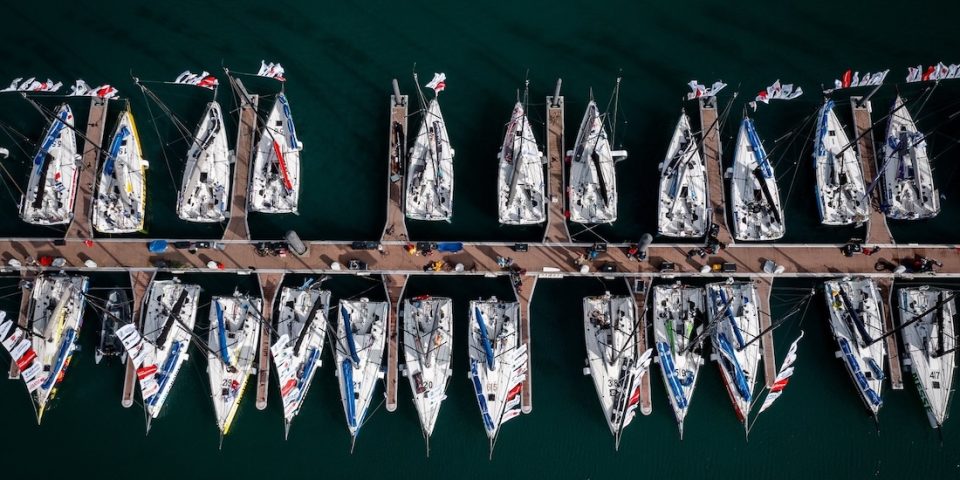
It is the Solo Guy Cotten that, from March 6 to 14, will kick off the new season of the Figaro Beneteau circuit, marked by a reshuffled calendar, with a springtime Solitaire, but also the return of former heavyweights of the circuit, coming back to test themselves against the younger generation.
In this winter marked by a succession of storms, it is fair to say that the sailors of the Figaro Beneteau class have spent plenty of time on the water pushing hard! And for good reason: with a Solitaire du Figaro Paprec brought forward to May (May 17–June 7), everyone has been diligent in training, especially as the announced return of several big names in the discipline has added “a good extra dose of spice to an already very competitive fleet,” rejoices Éléonore de Grissac, the class’s general secretary. She reports “a stable number of memberships and around forty expressions of interest for the four races of the French Elite Offshore Racing Championship.”
Among them, therefore, are illustrious returnees, from Yoann Richomme to Nicolas Lunven and Xavier Macaire, as well as, for part of the season, Jérémie Beyou, Nicolas Troussel and Adrien Hardy, while Loïs Berrehar, younger than his elders (32), returns under Banque Populaire colors. “We didn’t coordinate, but I know why so many of us are going back: it’s where we grew up and we know that we’ll find the same thing again—close racing, challenge, rigor and difficulty. The true strength of the Figaro class is that it guarantees all that. Everyone is on equal terms; once you’ve re-learned the ropes, it’s the sailor who makes the difference,” explains Yoann Richomme.
“I don’t know any former Figaro sailor who would say ‘never again’; there’s a form of addiction. We enjoy it just as much every time, and the level is extremely high,” adds Xavier Macaire, who returns under Snef colors to celebrate ten years of partnership and will contest his 12th Solitaire du Figaro. Another returnee, Nicolas Lunven (PRB), told us three weeks ago: “It’s a class I’ve remained very attached to. I had many great moments there, as well as setbacks and failures, but they helped me grow, because Figaro is solo and one-design racing, which means that when it doesn’t work, it’s because you weren’t good enough, and that pushes you to improve. This time, I felt that it was the right moment to come back, without being too old.”
“Bringing the Solitaire forward
changes the dynamic”
And in what state have these veterans found the circuit after a few years away? “I truly feel like I’ve found the same collective intelligence and the same profiles as before,” adds Yoann Richomme, double Solitaire winner in 2016 and 2019, the year of his last participation (and the first for the Figaro 3). “Talented youngsters just starting out, others entering the ‘money time’ of their third or fourth season, returnees… They’re going to make life difficult for us, for sure—we hope to give them a hard time as well.”
The only regret for the skipper of Paprec, whose new Imoca is currently under construction, is having lacked time to train. “Bringing the Solitaire forward to May inevitably changes the dynamic, but if you don’t want challenges, you don’t do Figaro. So I’ve put my foot back in the door; I don’t have all the pieces yet, but I hope to jump on the competition train with the Solo Guy Cotten so as to be fully ready in three months,” smiles the runner-up of the 2024 Vendée Globe.
This calendar change also makes life harder for newcomers to the circuit, such as François Jambou, Pierrick Letouzé, former Croatian skier Ivica Kostelic or Quentin Mocudet, fresh from the Mini circuit (runner-up in the 2025 Mini Transat series), who will have to get up to speed quickly. “It’s true that we were behind before even starting,” he smiles. “I could have skipped the Solitaire this year, but I figured it’s always better to race it than to watch the others!”
“Sailors are struggling
to secure budgets”
Why has the Solitaire start been moved from September to mid-May? “It was a request from the organizer, OC Sport, who hopes that this slot will make it easier to secure host cities, partner participation and overall visibility,” replies Jean-Bernard Le Boucher, the class president. “The economic climate is difficult; we know we need to try things, so we’re proactive in moving forward together.” He adds that in 2027, “it is very likely that the Solitaire will once again take place in the autumn, with the Transat Paprec at the start of the season.”
Beyond the economic context, the upcoming municipal elections are not helping matters, to the point that the finish city of the Solitaire has still not been finalized, nor has the route of the Tour Voile, raced since 2023 in Figaro boats and now a springboard for many young sailors. “Overall, the Figaro class is doing relatively well; the launch of the Academy has paid off and allowed us to have a pool of young sailors eager to continue on the circuit,” believes Éléonore de Grissac, who nevertheless adds: “But we know we must remain vigilant and that this is a pivotal moment for the entire ecosystem. Organizers are facing difficulties, sailors are struggling to secure budgets, and we need to support them all the more.”
Facing these challenges, Arno Biston, third in the last Solitaire du Figaro Paprec aboard Article 1, confides: “I had hoped to secure a full budget after my good results last year, but that hasn’t happened. Trying to do everything on a small budget, even with the best will in the world, just doesn’t work, so I had to make strategic choices: I will only race the solo events on my boat and will team up with another skipper on his boat for the double-handed races. It also helps preserve my sails for the Solitaire while still scoring championship points. It’s a shame because it means fewer boats on the starting lines, but that’s today’s reality! We already have the advantage of being a relatively low-cost class compared to its importance in the French offshore racing landscape.”
“Another ten years
with the Figaro 3”
“Our way of supporting sailors is also to guarantee a durable boat so that budgets don’t spiral. We’re approaching ten years of the Figaro 3, and our goal is to do another ten years with it,” explains Jean-Bernard Le Boucher. “To achieve that, we’re going to launch a major project to reinforce the one-design concept and upgrade areas of the boat that need to evolve.”
At the same time, the class wants to explore new territories and formats, such as the new double-handed race added to the calendar at the end of the season (August 24–September 7), between Vendée and Portugal. “It will start from Port Bourgenay and head to Lagos via Madeira. The second leg will finish on the island of Yeu, so in total we’re looking at at least 13 days at sea, including 8–9 on the first 1,600-mile leg. It will be true offshore racing; we really wanted to bring a bit of travel and adventure back into the program,” explains the organizer, Estelle Graveleau, former class general secretary and initiator of the Sardinha Cup (three editions in 2019, 2021 and 2022).
She adds: “The race will count for the French championship, with a coefficient of 3, so it will ensure suspense right to the end of the season. The project is ambitious, but we’re seeing interest everywhere we go, and we already have 22 declarations of intent. Nothing is guaranteed yet, but the bet is on.”
Image : Vincent Olivaud