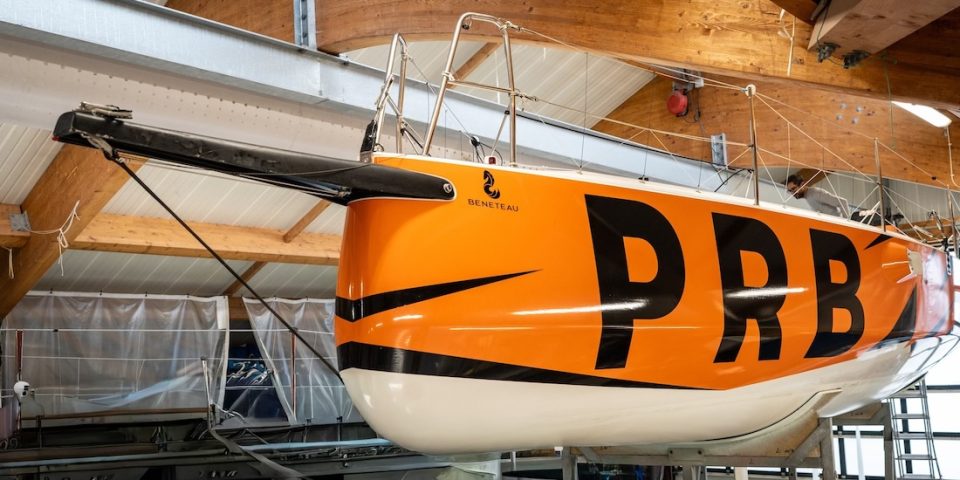
PRB announced on January 15 its commitment for 2026 to the Figaro Beneteau circuit alongside Nicolas Lunven. This marks a return to his roots for the sailor who finished sixth in the last Vendée Globe (sailing for Holcim PRB). Lunven has nine Solitaire participations under his belt, including two victories (2009 and 2017). After a few training sessions, the 43-year-old skipper speaks with Sailorz.
Before talking about the Figaro, let’s look back at 2025 in the Imoca. Did it take you long to recover from your first Vendée Globe?
No, I didn’t feel like I had a hard time getting back into it because quite quickly, once the euphoria of the finish passed, we had to dive back into the Imoca refit for our 2025 program. That program was exclusively crewed, which required some adaptations. I didn’t experience that difficult “post-Vendée Globe” period you hear about from some sailors—the drop in motivation or struggling to get back in the saddle physically. Having a precise roadmap played a big part. If I’d had nothing to do after the finish, I’m sure I would have spent weeks lounging on my sofa thinking about how hard it is to recover!
And what is your assessment of your Imoca season on Holcim PRB?
It wasn’t too bad; we finished third in the Course des Caps and third in The Ocean Race Europe, though there was a hint of disappointment regarding the European tour because we aimed to do a bit better. That said, we came up against teams stronger than us—specifically Biotherm, which dominated the field. We had a very tough fight with Paprec, and it came down to a single place on the final inshore race; it was real boat-on-boat racing.
Holcim PRB ended the Imoca project after The Ocean Race Europe. How did you take the news?
First of all, they never promised us anything for the future, so we can’t talk about a step backward or broken promises; their communication was always very clear and fair on that point. Nevertheless, there is always a form of disappointment when such a project stops. We hoped to continue until the summer, but quite soon after the European tour, they began telling us it was going to be more complicated than expected. In late October, they announced they didn’t wish to continue due to a set of parameters that are theirs to decide.
“One shouldn’t forbid oneself
from being ambitious”
How did your project to return to the Figaro take shape?
It’s something that had been on my mind for a while and began to mature more seriously last summer. It’s true that the fact that Yoann Richomme announced his return piqued my interest even more. I started talking about it with PRB, and the idea gained ground quickly with them; they came back to me in the autumn to say it was a go. Between my desire to return and the opportunity of a condensed calendar with the Solitaire in May this year, the project appealed to them internally.
Yoann Richomme will indeed be part of the fleet this season, as will Loïs Berrehar. Jérémie Beyou will do the early season races (though not the Solitaire), Nicolas Troussel would like to enter, and likely other veterans too. Does this mean the Figaro is a chapter that never really closes once you’ve tasted it?
These returns remind me of the era when I started (in 2007)—there were many former winners coming back. It seems to be shaping up that way this year, which is nice. Seeing someone like Jérémie, who has been in the Imoca world for years, return to the Figaro while waiting for his boat to be relaunched is a good signal and a great image for the class. Personally, it’s through this class that I learned solo sailing and offshore racing. Having raced nine Solitaires, it’s not something you can just set aside and say, “That’s the past, I’ll never go back.” It’s a class I’ve remained very attached to. I’ve had many great moments, as well as disappointments and failures, but they all helped me grow. The Figaro is about solo sailing and one-design racing—it means when it doesn’t work, it’s because you weren’t good enough, and that pushes you to progress. I told myself it was the right time to return, while not being too old, knowing that I’m almost starting from scratch because I’ve hardly sailed the Figaro 3. I did the boat’s very first race, the Sardinha Cup in 2019, and a Tour de Bretagne with Alan Roberts (in 2021).
And what do you think of this boat?
It’s not easy. I find the ergonomics aren’t very well designed; everything is hard on board. It’s not a boat where everything is fluid and easy to make fast, but the fact that the challenge is difficult makes it more exciting. It forces me to question myself and step out of my comfort zone. For now, I’ve only done three training sessions; I didn’t feel completely lost, but there is still work to do to be at the front of the pack.
Exactly, what are your ambitions as you return to the circuit?
I’m back with humility given the challenge ahead, but I also tell myself that one shouldn’t forbid oneself from being ambitious. The lineup is looking very strong, with my friend Yoann, and Loïs Berrehar too—who is younger than us but someone we’ve known for many years—and many very nice and talented young sailors. It’s also the fact of going up against these youngsters that does me good; it brings a certain freshness.
“The desire to do
another Vendée Globe”
Will your season end after the Solitaire? And if so, what’s next for you?
Yes, my Figaro season will end in June. Regarding the future, I can just tell you that I will still be sailing, but I’ll let the relevant parties communicate in due time; I don’t want to steal their thunder.
In the press release announcing the Figaro return, PRB mentions a “project deliberately tightened and limited to one season, thought of as a transition stage, without prejudging PRB’s future commitment to sailing.” Does this mean you are already discussing the future?
No. For the moment, it’s a one-year commitment; there are no calculations or anything for what follows. I cannot predict what tomorrow will bring, and I don’t know if the sailing project will continue or not. There is no ongoing discussion about it.
Do you still have the ambition to return to the Vendée Globe? And are you working toward that?
The first one went quite well; we managed to check a lot of boxes with the team, so yes, it certainly gives me the desire to do another one. However, the reality is that I don’t have much time to look for funding. The question I asked myself last year was: “Do I skip the Figaro to chase meetings with potential sponsors, at the risk of finding nothing? Or, since I have the opportunity to sail, do I put on my foulies and go?” Knowing that, in my opinion, it’s difficult to do both. When you’re racing in the Figaro, you aren’t sending out sponsorship decks or picking up the phone. So, four months ago, I had to decide, and I made my choice. Now, if a sponsor calls me to offer a Vendée Globe project, I’m not going to say no, but I am not in active research.
Image : Guillaume Le Corre / polaRYSE