
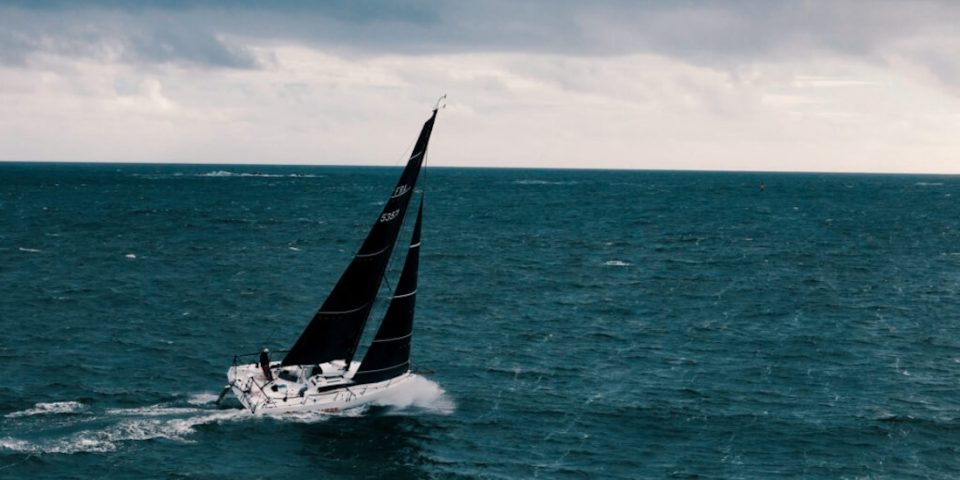
No introduction needed for Jean-Pierre Kelbert, who gave his initials to the JPK yard, whose various models have won everything in IRC over the past twenty years, both in France and internationally. A busy SME owner with more than 50 employees, the 62-year-old builder still has an undiminished appetite for competition and is lining up solo once again in the third edition of the Cap Martinique, which starts on Sunday from La Trinité-sur-Mer bound for Fort-de-France, with a strong fleet of 32 double-handed crews and 14 solo sailors. A race that also shapes up as a battle between boatyards.
With so many JPKs (18) on the start line of the Cap Martinique, do you even need to promote the yard anymore? Are you racing just for fun?
Exactly, I’m going with no pressure. In fact, I hadn’t planned to do the race again and it was the boat (the JPK 10.50) that made me want to come back. It’s probably my last one and I thought it would be a bit silly to miss out. So I arranged things with a client who lent me her boat, the one we won the Spi Ouest-France with. There will be three 10.50s, with Alex Ozon, who won in 2022 [on a Sun Fast 3300, ahead of Jean-Pierre Kelbert, editor’s note] and will skipper Léon, the yard’s boat, and Jean-François Hamon, who is also a loyal client.
A non-stop solo transatlantic in spring is no small feat. Approaching 63, weren’t you tempted to enter double-handed?
I loved racing double-handed, but I’ve discovered I really enjoy sailing solo. It’s not that I’m a natural loner, but I easily find my rhythm, I’m not constrained by watch systems. Believe it or not, I manage to read more solo than double-handed! That said, you need a great autopilot and everything to work perfectly because boats have become faster, plane much earlier and require more anticipation. The keel really starts to whistle from 13–14 knots, it’s a bit more stressful. Hopefully I won’t regret it!
“We’ve pushed the limits
while maintaining versatility”
In your account of the Spi Ouest-France, you said it was incredibly close with the Sam Manuard-designed Pogo RC (the designer is racing the Cap Martinique double-handed with Erwan Le Méné, and one Pogo RC is entered solo, skippered by Pascal Coret) and the Sun Fast 3300. Can you outline the strengths and weaknesses of each?
I’d say the Sun Fast is one step behind because there’s a generational gap. This Verdier design was the first IRC boat to adopt a fuller bow shape, with a reverse sheer under the transom, giving a lot of hull power. We followed with the JPK 10.30 and then Lann Ael 3, the Pogo RC prototype, came out. They went even further with a fairly radical hull and we saw that it worked better. On the JPK 10.50, with our in-house designer Jacques Valer, we pushed the boundaries while maintaining versatility. We’re often a bit better upwind than the Pogo, but they’re very comfortable downwind, especially as they’ve increased their sail plan with more square-top mainsails and bigger spinnakers. Logically they should be ahead, but the question is whether they’ll save their rating. They still owe us 30 minutes a day…
You mentioned improved performance, but boat prices have also risen significantly: €280,000 for a JPK 10.50. How do you explain that?
It’s true, we’ve increased by more than €70,000 compared to the JPK 10.30. The boats are more technical. The sandwich core is now Corecell rather than Herex as it uses less resin, the standard mast is carbon, the rudders are lifting on JP3 bearings… But most of the difference comes from labour because the composite work is more refined. We’ve gone back to vacuum laminating instead of infusion on many parts to reduce resin content, and there’s no structural bonding flange. All joints are done by hand. It’s getting close to Class40 construction standards. In the end, we save over 200kg on the platform, but we’ve gone from 1,100 to 1,400 working hours.
“Since the JPK 1010,
we’ve only made the right choices”
There were 60 boats at the start of the Cap Martinique in 2024, 48 this year. Could this drop be explained by the price and technical level of the boats?
Honestly, I don’t think so. We’re still producing one JPK 10.50 per month, demand is there and this race inspires a lot of experienced amateurs. There were actually 65 pre-entries a year ago, but the organisers recorded quite a few withdrawals. Some for medical reasons because there are a lot of boxes to tick, others, I think, due to the economic climate. There are many SME owners in this race’s audience and the current period isn’t easy, with a lot of uncertainty. When things get tighter at work, it’s not necessarily the right time to go sailing.
Which clearly isn’t your case!
I’m lucky to be in a strong market segment and surrounded by a great team, including Jean-Baptiste Dejeanty who supports Jacques (Valer) very well. We’re close to 60 people at JPK, the yard is doing well and I’m starting to think about succession. I’ve received quite a few external offers (to buy the company), but I haven’t really looked at them because I’d like it to happen internally. The expertise is there.
When you launched the first JPK in 2003 (the 9.60), you came from windsurfing, with no legitimacy as a builder or sailor, working with an unknown and unconventional designer. What’s the secret behind JPK’s success story?
I probably had a lucky star and I always believed in it. As you say, I came a bit out of nowhere, but I already had solid know-how at the time because, alongside boards, the JPK brand was doing a lot of moulding and parts for offshore racing. I knew the qualities of Jacques’ hulls and from there, imagination had no limits. It hasn’t all been smooth sailing either. We tried some models that didn’t work, but since the JPK 1010, we’ve only made the right choices and entered a virtuous cycle. We’ve diversified, with IRC boats but also fast cruisers and a bit of motor. When I retire, I think I’ll struggle not to stay involved in the design work, which is fantastic. I’ll keep lending a hand!
Photo : Sam Cade