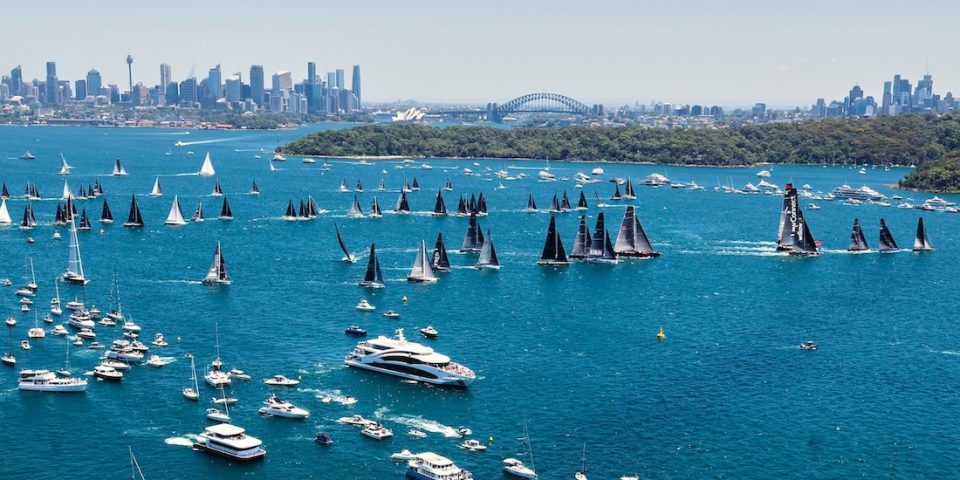
The rendezvous has remained unchanged since 1945. Every Boxing Day, around a hundred crews set off on the Rolex Sydney Hobart for a 628-mile course between New South Wales and Tasmania. For local sailors, it is THE big event of the year, but the fascination for this race at the end of the world is also shared, and has been for a long time, by French sailors who have made the long journey in large numbers to participate.
“It’s a legendary race, something to do at least once in a sailor’s life“, enthuses Corentin Douguet, winner a year ago in IRC double-handed and IRC 4 with Australian Rupert Henry. “When I was a kid, at the library, I read a book about the Sydney Hobart and I was fascinated by this already mythical race. When I had the opportunity to take part in 2019, I didn’t hesitate. It was the culmination of a dream”, says Frédéric Puzin, head of Corum L’Épargne – sponsor of Nicolas Troussel from 2018 to 2023 – and a seasoned sailor. Quentin Vlamynck, winner last year in IRC 3 with the crew of Cocody, highlights that the event fits well into the calendar. “The Christmas period is often off in French offshore racing. It’s a quieter time of year, boats are in the yards, and we can afford to go sailing elsewhere to learn something else.”
Taking part in the Sydney Hobart means treating yourself to a total change of scenery, even before the start. A fine connoisseur of the event – he is participating this year for the sixth time, in IRC double-handed with Australian Jiang Ming, and was also on board Cocody in 2024 -, Alexis Loison even describes it as “a clash of cultures“. He recalls an edition raced with an Australian crew: “We had completely different approaches to managing the boat and the crew. It was sometimes unsettling. For example, to furl the Code 0, I suggested bearing away hard to preserve the sail. For them, that was out of the question. The misunderstanding is sometimes mutual: when they see the Vendée Globe or our maxi-trimarans, they think we’re crazy.”
“A truly phenomenal spectacle”
This dynamism of the bay is exacerbated on the day of the start. In fact, the Sydney Hobart is a very popular race in Australia, with extensive media coverage. “This event doesn’t only interest sailing fans. It’s a bit like the Vendée Globe or the Route du Rhum back home, summarizes Corentin Douguet. This is felt at the moment of the start, there are an enormous amount of spectator boats. Since Sydney Harbor isn’t very large, it’s really intense to be tacking around in there!”
Alexis Loison adds: “It’s almost like a stadium, with a lot of people on the shores. Every time, I am struck by the noise. Last year, I counted seven helicopters. It creates a special atmosphere.” Éric de Turckheim, who has taken the start three times (winner in IRC 3 in 2015), is also still impressed by “the phenomenal spectacle, Sydney Harbor is a bit like the Solent at the time of the Fastnet Race: a sort of enclosed space that allows for very high visibility of the starting line and the exit of the entire fleet.”
“You know you might take a beating”
For Quentin Vlamynck, “the Bass Strait is clearly the place that scares you when you leave because the weather phenomena can be very violent, with sudden changes in wind.” He adds: “You feel it can quickly become catastrophic. When you sign up as a crew member, you know you might take a beating, you have to be ready to push your limits.” The storm stories are numerous. “On my first Sydney Hobart, we got hit by a huge gale, really violent. A wall fell on us, recalls Éric de Turckheim. On another edition, not directly in the Bass Strait, but arriving in Tasmania, the wind rose to 45 knots. We started running with the wind to try and douse the jib.”
Our five witnesses evoke varied conditions throughout the course, with contrasting weather. “You leave with your hat and plenty of sunscreen, and you can end up dressed as if you were going to the mountains, explains Alexis Loison. In Tasmania, you feel like you’re not far from the “big ice cube.” With a south wind, the atmosphere becomes freezing. During my second participation, I was with a crew from New Caledonia, I think they had never been so cold in their lives!”
The French shine
“Because of our offshore racing culture, we evolve our racer-cruiser boats, like the JPKs or the new Sun Fasts, which is less the case abroad, adds Quentin Vlamynck. When it’s downwind in the breeze, we pull ahead because the Australians still have boats that aren’t very wide with symmetrical spinnakers. They are great sailors but they are sometimes restricted by their boats.” The final word goes to Frédéric Puzin: “When you take part once, you only think about one thing: coming back“.
Image : Rolex