The Olympic sailing season has just begun with the test event for the 2027 World Championships in Fortaleza—where Lauriane Nolot took third place in kitefoil—and the Lanzarote International Regatta, notably marked by the victory of the Erwan Fischer/Clément Pequin duo in the 49er. This provides Sailorz an opportunity to review the French team’s ambitions for 2026.
Between Brazil, the Canaries, Marseille, and other training hubs, French athletes embarked on their Olympic preparation for the Los Angeles 2028 Games are currently fine-tuning their 2026 season. It begins with a major first milestone: the Elite French Championship. Relaunched this year by the French Sailing Federation (FFV), it will bring together approximately 150 crews across all ten Olympic classes in Marseille from February 18 to 22.
“It had been about twenty years since this French championship last took place. We felt that with the exceptional Olympic legacy of the Florence-Arthaud base in Marseille, it was the right year to relaunch it,” explains Loïc Billon, manager of the French team since last year alongside performance manager Franck Citeau. “It’s an opportunity to gather all our active forces and performance cells, to conduct a roster review, and especially to see if any young talents emerge. It’s also a chance to test the new race formats (*) for the Los Angeles Olympiad before officially launching the international preparation campaign, which starts in April with Palma Week.”
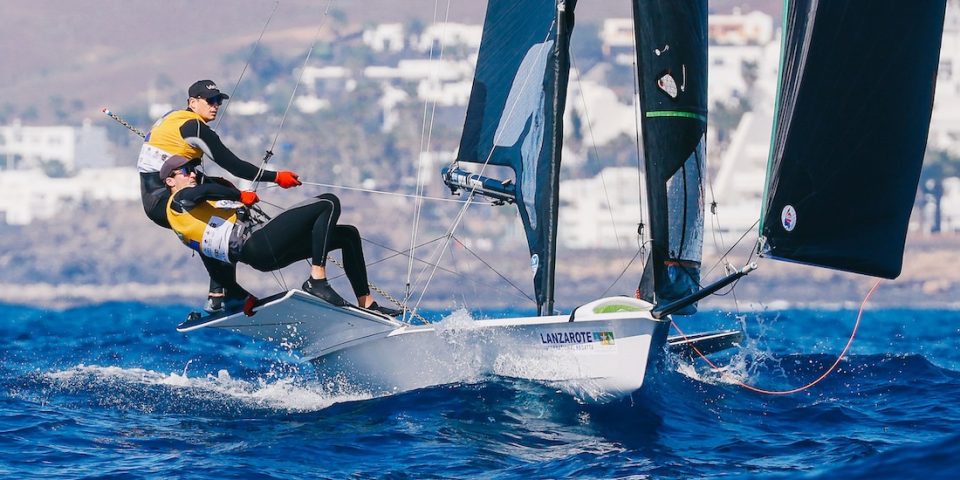
What do the athletes think? “It’s a great idea,” responds Aloïse Retornaz, who has been involved in a new Olympic project with Tim Mourniac in the Nacra 17 since last year. “It’s something that was missing; we were one of the few disciplines without a French championship. It’s a good way to get everyone together, create national momentum, and build moments of cohesion.” For Clément Pequin, winner of his first competition of the year in the 49er at the Lanzarote International Regatta (photo): “It’s good to have a French championship every year, even if I find it a bit early in the season. And for the record books, it’s always important to win a French champion title.”
Quiberon to Host World Championships
The rest of the season will follow the traditional steps of the Sailing Grand Slam (formerly the World Cup), including the Trofeo Princesa Sofia in Palma, the French Olympic Week in Hyères, Dutch Water Week, and Kieler Woche. A fifth event will also take place at the Los Angeles Olympic venue in July: the Long Beach and San Pedro OCR (see below). However, as with last year, the Tricolores are primarily expected to perform at the individual Class World Championships. The first meetings are in May for kitefoil (May 9–16 in Viana do Castelo, Portugal) and Quiberon (May 12–17) for the Nacra 17 and 49er/49er FX. Other Worlds will take place in August for the 470 (Aug 10–17, Enoshima, Japan) and ILCA 7 (Aug 23–30, Dun Laoghaire, Ireland), and in September for the ILCA 6 (Sept 5–12, same location) and iQFoil (Sept 4–12, Weymouth, England).
These dates are already circled by the athletes we interviewed, particularly the Quiberon Worlds. “A World Championship in France—that’s never happened to me,” confirms Aloïse Retornaz. “Plus, for Tim, it will be at home in Quiberon. We are quite eager to be there; we want to make our mark on home turf.” The same enthusiasm is shared by Clément Pequin: “It’s really nice to compete in this World Championship in front of family and partners. I get the impression there’s a major internal organization building up. It will inevitably mean extra pressure, but we will be determined to secure a podium, or even reclaim our title (they were crowned in 2024 and finished 11th last October in Cagliari).”
For Lou Berthomieu, who has teamed up with Mathilde Lovadina in the 49er FX after competing in the Paris Games in the Nacra 17 with Tim Mourniac: “This is clearly the main objective of the season, which will allow us to truly gauge ourselves against the global fleet. But we also have a longer-term vision, which is the national selection for the 2027 Games, so we’re giving ourselves a big year of work to continue growing our crew.”
The Financial Stake
As in 2025, these Class World Championships will serve as the final judge for inclusion in the French Team, with “normally the same criteria” according to Loïc Billon: a top 6 finish. This explains why this year’s team is quite tight, consisting of only nine sailors who met the selection requirements. “We hope others will join next year,” the manager adds, referring to those in the “France performance group and the youth French team, totaling more than 50 athletes preparing for the 2028 and 2032 Games”.
Meanwhile, only the nine selected sailors receive full federal support in 2026, though this doesn’t stop them from seeking additional partners. This is the case for Erwan Fischer and Clément Pequin. “To have everything we want in terms of equipment, external consultants, and travel, we need €100,000 to €120,000 per year,” Pequin comments. “The Federation supports us enormously, but it cannot meet 100% of our needs.”
For those in the performance group, the budgetary hurdle is even higher. Lou Berthomieu mentions an annual budget of €150,000: “Unlike last year, we aren’t ‘Equipe de France’ status, so we don’t have as much federal aid. It’s tighter; we watch every expense. But fundamentally, it doesn’t change much, as we are in a discipline where you must have significant financial input to perform. With Mathilde, it’s truly a project we carry ourselves, with our sponsors, patrons, and parents. It’s thanks to them that we were able to train this winter in Vilamoura instead of staying in Marseille.”
The rules of the game seem well-accepted by another 49er FX competitor, Amélie Riou, who changed teammates this winter (Manon Peyre succeeding Lara Granier). The newly formed duo is aiming for a “top 15” at the Quiberon Worlds: “Just because we aren’t in the official ‘Equipe de France’ doesn’t mean we should descend into a melodrama. It might be a bit harder financially, but it’s important to have demanding criteria because it raises the overall level. You have to take it as a challenge. And the Federation still makes resources available to us.”
Strengthened Support Staff
Nevertheless, for this season, the French FX crews, as well as the ILCA 7 and women’s iQFoil, will be deprived of federal support for the trip to Los Angeles next July, where training and regattas are scheduled on the Olympic waters. “It’s a choice we made based on 2025 performances, but also for budgetary considerations,” justifies Loïc Billon. “We targeted certain classes as a priority this year by increasing the resources available to them, but that doesn’t mean the door is closed for others in the future.”
The French Team’s management has indeed been strengthened. In addition to national coaches for each class, there is the temporary addition this year of “expert specialists,” as well as a data scientist cell that will welcome newcomers such as Benoît Ogier (via an agreement with Ifremer) and former double Tour Voile winner Valentin Sipan. “In each class, we want to form a manager-expert-data scientist trio,” Billon continues. “For the experts, it addresses areas identified by athletes and coaches. For example, we are welcoming Camille Lecointre, Stéphane Christidis, and Thomas Goyard this year.”
The budget allocated to the Olympic program this year? “In total, it is around €5 million, with €2.7 million provided by the National Sports Agency (ANS). It is slightly up, but we will have higher expenses because the Los Angeles trip is expensive,” the manager answers. These resources are intended to put the French team on the right track for a decisive 2027, when Olympic quotas will be up for grabs in all ten classes—particularly at the two World Sailing Worlds in January (Fortaleza, Brazil for single-handed) and in the summer (Gdynia, Poland for double-handed).
(*) The Los Angeles formats will be the same for kitefoil and iQFoil (qualifications, quarters, semi-finals, and final), while for other classes, the qualification phase will be followed by two medal races (for the top ten) instead of a single double-points race.
Image : Sailing Energy / LIR