
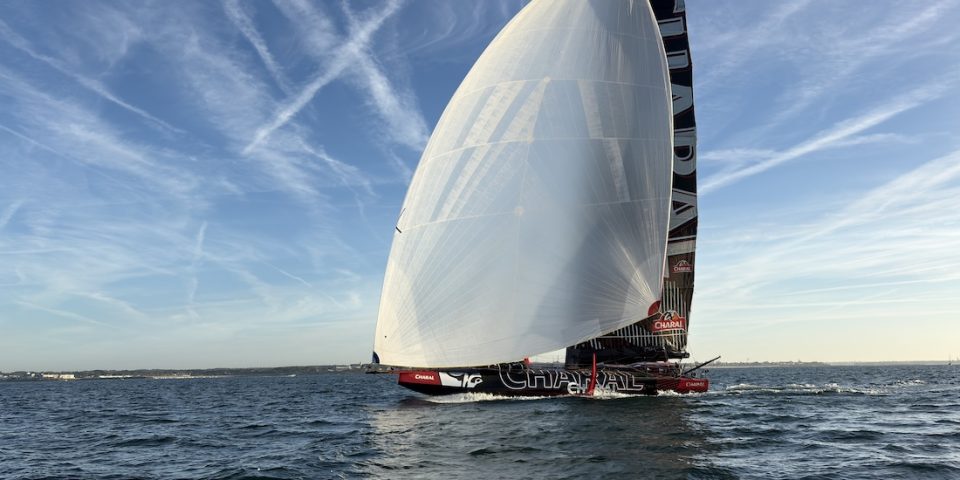
In November 2025, the victory of Jérémie Beyou and Morgan Lagravière in the Transat Café L’Or aboard the Imoca Charal was marked by a discreet innovation that nevertheless caught the eye of specialists: a spinnaker crafted from FA58, an Aluula polyethylene fabric, a new material designed and manufactured in Canada that could well be a game-changer in the world of competitive sailing.
It all began in 2017 in Victoria, British Columbia, at Ocean Rodeo, a board sports specialist seeking a lighter, stiffer alternative for the inflatable leading edges of its kitesurf and wingfoil wings. The answer came from polyethylene, the polymer with the lowest known density. The catch was that “to get anything to adhere to polyethylene, you normally had to go through a gluing process, which created durability and weight issues,” explains Dr. Tyler Cuthbert, Chief Scientific Officer at Aluula.
The Canadian team then developed a process that “enables the direct fusion between a high-modulus polyethylene yarn and films without any glue, resulting in an extremely light, strong, and rigid material.” The resulting product, named Aluula, boasts numerous advantages: not only is it fully hydrophobic—meaning the sail retains its weight even when wet—but the absence of adhesive also eliminates the risk of delamination, the main cause of degradation in traditional composite sails. Additionally, Aluula’s resistance to UV rays, chafing, and creasing extends its lifespan. “We succeeded in developing a material that doesn’t stretch, doesn’t deform, and retains its original properties longer,” summarizes Tyler Cuthbert.
These assets were bound to appeal to sailmakers and professional teams facing the limits of existing materials for spinnakers on boats such as Imocas. Charged with designing the spinnaker for Charal, Quentin Ponroy, now a sail designer at Incidence Sails, tested an Aluula-made spinnaker during 2025 with the Beyou Racing team. “On Imocas, which generate very high loads, nylon or polyester—which have barely evolved over the years—were showing their limits: their stretch under load deformed the sail compared to the original design,” he relates. “During the first test with the new Aluula spinnaker, the shape retention of the sail in dynamic conditions was far superior.”
In practical use, the material—which is also much easier to recycle than a traditional membrane because it is a single-component material—confirmed its potential: “For equal strength, it is about 50% lighter than a traditional fabric; you really feel like you’re taking a massive step forward,” continues Quentin Ponroy. “The stability gained on the luff also allows for the design of flatter sails suited to tighter angles, broadening their wind range,” notes Stéphane Fauve, an engineer who has been working with Aluula for several years on R&D related to maritime transport and sails. This development brings renewed interest to the spinnaker, which was increasingly being abandoned on latest-generation Imocas.
Corentin Horeau’s MACSF team has also placed an order for a spinnaker made with the material developed by Aluula, while Pierre-Antoine Morvan, offshore and superyachts division manager for Incidence Sails, emphasizes: “These early successes confirm the potential of Aluula as a high-performance solution for offshore racing applications. We intend to continue investing in the development and integration of this technology.”
Meanwhile, Aluula’s team is working on a new assembly method: welding. Called no-sew construction, this technique creates joints stronger than the material itself by eliminating seams and reinforcement strips, “which could further optimize sail performance and weight,” specifies Quentin Ponroy. Weight savings of around 15% have already been observed on wing and kite wings. “On superyachts, where sail areas can be particularly large, this weight reduction can translate into very significant absolute savings, making sail handling easier while reducing weight aloft”, explains Tyler Cuthbert.
This method also simplifies repairs at sea, as a simple heated iron is enough to weld a durable patch. The same welding technology also opens up interesting possibilities beyond sails, including hydrophobic, ultra-light and highly durable sail bags, deck bags, pockets and lazy bags, without relying on traditional sewn construction.
With these innovations, Aluula—which became an independent company following its public listing in Canada and the United States in 2023 (currently employing 25 people) and is preparing to open a new production facility in Vancouver—is asserting its ambitions in the competitive sailing market, from Imocas to superyachts.
Photo : Bertrand Pacé
In partnership with