
Did you expect such a strong backlash following your announcement?
Given the place the Solitaire du Figaro holds in our sport, yes, we expected it to generate reactions, particularly from everyone who has helped write the race’s history over the years. Those reactions are all legitimate, we hear them and we understand them, but what really matters isn’t so much what they express in the immediate aftermath of our announcement, but what they reveal about people’s vision of our sport. On one side, there is the vision of the Figaro Beneteau class and the French Sailing Federation, who see the race as the backbone of a development pathway and racing circuit, and who want to strengthen that role, which is perfectly legitimate, that’s their mission. On the other side, there is us as the organiser, whose responsibility is to convince partners, host cities and audiences to invest their time and money so that we can finance the event and enable sailors to fund their own campaigns. For years, those two visions managed to coexist, but today, while everyone agrees the sporting format is outstanding and consistently delivers thrilling racing, we also all recognise that the model is becoming increasingly fragile. I’d also like to respond to a comment made by Jean-Luc Denéchau (President of the French Sailing Federation), who said that if the Tour de France were raced on different bicycles, it would no longer be the Tour de France. That’s true, but the Tour de France is thriving. The Solitaire isn’t.
Can you share some figures?
Depending on the year, the Solitaire’s budget ranges between €1.5 million and €2 million, and overall it has rarely done more than break even. Not every year has been loss-making, but since we took over the management of the event in 2011, cumulative losses have reached €2 million, so it’s fair to describe the operation as structurally loss-making. The trend has worsened over the past three years, with a five-figure deficit in 2024 rising to a six-figure one in 2025, between €100,000 and €200,000 net per edition. What’s most worrying is that many indicators suggest things will get worse. Today, local authorities, which have historically been major supporters of offshore racing, are investing around 50% less than they used to. For example – and this is no criticism because they supported us this year – Le Havre now invests three times less in hosting a Solitaire finish than it did in the past, which is understandable given the constraints they face. Secondly, private partners are seeing less and less return on investment. People say today that the Solitaire is doing well; the reality is that it generates between €20 million and €30 million in AVE (Advertising Value Equivalent) every year, a figure that has remained stable, while every other major offshore race has doubled, tripled, quadrupled or even quintupled that. So when you approach a sponsor or a host city, they tell you the Solitaire isn’t what it used to be. Which leads us to believe today’s losses could become €200,000 to €300,000 next year. That’s simply not sustainable. With this model, the race will be bankrupt within two years.
“The more we invest,
the worse the results become”
The race receives less media coverage than it once did, but have you invested enough in content to improve its visibility?
I’ve heard that criticism, and I think it’s unfair to everyone who works tirelessly to make the Solitaire the best it can be. First of all, it’s worth remembering that we were one of the very few sporting events in France to go ahead during Covid, because we wanted the race to preserve its name and momentum in order to secure future partners, and we did that entirely at our own expense. That subsequently enabled us to bring in Loire-Atlantique and Paprec. The reality is that we’ve never stopped investing: we’ve changed the length of the legs, added onboard communications equipment so sailors could send back images, made full use of every available social media platform, created the Solitaire Trophy, which didn’t exist before, enhanced the event experience… But what we’ve found is that the more we invest, the weaker the results become, which clearly points to a structural problem with the model.
You tried to address that model by moving the race to June, which led to disagreements with the Figaro Beneteau class. How much did that influence what happened afterwards?
To answer that, it’s important to go back through the sequence of events. Immediately after organising the Solitaire during Covid, we met in Saint-Nazaire with the Federation and the class. Loire-Atlantique had just committed to the event, giving us six years of visibility, and the very first thing we asked was to move the race to May/June, because we’d already seen in 2018 that the August-September slot wasn’t economically viable. The result? The Federation and the class refused every year, in 2021, 2022, 2023, 2024 and 2025, with what was undoubtedly a legitimate position: “Our priority is to maintain a year-round circuit culminating with the Solitaire at the end of the season.” But that approach was purely sporting and ignored the economic reality. The consequences quickly became apparent. Loire-Atlantique found it increasingly difficult to organise a September event, particularly because staff had to work throughout August. That’s one of the reasons, though not the only one, why we lost them last year. And Loire-Atlantique represented €850,000 per year! The same applied to other partners, who had been telling us for three or four years that September didn’t suit them because they couldn’t activate their partnerships effectively.
“The Solitaire isn’t just a boat”
What many people have criticised over the past week is that you’re turning your back on the race’s history and DNA, particularly one-design racing, by switching to Ocean Fiftys. How do you respond to that?
Here again, it’s important to look at the chronology. Our agreement with Le Figaro was due to expire at the end of 2026. With that in mind, we began thinking about the race’s future back in 2023. Since then, every option has been on the table; we never ruled out continuing as a one-design race. In fact, it was the first avenue we explored. But while the Figaro class, the Federation and ourselves broadly agreed on the diagnosis, we disagreed on the solutions. Their approach, which was to fully embrace the race’s role as a training pathway, didn’t match our vision as organisers of a major sporting event. That led to the letter we sent them in 2025 to formalise the end of our agreement (which was due to expire at the end of 2026), although we eventually extended it by one year to give ourselves more time. At the same time, we held discussions with the Class40 association, which ultimately declined our proposal. It was only after a year and a half of exploring scenarios that seemed more “natural” that we concluded a more radical decision was needed. That’s when the Ocean Fifty option emerged, only a few months ago. So yes, we knew we were going against the last 30 years of the race’s history, but this wasn’t a decision we took lightly.
One thing that particularly shocks some people is that despite such a break with the past, the race will still be called the Solitaire du Figaro…
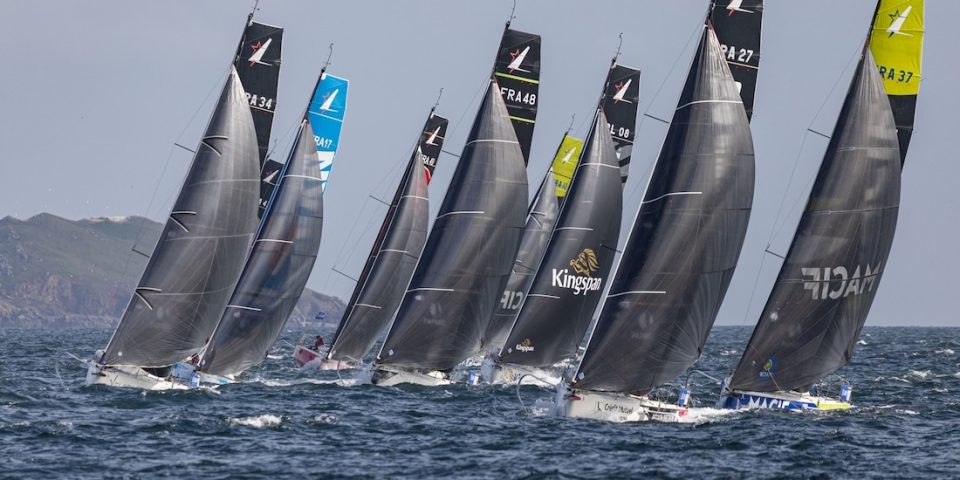
But the Solitaire isn’t just a boat. It’s a brand, a history, a sporting and event format, a collection of elements that, after 57 editions, make people say: “That’s the Solitaire du Figaro.” Over the past thirty years, one-design racing has become one of those defining elements, but that doesn’t necessarily mean it’s what will ensure the race survives into the future. Our conviction today is that one-design racing is not necessarily the answer for the next decade. And perhaps in fifteen years’ time the Solitaire will be raced on another platform, or perhaps it will return to one-design. I’ll give you one example: ten years ago, the Tour de Voile switched to an inshore Diam 24 format. Despite that radical change, it remained the Tour de Voile, and the Federation defended its place in the July calendar.
The Federation, the class and many skippers want to ensure the race continues in Figaro Beneteau 3s (the Figaro name will no longer be available from 2027). If they succeed and decide to call that race “La Solitaire”, would they be allowed to?
I’m not a lawyer, but I don’t believe that would really be possible under the current circumstances. That said, continuing a solo race in those boats is absolutely not an issue for us; in fact, we welcome it. We are obviously very supportive of this development pathway continuing. We’ve invested in it for 20 years and continue to do so, notably through the Transat Paprec. However, the intellectual property rights attached to the name La Solitaire du Figaro will have to be respected.
Photo : Thomas Campion